Four Things to Know About Hybrid Air Denial


Editor’s Note: Russia is using commercial drones to harass European airports, sowing fear and confusion—and this threat may be coming to the United States. The Stimson Center’s Maximilian Bremer and Kelly Grieco describe the hows and whys of Russia’s campaign and offer ways to reduce the danger.
Daniel Byman
***
In October, the European Union announced plans for a “drone wall” to fortify its borders—an ambitious effort to deploy anti-drone capabilities by year’s end and reach full operational capacity by 2027. The announcement followed weeks of unexplained drone sightings—suspected to be Russian—near civilian airports and military sites across Belgium, Poland, Romania, Denmark, and Germany, grounding flights and scrambling fighter jets.
The initiative underscores how Europe is racing to counter a new kind of gray-zone threat: hybrid air denial. This strategy adapts the wartime logic of air denial to peacetime, combining traditional, coercive airspace incursions with low-cost, hard-to-attribute technologies—like commercial drones operating in the air littoral—to disrupt commercial activity, impose economic and political costs, and probe defenses. Like other forms of “hybrid” warfare, it deliberately blends peacetime coercion with tactics traditionally associated with war, allowing adversaries to achieve strategic effects without triggering full-scale war.
Here is what policymakers and observers need to understand about this growing threat.
1. Air denial isn’t new—but new technologies make it increasingly relevant in peacetime.
Hybrid air denial combines two age-old ideas—hybrid warfare and the denial of air superiority—into a peacetime contest for control of the skies. Russia has long used airspace incursions to test its adversaries’ radar networks and political resolve. Since 2014, for example, Russian fighters and bombers have increasingly challenged NATO’s defenses over the Baltic and Black Seas, with many of these aircraft flying without filing a flight plan, with transponders off, and without communicating with civilian air traffic control. In 2024 alone, NATO scrambled its aircraft more than 400 times to intercept Russian military aircraft. These repeated incursions impose real costs and escalation risks; they signal Russia’s resolve and coerce NATO to act with restraint, discouraging NATO operations near Russia’s borders. But the recent drone operations represent a new approach that can limit rivals’ air control, even in peacetime, by employing cost-efficient technologies. Unlike fighter jets or bombers, these drones are operated remotely and typically launched from nearby territory by covert operatives or local proxies, enabling adversaries to disrupt airports or military bases without sending aircraft across borders.
Air denial has historically been a wartime strategy to prevent an adversary from gaining air superiority. In the 1940 Battle of Britain, the Royal Air Force dispersed fighter wings across the United Kingdom and used early warning radars to attrit the Luftwaffe and deny it freedom of action. Air denial has also been used to create effects beyond a state’s own territory: The Doolittle Raid in April 1942, the first U.S. air attack on Japanese territory following Pearl Harbor, struck Tokyo and other targets deep in Japan. Although the raid did not achieve the destruction of later bombing efforts, it forced Japan to divert air and ground resources to homeland defense, limiting its freedom of action. More recently, Ukraine has used mobile surface-to-air missile systems to keep its skies contested, and the Houthis have challenged U.S. control of the air in the southern Arabian Peninsula, shooting down MQ-9 Reaper drones and limiting U.S. Central Command’s operations.
Today, however, new technologies—from commercial drones to satellite and 5G mobile communications—make air denial more effective, cheaper, and more pervasive than ever. They allow adversaries to contest national airspace with lower political and physical risk. Unlike a Cessna of the last century, which was both relatively expensive and required a human to risk airspace encroachment, an inexpensive quadcopter bought online can loiter near a runway or base from nearby territory, often anonymously and with minimal risk to the human operator. These lower risks make it easier and less costly for adversaries to persistently probe airspace, undermining the illusion that any state can fully control its own skies.
2. Hybrid air denial is as much about economic and political coercion as it is about military force.
More than a military threat, hybrid air denial is an instrument of economic and political coercion. By disrupting commercial air traffic and inciting public fear, these incidents impose outsized political and economic costs on states and private actors alike. Drone incursions recently canceled or diverted 32 flights in Munich, affecting nearly 9,500 passengers. Each hour of closure can cost more than $2 million, not including the expense that states and companies must now spend on countermeasures.
Moscow aims to exploit these incidents to undermine European unity and erode support for Ukraine. By imposing economic costs and stoking public fear, hybrid air denial generates political pressure for leaders to act. After citizens expressed unease about the incursions—one Danish resident, for example, noted, “I feel rather insecure …. I am not really used to thinking about war”—European leaders came together to launch the drone wall initiative.
In that sense, the provocations may be backfiring, spurring resolve and cooperation rather than division. Yet the initiative has also exposed over funding, sovereignty, and operational priorities among member states—divisions that ultimately serve Moscow’s interests.
3. Hybrid air denial defies a single, technological solution.
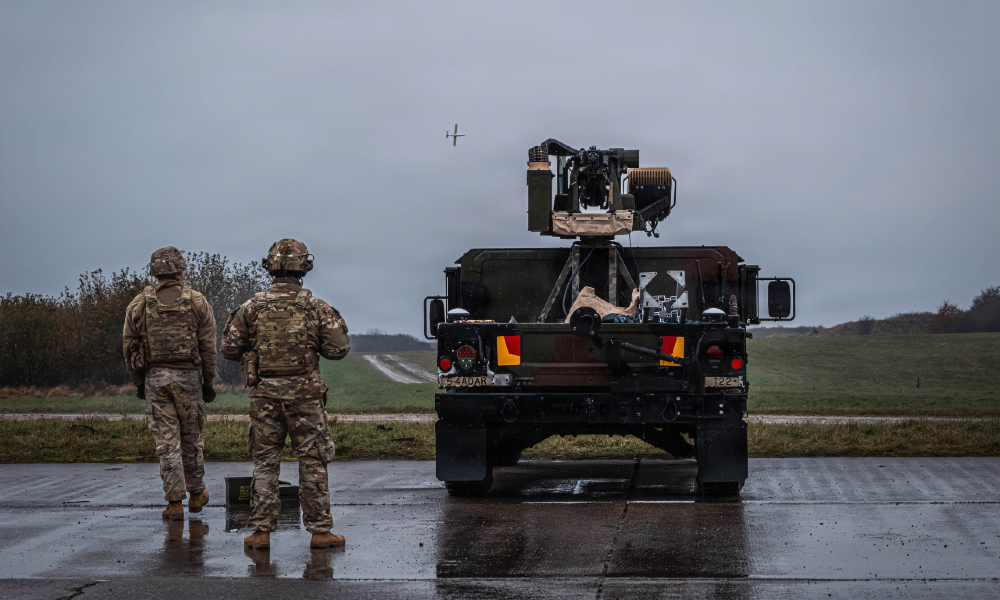
Europe’s drone wall—an integrated network of sensors, jamming systems, and anti-drone platforms—offers a start but cannot fully counter hybrid air denial, which exploits the low-altitude air littoral. Airborne systems, such as fighter patrols, can react quickly to incursions, but maintaining persistent coverage—either in the air or standing by on alert on the ground—is expensive. A single 24-hour combat air patrol with two fighters, a tanker, and airborne early warning and control can cost about $2.5-3 million per day. Ground-based systems, by contrast, are immobile and must therefore cover an entire border to be effective.
Above all, the drone wall faces an inherent scalability problem. The democratization of technology means that no single sensor or jammer can reliably counter the full range of readily available systems. To be effective, the wall will need to integrate multiple types of sensors and electronic countermeasures, each tuned to different signatures, frequencies, and flight profiles. That complexity adds significantly to the cost. In other words, Europe’s drone wall will be expensive—and still unlikely to prevent all incursions, playing to Moscow’s advantage.
4. Hybrid air denial is coming to the United States.
Europe’s experience exposes vulnerabilities that the United States shares. Mysterious drones have appeared over military sites and critical infrastructure—from Langley Air Force Base, which forced the relocation of advanced F-22s, to the Palo Verde nuclear power plant. Many incidents involve hobbyists or copycats, but some appear to involve foreign actors seeking to exert psychological and political pressure. In late 2024 and early 2025, unidentified drones over New Jersey caused public alarm, amplified by social media. Gen. Glen VanHerck, commander of the United States Northern Command and North American Aerospace Defense Command at the time, later noted the uncertainty these incidents created, acknowledging adversaries could be surveilling critical infrastructure or simply “embarrassing us with the fact that they can do this day after day and we’re not able to stop it.” Often, there is little way of knowing whether such incursions are espionage or something else until forensics are completed—and sometimes even then the answer remains unclear.
Amid this uncertainty, confirmed cases of foreign nationals using drones for intelligence gathering reveal a persistent pattern of foreign interference. Multiple Chinese nationals, for instance, have been arrested in recent years for operating drones near U.S. military installations, and senior U.S. military leaders have publicly confirmed that state actors have used drones to surveil bases. These documented cases, alongside many of uncertain origin, underscore the challenge: Adversaries can operate in U.S. airspace with plausible deniability, complicating both attribution and timely response.
These incidents make clear that hybrid air denial is a national problem, not merely a military, civil, or law enforcement one. Meeting that challenge will require reimagining the airspace itself. Rather than trying to secure it through exclusion, Washington should build an inclusive, adaptive airspace linking military, civil, and commercial operators into a shared network of sensors, data, and accountability.
This begins with the Federal Aviation Administration modernizing regulations to expand access to the air littoral, including establishing flexible low-altitude flight corridors, permitting routine beyond-visual-line-of-sight operations, and creating a national air littoral traffic management system for real-time data sharing and coordination. It also means accelerating the adoption of diverse “detect-and-avoid” systems, particularly those developed by commercial actors already fielding advanced sensing and autonomous flight capabilities. Achieving this will require clearing regulatory bottlenecks, supporting scalable testbeds, and creating public-private frameworks for rapid integration.
Paradoxically, the more accessible the airspace becomes to responsible actors, the easier it becomes to identify and isolate nefarious ones. A permissive yet transparent air littoral turns every legitimate drone into a sensor that makes it harder for adversaries to operate undetected. Additionally, the development of broad national drone capabilities will increase the availability of lower-cost options to address the problem. The threat of hybrid air denial is real, but it can be reduced by making airspace more accessible, inclusive, and visible.