Harsh Confinement
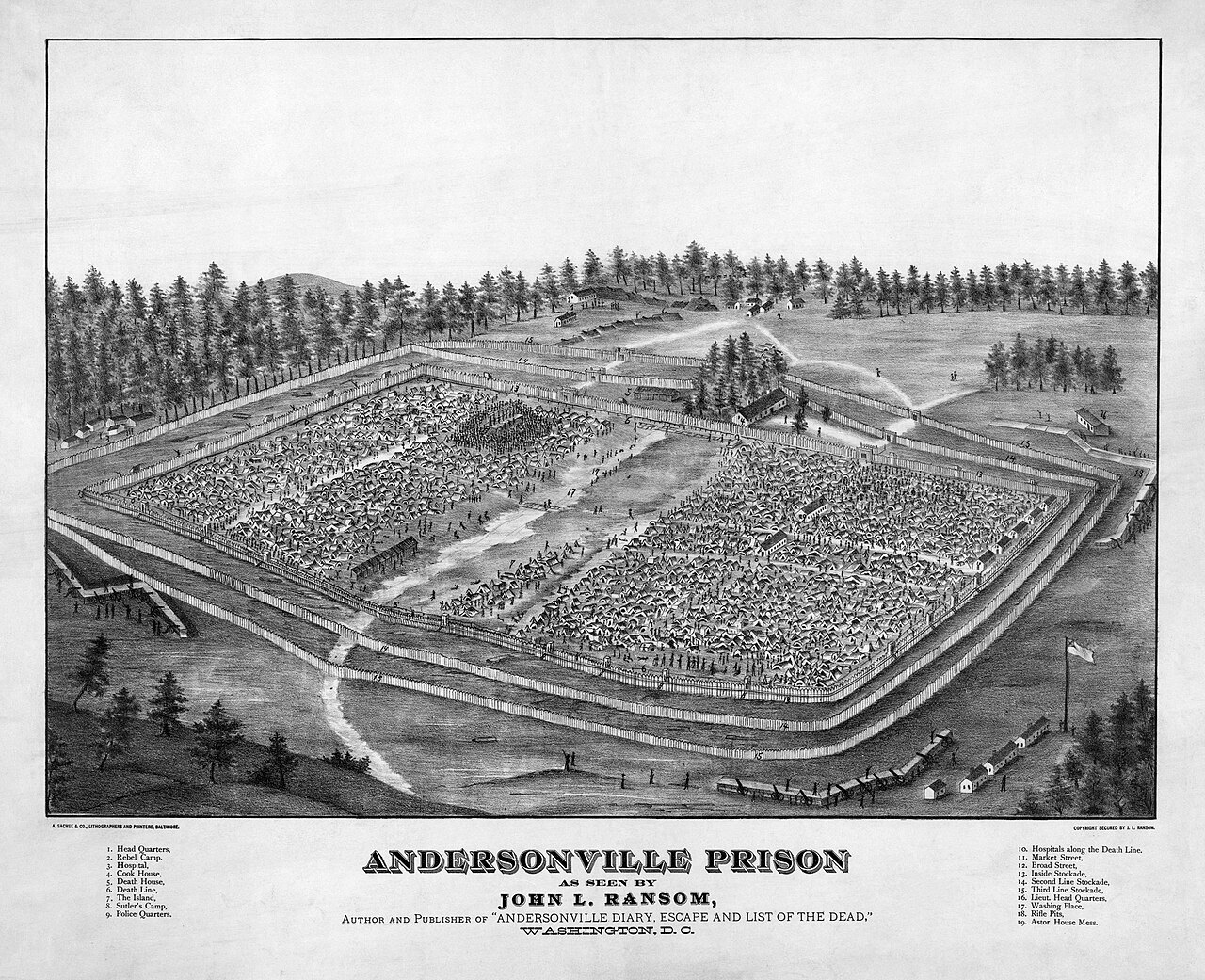

There’s not much left of the Confederate prison for captured Union soldiers that once sprawled across 26.5 acres near the rural hamlet of Andersonville, Georgia. Today, it’s a National Historical Site with some monuments, a museum, and row upon row of headstones, marking the burial places of some 13,000 Northern troops who died from hunger, disease, and neglect at the camp, whose prisoner-of-war population peaked at approximately 33,000 in 1864. A Southern photographer who visited during Andersonville’s most overcrowded phase recorded a muddy hellscape in which men dug mass graves, wandered about naked from the waist down, curled up in fetal positions on the ground, or probed the earth for edible roots.
For the Union, Andersonville became synonymous with squalor, cruelty, and death, and after the war a U.S. military commission sentenced its erstwhile commandant, the Swiss-born Capt. Henry Wirz, to hang for war crimes. His trial before a U.S. military commission in 1865 laid bare rampant abuses, including whippings, the withholding of food as punishment for disciplinary infractions, and the shooting of prisoners who approached a “deadline” near the prison’s perimeter fence. The case established an important precedent, both as to individual criminal responsibility for certain grave violations of the law of war and as to the impermissibility of relying on orders from superiors as a defense.
Andersonville was the worst Civil War prisoner-of-war camp in the United States, but it was far from the only one—or the only bad one. As W. Fitzhugh Brundage shows in this definitive account of the POW experience for both Union and Confederate soldiers, each side built a vast prison network to hold battlefield captives. These were not improvised facilities but consciously organized systems designed to cope with a detainee population much larger than the 124,000 POWs U.S. adversaries would hold in World War II. Some 194,000 Union soldiers and 214,000 Confederates were taken prisoner at some point during the Civil War, of whom half endured extended confinement.
Of the Union men held by the South, some 30,000 perished in custody. But a nearly equal number of Confederates—26,000—died in Union prisons. Some 4,000 of the Confederate deaths occurred at one location: Point Lookout in southern Maryland. All prisoners on both sides, Brundage shows, suffered from inadequate food, exposure to the weather, disease, and untreated or improperly treated wounds.
It’s a harrowing tale, and Brundage, a professor of history at the University of North Carolina whose previous work includes a Pulitzer Prize-finalist study of torture in U.S. history, tells it unflinchingly. The book is organized in a series of thematic chapters that cover medical care, prison discipline, and the postwar efforts at accountability, including Wirz’s trial. The book concludes by exploring the lingering trauma that affected both Union and Confederate prisoners, and the way in which the prison experience has been underplayed in modern historical treatments of the war.
A particularly strong chapter describes the efforts of prisoners to maintain their sanity and even a sense of community under unimaginably harsh circumstances. Prisoners sought out fellow soldiers from their home states, or former regiments, and bonded on that basis. Some formed theater troupes or, at one Union detention facility for Confederates, a debating society. As has occurred in other prisons throughout history, markets sprang up—even at Andersonville—for contraband food and personal services such as haircuts. These improvised bazaars were, Burbage writes, “crucial sinews of the prison community.”
Along the way, Brundage personalizes the story through illustrative mini-biographies of key characters, from Andrew Jackson Riddle, the apolitical Southern photographer whose pictures of the dead and dying at Andersonville inscribed the suffering there in American memory, to Col. William Hoffman, the punctilious Union military bureaucrat who created the North’s POW camps out of former training bases, civilian prisons, and, eventually, purpose-built sites such as Point Lookout.
“For too long,” Brundage writes, “the prison camps have been explained as products of expediency and improvisation. Let it be clear, Andersonville and the other camps were the product of design and resolve.”
And with that intentionality comes moral accountability, he argues. Neither side deliberately killed prisoners of war en masse, but much of the suffering and death could have been avoided, and not only in the sense that the responsible authorities should have acted more humanely toward the men in their custody. The key point is that, after the first two years of the war, the Union and the Confederacy all but ceased regular prisoner exchanges, which were a recognized element of the era’s prevailing laws of war. If continued, they would have enabled men from both sides to go back home after relatively short stints in enemy hands instead of enduring prolonged incarceration, under horrific conditions, which proved a de facto death sentence for so many.
Why did the exchanges cease? As Brundage explains, the turning point was President Lincoln’s issuance of the Emancipation Proclamation on Jan. 1, 1863, accompanied by the enrollment of Black men in the Union army. “The fragile principle of reciprocity upon which prisoner exchanges rested shattered when Black men donned the Union uniform,” Brundage writes. And why was that? Confederates considered Black Union military service “servile insurrection” and threatened to kill or reenslave Black soldiers who fell into their hands.
The South emphatically refused to entertain exchanging Black prisoners for captured white Confederate soldiers, lest it violate the principles of white supremacy upon which the entire Southern cause rested. “If we were insane enough to yield this point,” a Virginia newspaper editorialized, “to treat black men as the equals of white, and insurgent slaves as equivalent to our brave soldiers, the very foundation of slavery would be fatally wounded.”
For his part, Lincoln was determined to insist on equal treatment for Black Union POWs, who soon numbered in the thousands. On July 30, 1863, he declared that a Confederate prisoner would be executed for every captive Union soldier killed and another would be assigned to hard labor for every Union soldier enslaved.
This led to an impasse in prisoner exchange negotiations, the “most significant consequence” of which, Brundage writes, “was that the United States and the Confederacy began experiments in custodial imprisonment on a scale beyond anyone’s worst prewar premonitions.” The numbers of prisoners “ballooned,” leading directly to the construction of Andersonville in the South and the expansion of existing camps in the North.
During his 1864 reelection campaign, Lincoln took heat for his insistence that the South treat Union prisoners the same, regardless of race. Many Northern whites insisted that he concede the point for the sake of white Union prisoners, who were considerably more numerous than Black prisoners. It became a talking point for Lincoln’s Democratic opponents, but even Walt Whitman published an article blaming Secretary of War Edwin Stanton for a policy he deemed “more cruel than anything done by the Secessionists.”
The real story, as Brundage notes, was the Confederacy’s stubborn willingness to let its own men languish in Northern prisons rather than exchange them for Black Union prisoners. “The Confederacy’s intransigence,” Brundage writes, “at least as much as Union policy, condemned all white prisoners—Union and Confederate—to captivity without exchange. After all, the Confederacy stood to regain tens of thousands of their soldiers if they exchanged the few thousand Black prisoners they held.” And yet rebel leaders could not muster even that much pragmatism. A Confederate negotiator told his Union counterpart that Southerners would “die in the last ditch before giving up their right to send slaves back to slavery as property recaptured.”
Lincoln never backed down. And his firm stance did deter the South from acting on its worst threats to kill Black captives, though hundreds of Black Union troops were slaughtered after surrendering at Fort Pillow, Tennessee, on April 12, 1864—by rebel troops crying “no quarter.” Thus did the prisoner-of-war issue crystallize the true nature of the conflict, both in its own time and in retrospect, as a struggle over Black freedom, which one side was determined to deny.
A further lesson of the story is that law works best when buttressed by incentives but incentives work only when buttressed by rationality. As Brundage explains, the Civil War took place during a time of transition in the law of war, between ancient times—when slaughter and enslavement were the POW’s lot—and the modern era, which would be governed by the Hague and Geneva Conventions. The emerging norm in the mid-19th century was that prisoners would be kept alive and eventually exchanged, but the main enforcement mechanism was reciprocity, which in turn depended on the respective warring parties’ sense of enlightened self-interest. The Confederacy’s blind insistence on denying the humanity of Black people canceled out the seemingly more tangible benefits of getting its captive soldiers back.
Nor did this mindset die out after Appomattox. In fact, one bloody episode during the Civil War’s extended aftermath, the Colfax Massacre, suggests that it intensified. On April 13, 1873, a white paramilitary force led by ex-rebel soldiers skirmished with and quickly overpowered a group of armed Black men who were defending the courthouse at Colfax, Louisiana. The Black men had entrenched themselves there to protect officeholders whom they had elected the previous November—but whom white supremacists sought to oust.
After nightfall, the white paramilitaries assembled to decide what to do with some three dozen Black men they had captured. The leader of the white posse was a former Confederate army company commander, Christopher Columbus Nash, who had spent the last 20 months of the Civil War in a bleak Union prison on Johnson’s Island, in Lake Erie. Perhaps sensitized by that experience to the potential repercussions of mistreating prisoners, he told his men to let the captives go home. But he was met with protests; many of his comrades insisted that Black men who take up arms against whites must pay the ultimate price. Once Nash left the scene, these men marched the Black prisoners off into the darkness and shot them all, in the backs of their heads, at close range.
.jpg?sfvrsn=a9413207_5)