
Huawei Is Betting on the Future with HarmonyOS

As Presidents Trump and Xi prepare to meet at the end of March—forging a possible detente in the U.S.-China relationship—a storm is brewing beneath the surface of this fragile stability. It is on full display in the first sentence of America’s AI Action Plan unveiled last July: “The United States is in a race to achieve global dominance in artificial intelligence (AI).”
The U.S. has not softened its quest for dominance, while China’s leadership is pushing ahead on aggressive targets for AI adoption in plans unveiled at the National People’s Congress last week. In particular, there has been a proliferation of activity in China in agentic AI development: ByteDance’s new agentic AI smartphone; Manus, an AI agent developed from a Wuhan-based startup (recently acquired by Meta); Alibaba’s Qwen model series; and now, Huawei’s new system for coordinating agents built around its homegrown operating system, Harmony.
Another recent piece in Lawfare examines how China is grappling with unprecedented challenges to data security and privacy with the rise of AI agents—resulting in a tug of war to shape future agentic AI rules among Chinese tech platforms, AI developers, and superapps. How this new balance of power evolves could have far-reaching implications for China’s fiercely competitive domestic internet economy, with global ripple effects.
Here, I examine one of the leading companies in the contest for power in agentic AI in China: Huawei. Recent updates to HarmonyOS could turbocharge an entire ecosystem of connected devices centered on Huawei’s AI-enabled assistant.
While much attention has been devoted to AI chip export controls as part of the AI race, there has been little focus on operating systems. Yet the operating (OS) layer is crucial to how people interact with AI on their devices. It is why the U.S. Department of State just announced $200 million in foreign assistance to support next-generation smartphones running on affordable and secure operating systems as part of its AI Edge Package. Advances in AI agents (and the recent explosion of agents like OpenClaw interacting online) have decreased traditional barriers around data and internet traffic, as agents “break the blood-brain barrier between apps and operating systems, creating a seamless but opaque data pipeline between intimate digital behaviours and remote cloud servers.”
This is why understanding recent developments with Huawei’s HarmonyOS matters for the future of AI. HarmonyOS could be the vehicle by which users—mainly in China at present, but eventually globally—interact with Chinese AI.
Recent updates to Harmony aim to integrate layers of China’s AI ecosystem that have traditionally been walled off and that have made AI agents less useful and appealing to users. Huawei executives have suggested that they intend for HarmonyOS to eventually rival Apple iOS and Google Android as the world’s third operating system. If Huawei succeeds, HarmonyOS may one day soon run on devices for global export—from cars to phones to fridges—with its AI-enabled assistant coordinating across all aspects of users’ lives. Chinese AI integration, in other words, will affect everyone everywhere.
Huawei and the Contest Among Tech Titans in China
As I wrote about previously, a battle is underway in China to shape the rules for AI agents. Internet platforms that own the superapps and those with the AI agents, device makers, and state-owned telecom companies that double as cloud providers hope to craft the guardrails for data access and control, security authentication, and more.
Huawei occupies a remarkable position in this power struggle. It stands to benefit no matter what, because unlike any other company in the world, it reaches across the AI stack. Its AI offerings span network infrastructure, chips, cloud, personal computers, smartphones, tablets, cars, and industrial systems.
Additionally, Huawei could benefit from coming shifts accompanying the development of AI agents, unique to China and its fragmented internet environment. In my previous article I examined two kinds of fragmentation that present obstacles to the success of AI agents in China’s internet ecosystem: superapp fragmentation, with walled gardens fragmenting data and traffic, and device fragmentation, with many Chinese smartphone manufacturers each using their own system of apps and services because Google is blocked in China.
This means different apps and programs don’t interoperate or share data, and users can spend all their time within the universe of one without touching another. Broad permissions to operate seamlessly across different devices and apps will be necessary for AI agents to succeed—regardless of whether they are in the United States or China (which presents unprecedented data security and privacy challenges as experts like Signal’s Meredith Whitaker have stressed)—but obstacles to the level of access needed may be particularly acute in China.
However, recent developments with Huawei reveal that the company is preparing to tackle these barriers and, in doing so, overcome the Achilles’ heel of its global ambitions.
Understanding what leading Chinese firms are doing matters for mapping the competitive landscape beyond China. That is because U.S. policymakers are at this very moment in the process of developing an approach to export an American AI stack, one of the central pillars of America’s AI Action Plan. The U.S. Department of Commerce has sought comments from outside experts and industry about how to implement this part of the plan effectively. But for American AI products and services to be globally competitive, policymakers must also understand Chinese competition. If Huawei’s vision for HarmonyOS becomes reality, and it can overcome obstacles to growth outside of China, its new features could help improve the appeal of the Chinese AI stack to global users.
The impact will extend far beyond smartphones, since Huawei’s vision is to integrate an entire ecosystem of connected devices, from cars to wearables appliances and more.
HarmonyOS: Delivering AI to the World
Huawei is unlike any company in the world. Its AI offerings span an entire ecosystem: network infrastructure, chips, cloud, personal computers, smartphones, tablets, cars, and industrial systems. Its latest version of HarmonyOS, loaded with an AI-enabled assistant, Celia/Xiaoyi (which uses DeepSeek), aims to weave all these devices together into one singular, seamless experience. HarmonyOS is the consumer operating system to cap off Huawei’s AI offerings across the AI stack. It now runs on 1 billion devices, including both Internet of Things (IoT) and laptops. These devices come with applications running on DeepSeek large language models (LLMs).
In other words, Huawei now occupies a far more significant position in global technology competition than it did in the first Trump administration, when U.S. officials were focused on Huawei’s dominance in 5G and eliminating Huawei equipment from global networks. In fact, the company has grown since the U.S. Commerce Department placed Huawei and dozens of its affiliates on the Entity List in 2018; cutting off Huawei’s access to U.S. technology had the unintended consequence of fueling its drive for self-sufficiency.
Huawei has also become closer to the Chinese government since losing access to U.S. markets. As one expert in China recently put it in a meeting held under conditions of non-attribution, Huawei is so influential that it essentially “regulates the government,” with most (if not all) new standards in China involving information communications technology that requires the company’s approval.
HarmonyOS grew out of Huawei losing access to Google’s Android during the 2018 sanctions. At first, HarmonyOS closely resembled Google’s Android (many called it an Android “ripoff”). But 2024 marked a turning point when Huawei rolled out HarmonyOS Next, called “Pure Blood” by fans because it is entirely built in-house. Huawei executive Richard Yu proclaimed, “Our HarmonyOS has all the foundational core technologies and has realized full autonomy and has become self-secured and self-controllable.” A sign of Harmony’s break from Android: As of January 2026, over 90 percent of Huawei devices (not just smartphones but the wider ecosystem of wearables, tablets, IoT, etc.) ran on the homegrown version of Harmony.
For now HarmonyOS is offered only on smartphones in China, not globally. But statements by Huawei executives suggest that they intend to make Harmony a centerpiece of the company’s international ambitions. In a sign of what could be to come, Huawei recently began rolling out its GT 6 watch in global markets outside of China with HarmonyOS.
Obstacles to Expanding Beyond China
Harmony’s autonomy may render it ideal for Chinese indigenous innovation and independence from U.S. technology, but it presents a major obstacle for HarmonyOS success in markets beyond China. Android apps stopped working on Harmony with the change to HarmonyOS Next in 2024, and apps must be specifically built for Harmony in order to be installed and run on Harmony devices.
While that may not matter as much to the company’s growth in China, it could endanger Huawei’s aspirations in expanding HarmonyOS outside of China to become “a third mobile operating system for the world,” taking on Google Android, Apple iOS, and Microsoft Windows, as Huawei executives have outlined. Users in Europe or the Middle East, for example, will not want to buy a Huawei phone or tablet if they cannot use WhatsApp.
Given the obstacles ahead, it is not surprising that Huawei executive Richard Yu has touted Huawei’s new partnerships with Grab (a popular ride hailing app in Southeast Asia) and Emirates airline as stepping stones for expanding overseas. More of these types of partnerships with popular apps outside of China will be critical to its success. But for now, there is a long way to go: Harmony currently has only about 30,000 apps, short of its target of 100,000.
Enter the Agentic AI Era
Harmony’s obstacles to being viable outside of China are significant, but Huawei may be preparing to overcome them with new features designed specifically for the changes agentic AI will bring. As the U.S. prepares for global competition with Chinese firms in third countries, it is worth understanding these developments. After all, the competition with China will not just play over access to chips but increasingly center on how users around the world interact with AI on edge devices. Although the specific ways in which AI agents could shift how users interact with smartphones remain largely theoretical at this point, early discussion is underway in China about the kinds of barriers that will need to be surmounted for agents to offer valuable services. An article about AI-powered smartphones navigating unchartered territory states that “One major hurdle is that smartphone intelligent agents need to overcome the barriers between apps.” The article quotes Zhang Chi, head of the AGI Lab at Xihu University, who observes that smartphone AI agents
[W]ill need to be able to work together with third-party app operations and their array of complex, ever-changing user commands .…The technical concept is basically finalized now, but to truly implement it into a product, we still have to face a lot of engineering challenges.
Huawei has developed new features of AI infrastructure to make agents work more seamlessly across Huawei’s ecosystem of devices. On Oct. 22, 2025, Huawei released the latest version of HarmonyOS with new features that could prove incredibly valuable for overcoming precisely these barriers. In particular, HarmonyOS 6.0 comes with a new framework so that AI agents can perform tasks across different apps and services on devices. The Harmony Intelligent Agent Framework (HMAF) allows Huawei’s central assistant, Celia, to help users accomplish tasks using functions from different apps and services on a device. And at the network layer, Huawei launched the Agentic Core Framework at the Mobile World Congress in Barcelona on March 2 to enable AI agents to better communicate and handle surging traffic, with many AI agents embedded across devices.
The closest equivalent to HMAF is Apple’s App Intents Framework, which seeks to integrate across different apps on behalf of assistants or agents. Neither Google Android nor Apple iOS has anything similar to HMAF that would enable them to integrate across different apps on behalf of assistants or agents. The closest equivalent would be Apple Intelligence and Gemini, which are both OS-level AI but lack the capabilities to offer users the kind of interoperability among tools that Huawei envisions. For example, with HMAF on a Huawei device, a prompt such as “Summarize and organize the documents I received today” would enable the assistant to check email, sharing, chats, documents (pdf, images, docs, etc.) from various apps and then generate a summary and create backup for important documents. HMAF can also help Celia understand context, scan screens for relevant information (similar to Circle to Search and Gemini), process data with tools like ChatExcel, and provide developers with LLM capability to help build apps tailored to HarmonyOS.
Harmony may be positioned for the change in the app model that experts in and outside of China speculate may take place. The mobile experience is shifting from being app-centric, with users interacting with one app at a time, to agent-centric, where users will give instructions in natural language to an AI agent and that agent will orchestrate tasks across multiple apps in the background. This change could disrupt a large number of apps, turning them into background services that the primary operating system agent calls upon. As a result, developers may need to adapt to a paradigm in which people may engage with their services via a central AI assistant across different surfaces (e.g., phones, PCs, cars, watches). Elements of their products—the ability to book a flight in a travel app, for example—would be available to Celia and delivered to users when called upon.
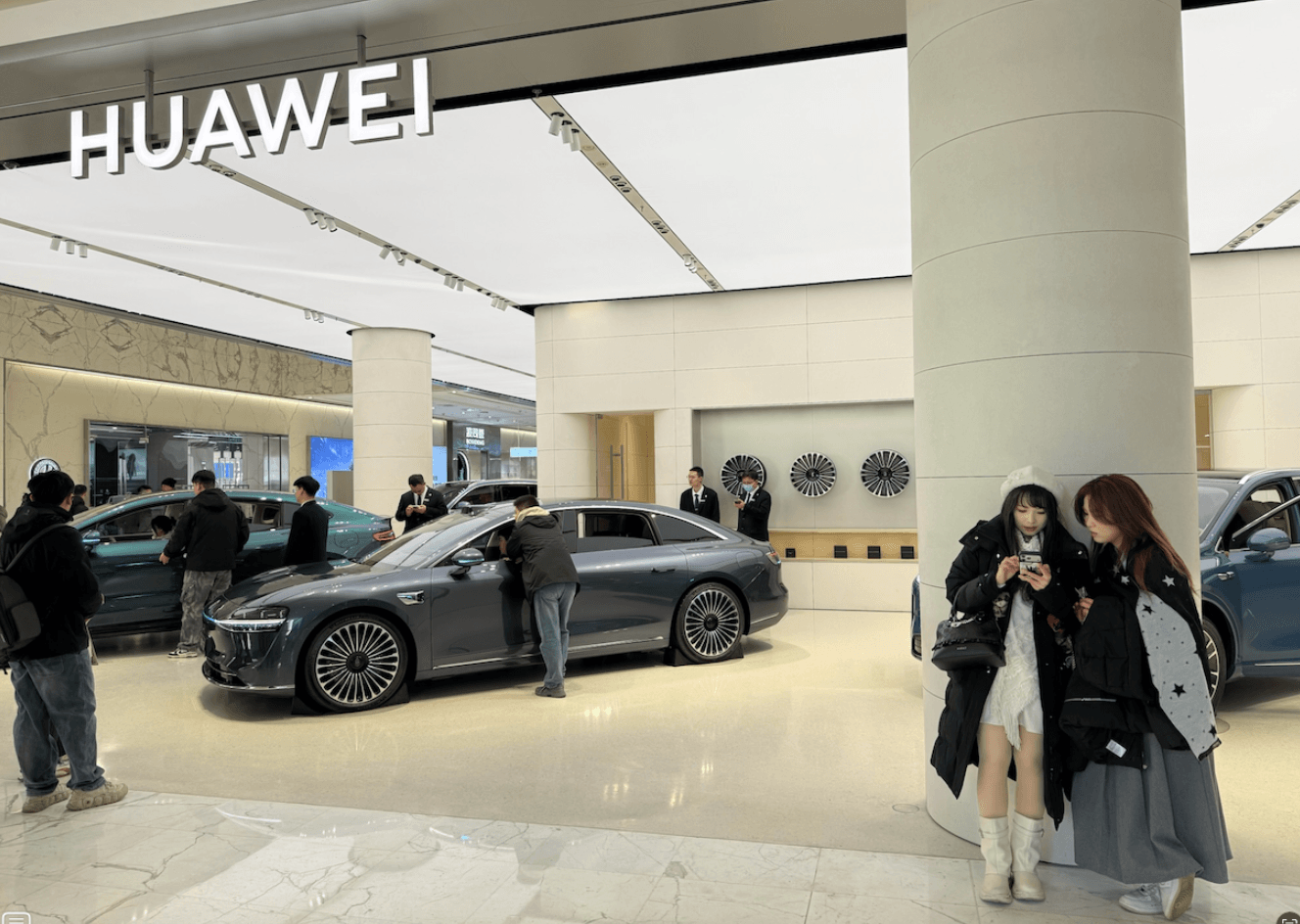
What this means is that Huawei’s vision extends far beyond smartphones, with the Harmony operating system enabling an entire system of connected devices to operate seamlessly across users’s lives. AI-enabled Celia would be at the center of the orchestra, weaving together data and functionality from apps on tablets, wearables, cars, and IoT. The latest indicator is Huawei’s new smart vehicle partnerships, unveiled in November 2025. Partnering with Chinese automakers GAC and Dongfeng Motor Group, HarmonyOS serves as the intelligent cockpit of the car, at the center of Huawei’s intelligent driving system. Huawei’s autonomous driving system Qiankun—which operates on top of Harmony as the OS for cars and user interface for drivers—runs in 80 car models.
While it is unlikely these changes spell the end of the app experience entirely, they could push developers to innovate in new ways and make their apps even more appealing, with exclusive new functionality or offers. Harmony would be well positioned to capture the benefits that could come with this evolution.
If Huawei succeeds, Harmony’s HMAF could deliver both the forward-looking, agentic experience that is the clear trend across the industry, and push developers to create entirely new experiences within their individual apps—a rising tide that lifts all of Huawei’s boats.
Why Huawei’s Bet Matters for Global Competition
When Huawei users received a notice in late October offering them the option to upgrade to the newest HarmonyOS, what may have seemed like a minor software update had significant implications for competition. HarmonyOS together with HMAF signal a bigger bet by Huawei on where the future of operating systems is headed with agentic AI.
And even beyond Huawei’s ecosystem of apps, Harmony (with HMAF’s common framework) could potentially offer its AI agent access behind the walled gardens of superapps like WeChat or Alipay, where traditionally data and services are kept separate within the fiefdoms of rival internet platforms. Huawei’s AI agent Celia would “handshake” even with agents from these superapps so that users would have a singular experience, not just within their smartphones but across multiple Huawei devices—creating a digital throughline across all aspects of their lives. The vision would be compelling to users in and beyond China because it would maximize the ability of AI agents to be interoperable across multiple, previously fragmented digital ecosystems.
However, even in this hypothetical new mobile landscape with agentic AI playing a central role, apps will still matter—and in the more foreseeable future, apps will offer siloed experiences themselves and provide inputs into more central assistants. As a result, Huawei’s struggle for more native apps will not become entirely moot; the company will still benefit in its expansion ambitions beyond China in having as many popular apps as possible.
Huawei has made a bet on where this emerging technology might be headed. If Huawei’s bet proves correct, its vision and design of HarmonyOS could impact the global competitive AI landscape—potentially allowing the company to overcome obstacles that stand in the way of its ability to compete with U.S. rivals.


_enforcement_and_removal_operations'_(ero)_officers_in_west_palm_beach-_florida_on_february_14-_2025_-_29.jpg?sfvrsn=132a52cd_5)
