Killing Khamenei
.jpg?sfvrsn=fe86d28c_3)
On Feb. 28, Israel killed the head of state and supreme religious authority of the Islamic Republic of Iran in a daytime strike on Tehran. The United States provided the intelligence of his location. Within hours, Israeli Defense Minister Israel Katz authorized the Israeli Defense Forces (IDF) to eliminate any senior Iranian official without further approval. The American doctrine on targeted killing of foreign leaders, built up over 50 years of executive orders, Office of Legal Counsel (OLC) opinions, and quiet operational practice, did not survive the day. The precedent is now available to every adversary watching, and to every future U.S. president. Washington has to work out what it actually thinks the rules of leadership decapitation are before the next war makes the question urgent.
The Strike
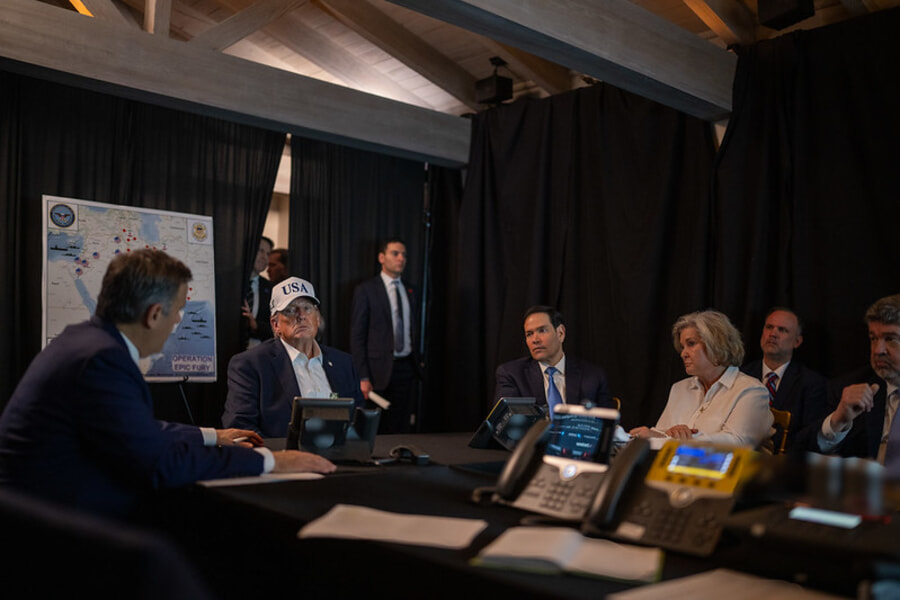
Operation Epic Fury opened with the most consequential leadership decapitation any modern war has seen since U.S. forces attempted (unsuccessfully) to kill Saddam Hussein at Dora Farms in the opening hours of the 2003 invasion of Iraq. Israeli aircraft struck Supreme Leader Ali Khamenei’s compound as he met with the senior leadership of Iran’s defense council. Killed alongside him were the commander of the Islamic Revolutionary Guard Corps, the defense minister, the army’s chief of staff, and the secretary of the Supreme National Security Council.
Two weeks later, in a 48-hour window in mid-March, Israel killed three more figures at the apex of the Iranian state: Ali Larijani, secretary of the Supreme National Security Council and the official who had been engaged in indirect talks with Washington; Gholamreza Soleimani, commander of the Basij paramilitary forces; and Esmail Khatib, the minister of intelligence. Katz announced that Prime Minister Benjamin Netanyahu had authorized the military to target any senior Iranian official the IDF chose, without further approval by civilian leaders. The kill chain had been delegated to Israel’s military before the Khamenei strike.
Each of these strikes was a deliberate, named killing of a senior state official by a close U.S. ally, with U.S. intelligence support, against a signatory to the United Nations Charter. Washington treated the campaign as operationally novel and legally familiar. It was wrong on both counts.
The Doctrine That Was
Every U.S. president since Ford has reaffirmed an executive prohibition on assassinations. Ford issued the original ban in Executive Order 11905 in 1976, after the Church Committee uncovered CIA plots against Patrice Lumumba, Fidel Castro, and others. Presidents Carter and Reagan reissued it; Reagan’s Executive Order 12333 remains in force. Its key language is one sentence: “No person employed by or acting on behalf of the United States Government shall engage in, or conspire to engage in, assassination.” Section 2.12 of the same order forbids indirect participation in any activity the order prohibits.
What the ban actually covers has never been settled. None of the three orders defines “assassination.” Ford’s version qualified it as “political;” Carter and Reagan dropped the adjective without explaining what the unqualified term was meant to reach. The gap has been filled by legal analysis rather than by formal codification.
The most authoritative interpretation came in November 1989, in a memorandum by W. Hays Parks of the U.S. Army’s Judge Advocate General’s International Affairs Division, signed off on by legal advisers at the Department of State, CIA, National Security Council, and Department of Justice. The memo turned on a single line between peacetime and wartime. If an intelligence agency killed a foreign official in peacetime, it was an assassination. Kill the same person as an enemy combatant during an armed conflict, senior or not, and you have a lawful strike. A combatant remains a combatant whether at the front, headquarters, or asleep in his quarters.
The Parks memorandum became the operational template for everything that followed. It supported the legal foundation for the 1986 strike on Muammar Qaddafi’s residence in Tripoli, the 1991 missions targeting Saddam Hussein during the Gulf War, and more recently the late commander of the Iranian IRGC Quds Force Gen. Qassem Soleimani. And it was the framework Legal Adviser Harold Koh used in his 2010 American Society of International Law speech defending drone strikes on al-Qaeda leaders: “The use of lawful weapons systems—consistent with the applicable laws of war—for precision targeting of specific high-level belligerent leaders when acting in self-defense or during an armed conflict is not unlawful, and hence does not constitute ‘assassination.’”
Three things have to be true for Koh’s doctrine to hold: An armed conflict already exists, the target qualifies as a combatant, and the means are proportionate, discriminating, and delivered by uniformed forces using lawful weapons. Political leaders can be considered combatants, but only if their political role is incidental to their real function as military commanders. Qaddafi and Soleimani satisfied both tests. The targeted killing of Khamenei does not.
The Doctrine That Is
The strike on Khamenei departs from the Parks framework in three ways.
The first is the target’s identity. Khamenei was Iran’s head of state under customary international law. The Iranian constitution made him commander in chief and supreme leader—the apex of clerical authority, holder of appointment power over the judiciary, and the figure whose religious legitimacy underwrote the entire political order. He was not a field commander. To classify Khamenei as a lawful combatant by virtue of his constitutional role as commander in chief is to make every head of state a lawful target in any armed conflict involving their country. Vladimir Putin is the commander in chief of the Russian armed forces. Xi Jinping chairs China’s Central Military Commission. If constitutional command authority is now sufficient to establish combatant status, the United States has endorsed a targeting rule it will not enjoy when applied in reverse.
The second departure is the killing of Larijani. He was the senior Iranian official indirectly negotiating with Washington at the time of his death. The classical law of war is unambiguous: Targeting negotiators is prohibited. Article 32 of the Hague Convention of 1907 protects parliamentarians and their staff, and the principle that a state must not kill the official with whom it is negotiating is among the oldest rules of customary armed conflict. A campaign receiving U.S. intelligence support killed Larijani. The Parks memorandum offers no theory that accommodates it.
The third departure is procedural. Israeli Defense Minister Katz’s announcement converted leadership decapitation—until now a case-by-case decision ordered by heads of government—into a standing program with pre-delegated kill-list authority. That practice exists in U.S. counterterrorism, but its targets have been members of designated terrorist organizations, not senior officials of sovereign states with seats at the United Nations. The Israeli authorization erased that distinction, and American intelligence support made the United States a party to the erasure.
On the U.S. side, no legal theory has been offered—not for Khamenei, not for Larijani, not for the pre-delegated authority. Israel pulled the trigger; U.S. intelligence support moved through classified channels. The doctrine governing assassination is being remade not through deliberate legal argument, but through the accumulation of actions no one has been required to publicly explain.
The Question of American Complicity
Executive Order 12333 prohibits U.S. personnel from directly assassinating a foreign official, and Section 2.12 prohibits indirect participation. The plain reading is that if a foreign official’s killing would be an assassination if conducted by the U.S. government, then a U.S. intelligence agency cannot facilitate the strike by sharing intelligence, providing targeting data, or coordinating the operation.
Here, the legal exposure runs deep. The U.S. reportedly gave Israel the intelligence of Khamenei’s location. U.S. Central Command ran the air defense suppression and the missile defense screens that protected the Israeli pilots during the strike. U.S. intelligence, surveillance, and reconnaissance (ISR) and refueling supported Israeli operations through the campaign. The live question is whether any of that crosses the line drawn in Section 2.12.
Historically, the executive branch has answered no. Under Parks’s framework, helping with a lawful targeted killing cannot itself be unlawful participation—the escape hatch on which every post-2001 intelligence-sharing arrangement with allies running their own targeted-killing programs rests.
But that escape hatch functions only if the underlying killing actually meets the criteria in the Parks memorandum. For Khamenei—head of state, supreme religious authority, killed in his own capital city in the opening hour of a war that began with the strike that killed him—the threshold question is whether the strike that initiated the armed conflict can be defended as a wartime targeted killing under the same body of law it created. The temporal problem is acute. No armed conflict existed when the missiles flew. The strike, in other words, manufactured the war whose laws it now invokes for cover.
One likely counterargument is that Iran’s nuclear program and proxy support constituted an ongoing armed attack under Article 51 of the UN Charter, justifying anticipatory self-defense and rendering Khamenei a lawful target. The Trump administration deployed this theory in the Soleimani strike of January 2020. UN Special Rapporteur Agnes Callamard’s report on Soleimani found the United States had failed to provide sufficient evidence of an imminent threat under Article 51. The Callamard report is not binding, but the Khamenei strike rests on the same theory at a weaker factual foundation: Soleimani’s role in attacks on U.S. personnel was extensively documented; Khamenei’s role in any specific imminent attack would be far harder to establish.
If the underlying strike does not satisfy Article 51, the entire chain of U.S. assistance—including intelligence sharing, ISR, refueling, and missile defense coordination—falls outside the wartime exception that the Parks memorandum carves out of the Section
The Precedents Now Available
The trouble with doctrine is that it generalizes. Whatever is permissible for Israel and the United States in 2026 is available to any state with the reach to attempt it in 2027. Several categories of precedent now sit on the shelf.
Heads of state are now on the table. If Khamenei was a lawful target by virtue of being commander in chief, then any head of state’s constitutional command role becomes a sufficient predicate in any armed conflict. That is not a hypothetical concern. Washington has long benefited from a de facto norm against targeting heads of state in armed conflict. That norm was never codified in treaty law; its force derived from reciprocal restraint. By striking Khamenei, the United States did not merely break the norm—it demonstrates that a state with sufficient capability and sufficient justification will act on it. Adversaries who were already calculating the value of U.S. leadership as a target will not miss the lesson. A leader who believes he has been placed on a potential strike list does not wait to confirm the threat is credible. He acts first. Putin, whose command authority now sits on the same legal terrain Washington just declared targetable, has every incentive to recalibrate. So does Beijing.
Targeting envoys amid negotiations is also now fair game. Larijani’s killing opens a precedent that would have been unthinkable in the Cold War. The norm against killing the official with whom one is negotiating has not been formally renounced, but it has been operationally breached at a high level. Any U.S. diplomat heading into a future high-stakes negotiation with a hostile state now operates under a thinner shield.
And there is now a precedent for pre-delegating kill authority across an adversary’s cabinet. The Katz authorization established that a defense minister can, by his own declaration, place the senior officials of an adversary state on a standing kill list. Procedure is not a small thing: The political friction case-by-case approval generates is itself part of the constraint on what gets done. Strip procedure out and decapitation drifts from grave sovereign decision toward routine operational work. The architecture for a future U.S. president to delegate similar authority to a combatant commander is now in place.
What Washington Should Do Now
Washington cannot undo the Khamenei strike, and it is in no position to condemn an operation it materially supported. What it can do, and ought to do, is formalize a legal position before the next conflict forces one out of it. A few steps would help.
For a start, the Department of Justice’s OLC should produce a written opinion on when the United States considers it lawful to target a foreign head of state under domestic law and the law of armed conflict. It need not be public in full, but the opinion should be available to the relevant congressional committees in classified form.
The executive branch also owes a clear reading of Section 2.12 as it applies to intelligence sharing with allies running their own decapitation operations. Present ambiguity buys short-term operational flexibility and eats away at legal credibility everywhere else. A stated standard, even a permissive one, beats a doctrine that lives in classified channels.
And Congress, finally, should hold hearings: on the targeting authorities used during Operation Epic Fury, the legal basis for American support to Israeli decapitation operations, and what the precedents now leave behind. The executive branch will not welcome the attention. But holding the executive accountable in matters of war is what the legislative branch is for, despite its current hesitation.
The doctrine that governed targeted killing for 50 years was painstakingly built. Its drafters—Hays Parks, Harold Koh, and others—worked through the differences between war and peace, commanders and political leaders, operations of necessity and political assassinations, knowing that the rules a great power writes for itself eventually become the rules its rivals write back. The Khamenei strike rewrote that work in a single day. The only question left is whether Washington faces what it has now licensed before some other capital tests the precedent against an American.