The Short-War Illusion: What Iran Teaches Beijing About Taiwan
In Iran, the U.S. won every battle but lost the war—a lesson for Beijing that decapitation and high-tech weapons don’t guarantee victory.


In a military conflict with Taiwan, China’s cheapest path to victory is a short, decisive one: a decapitating opening strike—that is, a strike targeting leadership—that collapses organized resistance and a rapid seizure of the island, handing Washington a fait accompli.
Two recent wars test that bet. Russia’s attempt in 2022 to decapitate Kyiv and force a quick capitulation fell apart within days. The U.S. and Israeli war with Iran in 2026 offers the same verdict. Decapitation strikes did not end the war, the denial of a key chokepoint proved cheap to impose and costly to break, and protraction favored the dispersed defender. None of this should let Taiwan rest easy—Iran spent decades preparing for exactly this kind of war.

This piece views the conflict through the lens the People’s Liberation Army (PLA) itself might use—the essential audience whose response Washington and Taipei must anticipate as they design their own defenses. Beijing performs this same exercise in earnest: Having not fought a war since 1979, the PLA studies other states’ wars precisely to learn lessons for modern warfare.
At stake is the proposition underlying much of China’s planning for a war over Taiwan: that it can be won quickly, before the U.S. has time to intervene decisively.
Short-War Illusion
A Chinese attack on Taiwan runs against a clock. The island sits only 100 miles from the mainland at the Taiwan Strait’s narrowest point, while a web of American military power dots the First Island Chain, the archipelago running from Japan through the Ryukyus to Taiwan and the Philippines. Beyond it lies America’s global joint force, which would need weeks if not months to mobilize and close the distance. The central problem for the PLA is not seizing Taiwan so much as seizing it before the U.S. and its allies can respond—which is why the most attractive military option is the fastest: decapitation, a rapid strait crossing, and the seizure of Taipei. After watching American endurance buckle in Iran, Beijing might reasonably ask a more basic question: Would this administration even enter at all? But a PLA planner cannot stake the regime on American absence; the mere possibility of intervention still sets the deadline the invasion plan must beat.
That proposition has a long history and a poor record. Surveying six centuries of great power conflict, the military historian Cathal Nolan called it the “short-war illusion”—the hope that a single decisive blow can spare an aggressor a protracted war of attrition that it would probably lose. Nolan finds the illusion most seductive to the powers least able to afford to be wrong.
The appeal is obvious. Germany went into both world wars betting on a quick knockout to avoid a long two-front war. In both cases, the bet’s failure produced the protracted, industrial war of attrition the gambit was meant to prevent. Japan made the same gamble at Pearl Harbor, hoping a crippling blow would force Washington to negotiate rather than fight. The pattern recurs because the illusion lets a weaker or impatient power believe that boldness and technology can substitute for the harder currencies of manpower, materiel, and endurance.
Beijing might seem immune to the error: Its strategic culture is cautious, its overmatch of Taiwan is vast, and its depth in manpower, military platforms, and economic resources is enormous. But Beijing also fears that a protracted conflict could escalate into a global war with the U.S. and its allies, and that a failed invasion would imperil China’s global rise and the Communist Party’s grip on power. If China’s leaders concluded that force was the only path to unification, and that lesser measures such as an economic blockade would not force Taiwan’s capitulation, the allure of a short, sharp war could prove overwhelming.
Two features of the current moment may sharpen the temptation. Chinese President Xi Jinping has made unification a personal and party priority. While the oft-cited 2027 timeline is for the PLA to have the capability to seize Taiwan, not a countdown to invasion, it follows that a leader who has staked his legitimacy on a goal is more likely to act if he believes it will succeed. At the same time, Xi’s purge of the senior military command—including two vice chairmen of the Central Military Commission and the commander of the Eastern Theater Command that would run a Taiwan campaign—has removed much of the experienced leadership that might temper an optimistic assessment. The same turnover likely delayed both of China’s major military exercises around Taiwan in 2025. Militaries that cannot tell their leader hard truths are the ones most likely to promise a short war.
The Limits of Analogy
Before drawing lessons from Iran, it’s worth acknowledging how imperfectly that case maps onto Taiwan. Geographically, Iran is a vast state with the strategic depth to absorb a blow and faces no serious threat of ground invasion. Taiwan, however, is an island barely larger than Maryland, and its political and military leadership is concentrated in a single metropolitan area. Iran shares land borders with seven countries; Taiwan, by contrast, can be cut off by the ocean alone. Most starkly, Iran sits atop its own oil and gas, while Taiwan imports roughly 97 percent of its energy and holds only days of liquefied natural gas in reserve. A blockade that damaged Iran’s economy would turn off the lights in Taipei. The firepower ledger is likewise inverted: Iran could barely reach American forces, while the PLA has built a joint strike complex able to range U.S. forces up to 2,000 nautical miles from China, and it would face U.S. magazines already half-emptied by the Iran war.
In several respects Taiwan is more vulnerable than Iran to the short-war strategy examined here, and therefore a more tempting target for it. The task, then, is to separate what travels from what does not: lessons that depend on Iran’s geography—its overland lifelines, its capacity to disperse—do not transfer.
What transfers are the other lessons for Beijing: (a) Killing the leadership need not dissolve the state, (b) a determined defender can deny a strait at a cost the attacker cannot easily bear, and (c) once a war passes its opening moves, the advantage shifts to the side ready to endure. These hold whether the defender is a continent or an island, and the rest of this piece takes each pillar in turn and asks what Iran—and, where relevant, Ukraine—did to deny the attacker a rapid, decisive victory.
Decapitation Strikes Do Not Guarantee Victory
The short-war bet turns first on a single question: If you decapitate the adversary, does the war end? For most of the past two decades, the U.S. wars in Iraq and Afghanistan offered Beijing little comfort as U.S. forces captured and killed successive enemy leaders.
While PLA planners could dismiss those counterinsurgencies as irrelevant, Russia’s failure in 2022 to decapitate Ukraine’s leadership was harder to wave away. Russia opened its invasion with targeted strikes to kill Ukrainian President Volodymyr Zelenskyy and a dash to seize Kyiv within days. When Washington offered to evacuate Zelenskyy, he refused: “I need ammunition, not a ride.” Ukraine’s government held, and Russia’s “special military operation” ground into the long war of attrition Moscow wanted to avoid.
In 2026, the U.S. and Israel opened their war with Iran with precisely the kind of decapitating blow Beijing imagines. Before dawn on Feb. 28, a joint U.S.-Israeli strike killed Supreme Leader Ali Khamenei in central Tehran, along with much of the senior military command. If removing the leadership were enough to end a war, it would have ended there. It did not.
Iran’s clerical system was built to survive the loss of individuals, and the Guardian Council and Assembly of Experts named a successor within days—Ayatollah Khamenei’s son. Meanwhile, the military command chain held and the Islamic Revolutionary Guard Corps (IRGC) and local Basij militia suppressed popular discontent. Within hours the IRGC launched missiles and drones at Israel, U.S. bases, and the Gulf states, and Iran began to close the Strait of Hormuz.
Decapitation removed a man. But it did not remove the regime or deny Iran’s key leverage. More than 100 days later, the U.S. and Iran suspended hostilities with a negotiated memorandum, signed by President Trump at Versailles, that lifted U.S. sanctions, released Iran’s frozen assets, reopened the strait on Iranian terms, and committed Washington and its partners to help fund Iranian reconstruction. Iran’s terms led a Republican senator to call the deal the worst American foreign policy blunder in decades. As of this writing, the ceasefire had collapsed, but the U.S. still lacked a clear path to achieving its war aims.
The reason is structural. A modern state is not one person. Authority can be made redundant, command devolved, and a population under attack often hardens against the aggressor rather than breaking.
That is the first, uncomfortable lesson for Beijing.
According to Chinese military writing, the opening hours of a Taiwan campaign will target the nervous system: the political leadership in Taipei, the command-and-control and sensor nodes that connect it to its military forces and let the island see and coordinate its defense. PLA researchers describe this as “systems-destruction warfare”—a theory of victory built on paralysis rather than annihilation, it is the idea that a modern military is a system of systems, and that severing the links between the parts can collapse the whole faster and cheaper than destroying each unit in turn. The theory is that a decapitated island would lose the ability and will to resist, presenting Washington with an accomplished fact rather than an ongoing war to join. This is not merely doctrine. At the Zhurihe training base in Inner Mongolia, the PLA has built and steadily expanded a full-scale replica of Taiwan’s Presidential Office Building—tripled in size since 2020 and now joined by mock-ups of other government buildings—where its units rehearse storming the seat of Taiwan’s government.
Beijing has sound reasons to assess that Taiwan’s secular democracy and wealthy citizens lack the Iranian regime’s will to resist. However, a PLA invasion plan that assumes that the swift removal of Taiwan’s leader will result in capitulation is betting on the thing that failed in two recent wars, and if the opening strike misses, the PLA might struggle to locate leaders gone to ground in Taiwan’s dense urban centers.
Beijing’s likely takeaway is not that decapitation is useless, but that it cannot be the failure point for the entire plan. We should expect the PLA to pair leadership strikes with moves to deepen the island’s isolation—severing the two dozen undersea cables that carry nearly all of Taiwan’s connectivity, a vulnerability Chinese-linked vessels have already rehearsed cutting. Beijing is likely to leverage cyberattacks to cripple domestic communications so that a surviving government cannot communicate with the outside world, coordinate its military, or reassure its public, and expand the on-island subversion and disinformation capabilities it has spent years building to ensure Taiwan cannot—as Iran did—quickly name a successor.
Denial Is Cheap; Opening a Chokepoint Is Not
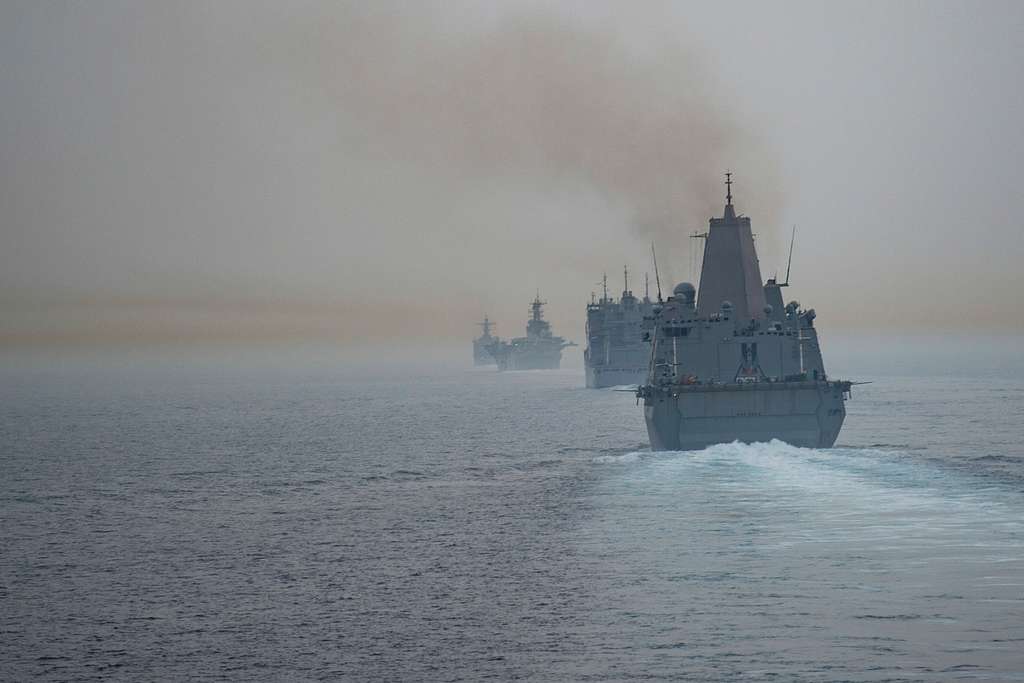
The second lesson is the unequal cost of control versus denial. Iran did not try to defeat the U.S. Navy but made the Strait of Hormuz—through which a fifth of the world’s oil and natural gas passes—too dangerous to use. Above 20,000 feet, American airpower did everything it was designed to do: It won air superiority, degraded Iran’s defenses, sank the bulk of its blue-water navy, and killed the IRGC commander running the blockade. Yet none of it changed the facts on the water.
Tehran closed the strait with cheap and dispersed drones, anti-ship missiles, fast-attack boats, and naval mines laid from ordinary fishing craft; jammed satellite navigation; and seized a handful of ships. The combination made the waterway unusable by commercial shipping at a fraction of what it would cost to reopen.
Trivial to lay and agonizing to clear, mines proved the most insidious threat. After the 1991 Gulf War, it took the U.S. and its allies 51 days to sweep some 900 mines from Kuwaiti waters—with Iraqi minefield maps in hand.
In 2026, Iran offered no maps and claimed it could not locate all the mines it had laid, a calculated ambiguity that deterred insurers and shippers. When Washington finally launched an escort effort, it amounted to little more than routing advice and was paused within days. The strait reopened only when the war ended, and then on Iran’s terms, toll-free for 60 days—and tolled thereafter.
A land power with no navy imposed a closure that the world’s most dominant navy could not break, because the cost of denial runs far below the cost of guaranteeing passage. An Iranian contact mine can cost as little as $1,500—one crippled the frigate Samuel B. Roberts in 1988, which took $96 million and 18 months to repair. Iran’s one-way attack Shahed-136 drones cost $20,000 to $50,000 apiece, against interceptors costing millions. Ukraine showed the same arithmetic, sinking the cruiser Moskva with cheap cruise missiles, and pushing Russia’s fleet back without having a navy of its own.
That is the unforgiving math of a chokepoint.
For Beijing, the lesson cuts both ways. Read one way, the same tools that sealed Hormuz could seal the approaches to Taiwan, and block U.S. submarines attempting to fight their way in. Read the other way, the 100-mile strait is itself a chokepoint that a Chinese invasion fleet must cross.
An amphibious assault—the largest since D-Day and the first ever mounted against modern anti-ship missiles—executed by a PLA that hasn’t fought a war since the 1970s would be extraordinarily difficult under any circumstances. The same cheap denial tools in Taiwan’s hands—mobile anti-ship missiles, sea mines, swarming drones—could make the crossing ruinous and the resupply of forces that make it to the beaches nearly impossible. Hormuz shows the analogy’s limit as well as its force: Mines that turned back tanker insurers will not turn back a navy prepared to take losses. Against an invasion fleet they work by delay—forcing sweeping operations under fire that break the timetable a lift-constrained crossing depends on.
That threat suggests the PLA is likely to adapt in two directions. The first is to prepare alternatives such as a blockade of the import-dependent island, in which China—not Taiwan—is the denier, and the cost asymmetry swings back to Beijing. The PLA’s December exercises practiced blockading Taiwan’s key ports, and its coast guard now patrols Taiwan’s outlying islands to normalize the control a blockade would require. But even that option is not without risk: A blockade would give Washington far more time to mobilize U.S. and allied forces, and the mines that seal Taiwan’s ports could foul the same waters an invasion fleet would cross. A blockade and an assault are not freely stackable strategies. The costs would not fall on Taiwan alone. The island makes roughly 92 percent of the world’s most advanced semiconductors and sits astride one of its busiest sea lanes, so a blockade would throttle global trade—that is, more than $2 trillion in activity by one estimate—and rebound onto China’s own export-dependent economy; as with Iran’s closure of Hormuz, punishing the world would harden the trading partners Beijing most needs against it.
If a strait crossing proves unavoidable, Beijing’s second adaptation will be to enhance its ability to fight through Taiwan’s denial weapons: mine countermeasures, drones to hunt for mobile launchers, and preemptive opening strikes to destroy missile launchers and minelayers before they disperse from their bases. Some of that work is already in the water: Since early 2025, China has been building and testing the Shuiqiao “water bridge” barges—self-propelled craft that link to an 800-meter causeway to drive armor ashore, an echo of the Mulberry harbors of D-Day. However, these efforts run headlong into the Iran war’s third lesson.
Protraction Favors the Defender
The third lesson emerges from the interaction of the first two—it is their compounding effect, not either one alone. A decapitation that fails to end the war buys the defender the time to impose sea denial. But sea denial that cannot be cheaply broken forces the attacker into a longer campaign, and length is precisely the condition under which dispersal and endurance will decide the outcome. A planned three-week war becomes an open-ended one, creating the war of attrition the short-war strategy existed to avoid.
Iran’s dispersal is what let it endure: mobile, hidden, and redundant systems—launchers, boats, and mines that could scatter faster than they could be hunted. When American bombing failed to compel, Washington resorted to a naval blockade and turned the war into an endurance contest the U.S. was not prepared to win. Assessments judged that Iran could endure a blockade for months, while the costs on the U.S. side—higher gas prices, uneasy allies, a public opposed to the war from its first week—mounted week by week. The war ended where it did, not because Iran prevailed on the water, but because of relative cost tolerance—the United States reached the limit of what it would pay in a war of choice.
That asymmetry should trouble any attacker counting on a quick win. A nation fighting for its survival will endure costs far greater than a country fighting a war of choice, which had been assured that the war would be short, or that victory had already been achieved.
This is where a PLA analyst might draw the conclusion that the American superpower opened the war with an impressive display of military power, but could not stand the cost of a protracted conflict. China, by contrast, more populous and more committed, can simply outlast it.
This confidence must contend with some facts. Roughly 80 percent of China’s imported oil passes through the Strait of Malacca—the chokepoint vulnerability then-Chinese President Hu Jintao named the “Malacca dilemma” in 2003. A protracted war would expose those lifelines, and the export trade that sustains China’s economy, to the same cheap interdiction Iran demonstrated at Hormuz.
However, Beijing has been preparing for a war over Taiwan for some time. China has built a strategic petroleum reserve of nearly 1.4 billion barrels—more than four months of seaborne imports—assembled largely from cheap sanctioned crude. Beijing has stockpiled grain and metals and built a financial system increasingly insulated from sanctions. And unlike in the deeply unpopular Iran war, Beijing has indoctrinated its public, portraying a unification war as the final act of the Chinese Civil War.
That reading is seductive and, for China, dangerous. It conflates an American war of choice with a conflict that could become a global or nuclear contest, in which China might strike U.S. forces first to preempt intervention, and Taiwan is fighting for its survival. Taiwan’s defenders need not win—they need only refuse to lose long enough to hold open the chance of outside intervention. If China’s assumptions about Washington’s willingness to intervene or Taiwan’s will to fight prove wrong, Xi could find himself in the protracted conflict the short-war strategy was designed to prevent—a war on which he has staked the Communist Party’s legitimacy and his own.
Taiwan and the Will to Prepare
Beijing has sound reasons to doubt Taiwan’s ability and willingness to withstand a prolonged conflict.
Taiwan’s democracy vests command in an elected president and a constitutional line of succession that has never been tested. What’s more, Taiwan and its forces have not fought a war in decades. Taipei should make decapitation pointless: deepen the line of succession, rehearse continuity of government from dispersed and concealed sites within Taiwan’s dense urban centers, and pre-delegate authority down a redundant chain of command so that the state can fight on headless.
For decades, Taiwan overspent on a few exquisite U.S. platforms unlikely to survive a war’s opening hours, only recently abandoning a Maginot-like beach defense. It should mimic Iran’s focus on cheap, dispersible systems—including drones, unmanned surface vessels, and mobile anti-air and anti-ship launchers that survive the first salvo—and exploit the island’s forbidding geography. That shift has begun: Taiwan’s 2025 National Defense Report prioritizes these asymmetric systems, and its state shipbuilder has unveiled the island’s first indigenous armed sea drone.
Taipei has also been slow to prepare for the blockade contingency, unwilling to disrupt the civilian economy or stockpile sufficient necessities to survive a months-long quarantine. Taipei recently created a presidential-level resilience committee that now plans island-wide drills for blockade, blackout, and disinformation, but these efforts have been late and inadequate given the existential threat facing the island.
While Iran spent decades preparing for war, Taiwan must demonstrate a similar willingness to prepare for wars—both short and protracted—if it aims to survive long enough for outside intervention to matter.
All statements of fact, opinion, or analysis expressed are those of the author and do not reflect the official positions or views of the U.S. Government. Nothing in the contents should be construed as asserting or implying U.S. Government authentication of information or endorsement of the author’s views.