
Lawfare Daily: The U.S. Foreign Service at a ‘Breaking Point,’ with John Dinkelman

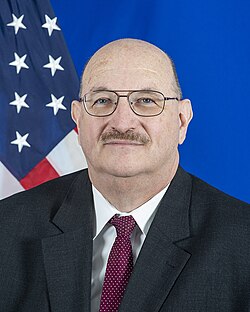

On today’s episode, Lawfare Managing Editor Tyler McBrien sits down with John Dinkelman, president of the American Foreign Service Association (AFSA), to discuss his organization’s latest report, entitled, “At the Breaking Point: The State of the U.S. Foreign Service in 2025.” They talk about why AFSA undertook such a project after the federal government workforce survey was canceled earlier in the year, the report’s major findings, and why a robust foreign service is vital to U.S. national security.
To receive ad-free podcasts, become a Lawfare Material Supporter at www.patreon.com/lawfare. You can also support Lawfare by making a one-time donation at https://givebutter.com/lawfare-institute.
Click the button below to view a transcript of this podcast. Please note that the transcript was auto-generated and may contain errors.
Transcript
[Intro]
John Dinkelman: We're
there for America. So what happens when all of a sudden I can no longer provide
that input without fear of adverse ramifications, retribution, recrimination,
or retaliation? It's going to close people down. People are going to start
worrying more about themselves than they are about the service to the country
that they've sworn to do.
Tyler McBrien: It's
the Lawfare Podcast. I'm Tyler McBrien, managing editor of Lawfare
with John Dinkelman, president of the American Foreign Service Association.
John Dinkelman: The
foreign service is a canary in the coal mine for other ranking person systems
in the U.S. government, namely the U.S. military. And as we see the erosion in
the confidence that we have in our duly appointed, commissioned officers of our
government to fulfill the legal requirements of their positions, it is
potentially increasingly adverse in its effects on our government.
Tyler McBrien: Today
we're talking about the association's latest report entitled “At the Breaking
Point, the State of the U.S. Foreign Service in 2025.”
[Main Episode]
So John, the American Foreign Service Association just
published a report in December called “At the Breaking Point, the State of the U.S.
Foreign Service in 2025.”
So first I'm curious what motivated this report? Is this
something that the association normally does or was this a new endeavor? And if
so, why did you undertake, you know, such an in-depth survey of the foreign
service?
John Dinkelman: Well,
thanks for that question, 'cause that's really the basis of why we're here in
that the federal government decided to not conduct its annual survey of
workplace conditions of employee satisfaction of what have you. It's quite an
intricate survey, having taken it over the course of many years myself.
They decided to dispense with that. Go figure. And the American
Foreign Service Association determined that it was in the best interest of our
membership, and frankly, in the best interest of our organization, meaning the
larger foreign service that we at least get a grasp of the nature of the
workplace as it was being portrayed in 2025.
So we jumped into that breach and we conducted a survey, we
went out to our membership and we're quite happy with the voluminous response
that we got. We weren't so happy with the results, which I'm sure we can go
into in some depth, but that's the genesis. No one was going to speak the truth
that power needed to hear, and so we jumped into that breach.
Tyler McBrien: Yeah,
that's, I think one of the reasons I've found the reports so valuable is that,
for the past year many of our listeners will also relate to this, just hearing
things being done to the foreign service and on, on behalf of the foreign
service. And so rarely hearing from foreign service officers themselves, due to
very good reasons of nonpartisanship and all of that good stuff.
So you mentioned that you sent this out to your membership and
you had quite a robust response. We'll go into the findings in just a bit, but
how many survey respondents, how representative of the foreign service, both
former and current, is this report?
John Dinkelman: Current
is the issue. We're talking about the workplace as its sits right now. We went
out to a total—and remember, we only reach our members, right, so, so we are a
subset of the foreign service, but rather unique to government unions in
general. About 85% of the foreign service are members of our organization. We
originally went out to over 6,000 individuals to survey, and over 2,000 people
responded.
We feel that is an excellent response rate given the overall
concerns in the workforce of being perceived as giving bad information, but
also in general, I think a 30-plus percent survey response is quite high and
was certainly statistically significant and reliable.
Tyler McBrien: Before
we get into the findings, out of curiosity, were you, what was your reaction to
that high response rate? I think anyone who's done a survey of any kind would
be happy with that response rate, but what did that tell you about the state of
the foreign service?
John Dinkelman: That
people are unhappy, but there's much more to it than simply saying, ‘Oh, you're
unhappy in your job. Life's tough, suck it up.’
The overall responses, the unanimity, not just uniformity, but
the overwhelming messages that over 86% of the foreign service said that their
ability to carry out their jobs has been inhibited over the past eight months.
That 78% reported that their budgets and their resources have been reduced, and
75% say that they've been hurt in their ability to do their job. And finally,
of course, that 98% of them feel that morale has been adversely affected.
I mean, I don't think you can get 98% of people to agree, any
group of people to agree that the sky is blue, much less that the situation is
dire. But it's one thing for us to simply say, yeah, people are unhappy. It's
another to think about the secondary and tertiary ramifications of our
abilities to do our jobs when the workforce is being adversely affected in such
a way.
When you weaken the foreign service, you weaken America and
that message needs to be brought home. And I don't know how better to do it
than to meet with people like you who will listen, since leadership in and of
itself seems to have a deaf ear for all of this.
Tyler McBrien: I
wanna drill down on that. How do these, this low morale, pretty wide-scale
firings, how does this material affect the work, the day-to-day work, of the
foreign service officer?
You know, people can conceive of how low morale would translate
to their own work, but from the point of view of a foreign service officer, how
does this make their job harder? How does it weaken America with a diminished
foreign service? What did you hear, maybe beyond the data, from some of your
members?
John Dinkelman:
That's an excellent question. Now, I'll try to get to the core of it, but
you're gonna have to forgive me if my answer is rather long. So there's a
vicious cycle that's taking place here. When I was hired as a foreign service
officer, oh so many years ago, it was drilled into me that the greatest single
value I brought to the workplace was my unique input, whether it was my
regional expertise, my functional expertise, my linguistic capabilities, my
intercultural abilities, and my institutional understanding were all brought
together over the course of decades for me to be able to produce for elected
leadership, the full picture of what was going on around the world.
Simply put, the uninhibited ability to speak truth to power and
to provide a sometimes very ugly picture of what's going on or how it's being
interpreted outside the United States is the reason why the State Department
exists. Yes, we are there to, to advocate for the poor American who's found
himself in a victim of crime or to help people in jail, or to go to the poor
child who's been abducted by one parent and the poor parent in the United
States isn't able to get to their kid. We are there on the ground for all of
that.
In addition to that, we're able to tell people what it's like
in Washington where the beltway is such an inhibitor in the ability to feel
what's going on in the rest of our country, much less the rest of the world.
We're there for America. So what happens when all of a sudden I
can no longer provide that input without fear of adverse ramifications,
retribution, recrimination, or retaliation? It's going to close people down.
People are going to start worrying more about themselves than they are about
the service to the country that they've sworn to do, and that's going on.
It's more a managerial issue than anything. As I have led
organizations, one of the greatest things that I've learned is that being able
to empower my people with the safety of knowing that their input, their
opinions, and their true desires to contribute to the organization will never
endanger the value I place in them.
Rather, I want to make sure that my people know how to deliver
those messages to maximize their effects on an organization. And the opposite
is going on right now with thousands of diplomats around the world worried that
their next step might be their last.
Just yesterday, I received an email from an employee who was
informed that he had been fired on that day while back in the United States on
leave, visiting his family at Christmas, coming from a rather isolated,
difficult place to be in, and he gets a message informing him that his ticket,
going back to his overseas assignment, has been canceled. And he will be
severed that afternoon.
This is no way to run an organization that is more akin to the
military than it is to the private sector, and this is the state of affairs
that we find ourselves in right now.
Tyler McBrien: I'm
also curious about your own background. Could you share a bit about, you know,
your career in the foreign service and when you took this position as the head
of the association, why did you decide to helm an organization like this at a
time of such crisis?
John Dinkelman: I was
approaching the end of a 37-year career with the Department of State. It's been
an absolutely fantastic ride. It has been nothing but an honor to represent my
country since before the fall of the Iron Curtain. As a matter of fact, my
first assignment was on the other side of that Iron Curtain as those walls came
down. And nothing can be more invigorating or wonderful than seeing our
national policies lead to such sea changes around the world.
So at the end of this career, I thought the best way that I
could contribute to the organization and the people who have grown to love and
respect so much was to join the collective bargaining unit, to be the
individual who leads the professional association.
You know, if you're a doctor and you become the head of the
American Medical Association, it probably says something about you and the
people you work with. And so that, that was the situation with the American
Foreign Service Association until March 27th, when the president
decided that we no longer should be a collective bargaining unit.
Adding to the insult to the injury of that, however, is more
the Department of State's unwillingness to even recognize the value of a
professional association, which AFSA has been for a hundred years. We've only
been a collective bargaining unit since the mess that was Watergate and the
Vietnam War caused the Nixon administration to determine that it was in our
national interest to have a way in which the diplomats could organizationally
state, you know, this isn't what we are telling you, so please don't try to
convey this as being something that the diplomatic corps is telling you as far
as a policy inducing action.
Unfortunately, the Trump administration has determined that we
don't need that guardrail or those safeguards anymore. It's really unfortunate.
And so anyway, your question back to me, I am in this breach
because frankly, I've been in the organization for a long time. I've seen what
can go wrong and I wanna make sure it doesn't go wrong. And unfortunately
things are going wrong.
Tyler McBrien: You
mentioned a moment ago, the rolling back of certain protections for the
workforce, protections that are in place to I believe, to ensure that it
remains a professional diplomatic corps and an apolitical one or a non-partisan
one.
I'm curious what other similar things have we seen similar to
that I, you know, the report sites, for example, changes to the foreign affairs
manual. What other actions by the administration do you also put into this
bucket of the guardrails?
John Dinkelman: It's
a rather big picture to paint my friend. The issue being that you have a
professional foreign service that is nonpartisan so that it can serve the
interests of the nation. And because that is such a sensitive and critical tool
for a government over the course of literally centuries, we have enshrined the
organization so that it could not be used to the disadvantage of our country
for internal political purposes.
There are a lot of safeguards that were put into place. One
example would be, let's assume for a moment that for some unanticipated reason,
we decided that we didn't need 10,000 diplomats, but rather we wanted to have
only 8,000 and so it was time to summarily escort 2,000 of them out the door.
There is an intricate, or there was an intricate system, by
which it would be determined which one of us would be of the least value to the
United States government. Putting it in military terms, if you have a bunch of
majors. And you decide that you want to get rid of 20% of your majors, do you
just take the ones who are assigned to one military base and say you're all
fired?
Or do you go through, and you look at their evaluations, you
see their performance, you see their expertise, and you take the 20% of the
lowest performers and you tell them that they're done? And that's the way it
had been with the foreign service, to allow the safeguards to be in place to
tell those under performers or lower performers in the case that it was their
time to go.
But instead, the administration just summarily decided to throw
all those rules out the window and to go with the military example, to simply
take the bases that they didn't want to continue on and tell everybody that
they were gone.
That undermined the confidence that individuals within the
foreign service had, that they would be judged on their merits, that
meritocracy would prevail, and that if they did a good job, that they would be
rewarded or at least not punished accordingly.
That went out the window on July 11th and has led to the crisis
of confidence, which we have within the organization. And that is one of, but
various things, that has gone on in the organization that has eroded our
ability to conduct our diplomacy in a manner that America deserves.
Tyler McBrien:
Unfortunately, as you know, and many of our listeners know, some of these
actions and contours of the crisis are not unique, unfortunately, to the
foreign service and are occurring elsewhere in the civil service.
In other parts of the civil service, there has been litigation
to challenge some of these firings and layoffs as illegal or circumventing
proper procedure. Are you seeing similar legal challenges among the, your
members in the foreign service? And if so, has there been any success in
rolling back some of these cuts?
John Dinkelman:
Successes, not yet, but the cases are still working their way through the
courts. I think a bigger picture needs to be painted. And then, and I won't go
into the Title 22 versus Title V, areas of discussion, which I'm sure your
audience is well acquainted with.
The way I will portray this differently is that the foreign
service is a canary in the coal mine for other ranking person systems in the U.S.
government, namely the U.S. military. And as we see the erosion in the
confidence that we have in our duly appointed, commissioned officers of our
government to fulfill the legal requirements of their positions, it is
potentially increasingly adverse in its effects on our government.
Tyler McBrien: Before
I turn to some of the recommendations at the end of the report to reverse
what's happening or strengthen the foreign service in this new reality. I
wanted to zero in on one of the major findings here, which is that nearly one
in three officers surveyed are considering leaving the foreign service.
And, you know, I also, I can't imagine that, you know, young
people who are graduating from graduate degrees in international relations and
similar fields are eager to join up seeing the corps in the crisis that it's
in.
If the crisis continues you know, what could the foreign
service look like in the next administration and two administrations from now? What
worries you about this trend? If the crisis continues the way it is?
John Dinkelman: We'll
see a politicized foreign service with individuals being brought in by
whichever party has the administration at the time, who have proven themselves
favorable for eight or 12 years prior. It will erode the institutional
understanding and the expertise that we take decades to build up. That's the long-term
concern that I have.
The short-term concern is a caliber issue. Let's face it. If
you're a college sophomore and you've decided that in your heart you called to
be a diplomat for your country and you are gearing yourself up, are you going
to consider a profession that is undergoing such a tumultuous adversity at this
time?
Everyone I ask, I tell them that I am still bullish on
diplomacy. I'm still encouraging the youth of the United States to consider
this profession because in the end, whether it is in 2028 or 2032. We will have
to rebuild the diplomatic element of our national power.
And we need levelheaded, nonpartisan professionals who are
willing to devote their lives to a profession that will at least assure them
that when the winds of policy change in Washington, that they're not out the
door, simply because they refuse to sign some loyalty oath to whomever is in
office at any given time.
We swear an allegiance to the Constitution, we swear an
allegiance to execute the legal policies of the duly elected leaders of our
country. I have never seen in my 37 years in the organization, I have never
seen a foreign service officer who has violated that tenant or those precepts,
and I doubt I ever would for the simple fact that, who is going to enter into
such a profession with such malforethought?
But that's not the issue that we're facing now. We're facing
the potential brain drain of our diplomats going into areas where they feel
they can be of greater service to our country. And it's a loss that we will
continue to feel. We've seen it with the U.S. Agency for International
Development, the horrific situation of our government cutting off its nose to
spite its face because they think that development is a bad thing, or at least
they portray it that way.
And now we see this massive rush to try to repair and redirect
our abilities to be of assistance in our own national interests. And the mess
that is creating will eventually be sorted out. But the good people who have
that expertise, they are going to international organizations, they're going
into the private sector, and they are done with it because we have eroded the
confidence and goodwill with that workforce. And it will take a generation, if
ever, to rebuild that confidence.
Tyler McBrien: We
mentioned how the nature of the foreign services, if not already changed, may be
starting to change, in terms of starting to become more of a political arm, this
being of course, forced upon the service by changes from the administration.
I'm curious though, how the American Foreign Service
Association has also had to change potentially vis-a-vis its interactions with
the administration or how has, you know, your organization been forced to adapt
to this new environment this year? In addition, you know, other than of course
conducting this survey where the foreign service had in years past.
John Dinkelman: Understood.
The nature of diplomacy the work of the diplomat has always been one—it's
always supposed to have been one that's behind the scenes. It is far better for
our diplomats to work with foreign interlocutors, to negotiate with them, to
convince them to reason with them as to why their desired course of action
should be our desired course of action, and it is far better for everyone
involved if they come to the right decision in and of themselves.
And our job is done with a minimum of fingerprints on what is
going on around the world. And that in some ways, that ethos has bled into the
way that the American Foreign Service Association has worked with foreign
affairs agencies in the past for over a century.
We've been the one who have quietly had the meetings. We've
explained, of course, we support policies and we will execute policies. That's
what we're there for. But when the unforeseen consequence of a policy might be
adverse, especially to our nation, but also to the workforce, we'll explain it
to the bosses. We'll let them understand what we see and they'll make their
decisions and we will salute and march smartly.
This has all been done quietly. This has all been done in
meetings, in communications, heavens at lunch, where people are given the
information they need and they act accordingly. But frankly, I can't even get
into the State Department anymore and they don't even recognize that I exist.
So unfortunately, AFSA, for its part, has to take more public
of a stance. Meeting with you, going on to podcasts, in the press, explaining
these negative ramifications that decisions are being taken, that are adversely
affecting our nation, that are having, what I hope are unforeseen consequences,
bringing us into a dire situation.
Lamentably, my job has become much more outward facing than any
of my predecessors. I would hope that someday this could return, and that at
least the professional association element of what we have to offer, all of the
foreign affairs agencies, would be utilized by leaders to effectively steer our
government.
Tyler McBrien: So in
addition to stepping into the spotlight in ways that maybe AFSA has never done
before, to better explain the value of the foreign service and the, especially
the apolitical, nonpartisan nature of it, to the public and to leaders, what
else can be done here to address the crisis, to strengthen the foreign service
for the future?
I know the report mentions a few recommendations toward the
end, but what can we do? And again, and then who is the “we” here? You know,
what can be done and by whom?
John Dinkelman: Well,
we look to Congress to exercise its oversight authority to make sure that they
support what is being done to our foreign affairs complex.
In the end, we rely on external actors to make sure that our
branches of government are acting within the guardrails they have been given. And
now would be such a time. Barring that, I will continue to ring as many bells
as possible with the media, such as yourself, and with the workforce, so that
they are at least aware of things that their own leadership are not sharing
with them.
Tyler McBrien: So I
just wanted to toss it over to you for the final word. If you have a parting
word for your membership or, you know, a message heading into the new year for
your membership and the public and our listenership, of course. What are you
thinking, you know, heading into 2026 vis-a-vis this crisis?
John Dinkelman: Well,
first and foremost, whatever storms may be blowing outside, AFSA will never lie
to our members. We will always be a source of truth and a reliable repository
of institutional memory as to the way things have been run in the past and the
way they can be restored in the future. Simply put, AFSA will still be here.
The winds may blow, but we are shuttered tight and we are ready
for this fight. Going forward, I would continue to, to a more external audience,
I would continue to sound the alarm. There is an urgency here. It is not too
late to save the ship of state from the perils that are on our course.
It will require the meeting of many right-thinking individuals.
And frankly, it is not too late for leadership either. I know for a fact that
there are good and honorable people in positions of responsibility in the Harry
S. Truman building who truly want what is best for our country, and they see
that that is done only through the effective application of a non-partisan
foreign service.
They are willing, they're simply not able because of the
pressures that they're receiving from above. I would encourage those pressures
from above to reconsider their actions and make use of a workforce that is
ready to serve the United States.
Tyler McBrien: So I
think it's fair to say at a breaking point, but not yet broken. Which I think
is a good note to end on. So John, thank you so much for taking the time to
speak with me today.
John Dinkelman: Been
a pleasure.
Tyler McBrien: Thank
you.
[Outro]
The Lawfare Podcast is produced by the Lawfare
Institute. If you wanna support the show and listen ad free, you can become a Lawfare
material supporter at lawfaremedia.org/support.
Supporters also get access to special events and other bonus content we don't
share anywhere else. If you enjoy the podcast, please rate and review us
wherever you listen. It really does help.
And be sure to check out our other shows, including Rational
Security, Allies, the Aftermath, and Escalation, our latest Lawfare Presents,
a podcast series about the war in Ukraine. You can also find all of our written
work at lawfaremedia.org. The podcast is
edited by Jen Patja with audio engineering by me, Tyler McBrien of Lawfare.
Our theme music is from Alibi music. As always, thanks for
listening.

_enforcement_and_removal_operations'_(ero)_from_baltimore-_maryland__ride_along__on_2_august_2023-1.jpg?sfvrsn=50aeaecc_5)
