
Rules of Engagement When the Troops Appear at Polling Sites
-2025.jpg?sfvrsn=333295e6_3)
Open, noncoercive, and safe elections are a hallmark of a healthy democracy. Today, those characteristics are in jeopardy. In January, President Trump boasted of his administration’s first year back in office and said, “When you think of it, we shouldn’t even have an election.” Speaking on former Deputy FBI Director Dan Bongino’s podcast in early February, Trump claimed that illegal immigrants “were brought to our country to vote, and they vote illegally.” He continued, “The Republicans should say, we should take over the voting in at least 15 places. The Republicans ought to nationalize the voting.” And in September 2025, Trump blamed “radical left democrats” for political violence and designated “antifa” activities as “domestic terrorism.”
These three statements come amid a campaign by popular MAGA influencers and some members of Congress urging Trump to deploy forces at polling sites. The fact that 46 percent of the public supports the idea of the National Guard monitoring or patrolling the ballot provides the administration enough of a basis to claim it has a “mandate” to do so.
This climate and Trump’s words crystallize the fear that anti-democratic, nativist, and militarized sentiments within the administration will push Trump toward invoking the Insurrection Act to deploy U.S. military troops and Immigration and Customs Enforcement (ICE) around polling sites for the midterm elections in November. But the Insurrection Act is not the only legal authority Trump may use to justify militarizing election security. (A senior Department of Homeland Security official recently said that federal immigration agents would not be at polling sites.)
Much has been written about the likely legal challenges of such a deployment, but to date, there has been no discussion of the rules, in most cases based on federal criminal law or the Constitution, that should restrain federal law enforcement and the military if the president attempts a deployment. This article suggests state and local election officials should articulate certain rules in a public awareness campaign designed to mitigate the risk of violent confrontations and misunderstandings between two parties that do not normally interact: troops and voters. As described below, these “rules of engagement” lie at the intersection of the constitutional right to vote, right to privacy, right to assemble, restraints on law enforcement agents’ use of force, and authority to search, and the military’s rules for discipline within the ranks and their use of force. The more the public understands their rights and the security forces’ authorities in this historically abnormal setting, the lower the risk of tragic mistakes and open hostility.
What If?
Imagine that Trump posts the following hypothetical note to his Truth Social account on Oct. 3, 2026, one month before the federal midterm election:
At the request of the Attorney General, the GREAT Todd Blanche, I am directing Secretary of War, Pete Hegseth, and Secretary of Homeland Security, Markwayne Mullin, to provide all necessary Troops and I.C.E. agents to protect our GREAT BALLOT BOXES and POLL WORKERS, under Threat from attack by Antifa and other domestic terrorists. We will be sending them to certain cities currently Under Siege by Illegal Immigrants. These dangerous criminals are protected by the crazy Radical leftist city mayors and so-called “governors” who “just let it happen!” I am also authorizing Full Force, if necessary, to protect the American Citizen’s Right to Vote. Our strong men in Uniform will not permit Fraud by the Deranged Democrats and will make sure legal voters are safe at all times! STOP THE STEAL! I don’t want to use the Insurrection Act but I might have to! Thank you for your attention to this matter!
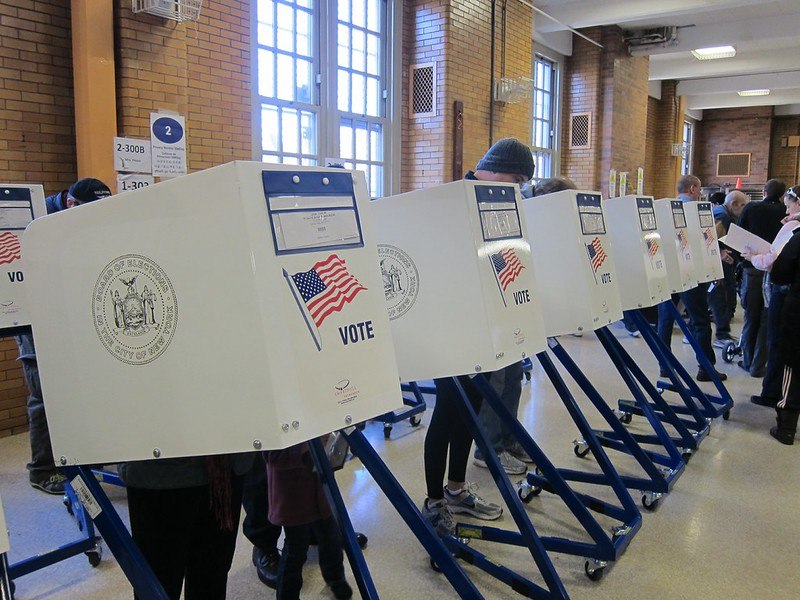
Such a post would not come as a surprise. This article is not a legal analysis of whether such domestic use or show of force is lawful. Instead, this article assumes the president has decided, under the cover of some articulable legal authority, to insert federal law enforcement and the military to “protect” election integrity and that voters will encounter the unusual sight of uniformed soldiers—likely armed—in a perimeter around a church, inside school cafeterias, or wherever voters fill in their ballots.
Such a scene creates unique challenges for civil-military relations, public safety, and the free exercise of the right to vote.
Boots on the Ground—at the Polls
Three recurring messages by the Trump administration should give democracy observers specific cause for concern that the U.S. military will have boots on the ground at or near polling stations in November’s midterm elections. The administration will perhaps justify these domestic deployments as a lawful and prudent response to an alleged threat to the safety of voters or election staff posed by “leftist” terrorist organizations, or to prevent illegal voting and election fraud—a recurring but factually unsupported Trump claim.
First, the Trump administration distrusts some states’ ability or willingness to conduct elections in a secure manner, free from fraud. On March 31, Trump issued an executive order that, as described by the Brennan Center, “would inject chaos into our elections, block eligible American citizens from voting, undermine voter privacy, and expose election officials and others to criminal prosecution simply for doing their jobs.” On April 21, Virginia held a vote on a controversial redistricting referendum. Predictably, once it was clear that the referendum vote went the way Democrats had hoped, Trump proclaimed it was a fraudulent election: “All day long Republicans were winning, the Spirit was unbelievable, until the very end when, of course, there was a massive “Mail In Ballot Drop!,” he posted from his Truth Social account. Trump continues to claim, without evidence, that thousands or millions of illegal immigrants vote in federal elections and continues to impugn the integrity of the “patchwork” of state-by-state voting processes. There is a widespread concern, reinforced by Trump’s own words, that he wants Republicans to nationalize the election process in ways that deter and disenfranchise likely Democratic voters.
Second, the administration has carried out a precedent-setting deployment of the military into major U.S. cities under the pretext of supporting and protecting civilian law enforcement, specifically, immigration law enforcement. Having described illegal immigration as an “invasion,” Trump federalized the California Army National Guard over the objection of Gov. Gavin Newsom and deployed it—along with active-duty U.S. Marines—to Los Angeles to “protect” federal property and federal agents enforcing immigration law from what he referred to as a “rebellion” (these missions violated the Posse Comitatus Act, according to the U.S. District Court for the Northern District of California). He attempted similar approaches to immigration law enforcement in Portland, Oregon (which he described as “war ravaged”), and Chicago, both over the objections of city and state elected officials. Back in January, Trump declared that he regretted not using the National Guard to seize voting machines in the wake of the 2020 presidential election to support his regularly debunked claim of voter fraud and a “stolen” election that led to his defeat.
Third, the administration has designated “antifa” as a “domestic terrorist organization.” Trump declared that members of this “militarist, anarchist enterprise”:
obstruct enforcement of Federal laws through armed standoffs with law enforcement, organized riots, violent assaults on Immigration and Customs Enforcement and other law enforcement officers, and routine doxing of and other threats against political figures and activists. Antifa recruits, trains, and radicalizes young Americans to engage in this violence and suppression of political activity[.]
The very language used in this executive order—“obstruct enforcement of federal laws” and “armed standoffs”—seems to prime the public (or lay groundwork for an eventual legal argument) for accepting this factual predicate required to invoke the Insurrection Act. Invoking it permits the use of federal armed forces to “execute the law” when such conditions are present, at the president’s sole discretion. Just as easily, that language is primed to justify putting troops at the ballot boxes even without invoking the Insurrection Act under a little-known law, 18 U.S.C. § 592, which expressly permits the troops to be at the polls “to repel armed enemies of the United States.”
The net result of these three messages is a nonzero, and potentially high, probability that the U.S. military (either federalized National Guard troops or active duty) will be present at or near polling sites this November.
If troops are present, it is reasonable to prepare for the increased risk of dangerous miscommunication and confrontation between militarized law enforcement and voters (and potentially protesters). What may be nothing more than a routine act of force protection by the military might be misinterpreted by voters as an intimidating or coercive show of force. What may be nothing more than insistent or pejorative speech by a protester near the polling site may be misread by the military as “hostile intent.” And what may be nothing more than a voter exercising her right to privacy might be miscast as “obstruction” by law enforcement.
As a matter of common sense, state and local officials should collaborate in a public information campaign intended to deescalate tension and deter hostility between voters and any law enforcement or military personnel present at or near polling sites. Such a campaign would support election-specific state and local public safety efforts, combat election disinformation, and encourage informed caution by voters in the unusual event that federal law enforcement and military forces are present under orders to enforce immigration law, provide security against an alleged threat of “domestic terrorism,” or confront some other threat to an ill-defined “national security” interest.
There are precedents for such public awareness campaigns. Two are highly relevant to the challenge of troops and federal agents at polls with a mission to protect against violence and voter fraud. Organizations such as the Immigrant Legal Resource Center have created and widely distributed “red cards” that inform community members of their civil rights when confronted by ICE agents. The International Committee for the Red Cross has suggested that the U.S. military can and should share key pieces of its combat “rules of engagement” with the local population during counterinsurgency armed conflicts to avoid triggering an unnecessary or mistaken use of force, including at traffic checkpoints where conduct can be easily misread as hostile even by troops acting in good faith. The rationale for a public awareness campaign about civil rights at militarized polling places during the November midterm election is the same.
Rules of Engagement with Police and Military Forces
States and nongovernmental public interest groups should develop community-accessible resources to support local public safety efforts, combat election-related disinformation, and encourage voters and protesters to exercise caution when military forces are present at or near polling places. To accomplish those distinct goals, that resource should clearly address five subjects: (a) the basic guarantees of the right to vote; (b) logistical and administrative conditions on exercising that right; (c) the federal laws that prohibit the use of law enforcement and the military during elections as the default rule (as well as its exceptions); (d) the relevant constitutional protections implicated by law enforcement encounters; and (e) the rules governing how, when, and under what conditions law enforcement or the military might use force.
Basic Guarantees
The community resource guide, or other public awareness and civic education tactic, should emphatically emphasize that the right to vote, free from harassment, intimidation, threats, and violence, is protected by the Fifteenth and Nineteenth Amendments to the U.S. Constitution and the Voting Rights Act of 1965. It is a right, not a privilege. The guide should explain that this right can be exercised even if the voter is unhoused, and even if they do not speak or read English. It should caution the public that this right may be denied to felons or to those with certain mental disabilities, depending on that state’s election eligibility laws.
Logistical and Administrative Conditions
Most polling places are in government buildings, schools, or places of worship. The public should be reminded to follow all notices and warnings posted at those sites concerning voting procedures and safety, including any prohibitions on possession of firearms or other weapons (concealed or openly carried).
Prohibitions on the Use of Federal Law Enforcement and the Military at Elections
It is a federal crime for anyone (private citizen or government official) to intimidate, threaten, coerce, or attempt to, any other person for the purpose of interfering with their right to vote (18 U.S.C. § 594). The state should also explain the extent to which such conduct also violates state criminal law (Virginia’s law is illustrative). Moreover, it is a federal crime for any member of the armed forces to prevent or attempt to prevent by force, threat, intimidation, advice, or other negative action, any qualified voter from fully exercising their right to vote in any election (18 U.S.C. § 593).
The resource guide should also explain that it is a federal crime for any federal official (military or civilian) to order, bring, keep, or control “any troops or armed men” at any place where a general or special election is held, “unless such force be necessary to repel armed enemies of the United States” (18 U.S.C. § 592)—a determination that appears to be solely within the president’s discretion. Finally, it is a federal crime to use any part of the federal armed forces to “execute the law” unless it is authorized by a federal law or the Constitution (18 U.S.C. § 1385—the Posse Comitatus Act). This prohibition does not apply to state-commanded National Guard troops. If the president invokes the Insurrection Act (10 U.S.C. §§ 251-255) with respect to protecting the electoral process and voters at designated locations, he is legally authorized to use the federal military in a temporary law enforcement capacity as an exception to the Posse Comitatus Act.
Relevant Constitutional Protections
Even if federal troops, or state National Guard troops under federal control, are deployed to conduct law enforcement with respect to security around election processes and polling sites under the Insurrection Act or 18 U.S.C. § 592, the military must respect the public’s constitutional rights to peacefully assemble, speak, protest, and record law enforcement officers performing their duties in public spaces, including taking photos, video, or audio recordings. The community resource guide should explain how these rights are subject to state and local regulations that may limit the time, manner, and locations for organized public protesting and for recording in public.
The guide should carefully remind the public that all law enforcement officials—local, state, and federal—and any military members deployed under the Insurrection Act (if any) must also respect the right under the Fourth Amendment for individuals and their property to be free from unreasonable searches and seizures. It should explain that a person may be subjected to a brief, temporary, and involuntary detention by police, based on “reasonable suspicion” of criminal activity (such as being an illegal immigrant attempting to vote), and may be “frisked” if the officer has reasonable suspicion that the person is carrying a weapon and is dangerous. Reasonable suspicion must be based on more than a “gut feeling” but requires less evidence than “probable cause.”
Based on a 2025 U.S. Supreme Court decision, the guide should inform the public that enforcement of federal immigration law permits law enforcement agents to temporarily stop a person based on “reasonable suspicion” of illegal presence in the United States. Importantly, one factor that is “relevant” to that suspicion is “apparent ethnicity.” The guide might recommend carrying proof of citizenship to reduce the risk of unnecessary confrontation and unjustified arrests. Documents (originals or certified copies) include a valid U.S. passport (or expired within 12 months); a state-issued REAL ID card (some indicate citizenship status); military identification card or military records (if indicating U.S. citizenship); Certificate of Naturalization (Form N-550); Certificate of Citizenship (Form N-560); or a state-issued birth certificate.
Given the likelihood that civil protests will happen near polling sites to demonstrate against the deployment of ICE and/or the military during the election, the community resource guide could explain that law enforcement cannot confiscate, or order a person to show the contents of, or to delete photographic, video, or audio recordings of law enforcement operations in public places without a judge-issued warrant based on probable cause of criminal activity. Such criminal activity may include allegations that the act of recording impedes an investigation. However, if an officer believes she has probable cause that the recording device is or contains contraband, the officer may conduct a plain view seizure of the item. Moreover, police or other law enforcement officers may arrest an individual based on probable cause that any criminal offense has been committed, even if the offense does not authorize incarceration as a penalty. No warrant is required if the individual is in public and there is probable cause that a felony happened, or if the officer observes the individual commit a misdemeanor.
The guide could also explain that any person subject to arrest may be fully searched, along with any bag or container within his or her possession. However, law enforcement agents cannot search the contents of a smartphone pursuant to this authority without getting a warrant first.
Finally, the guide should explain the basic Fifth Amendment guarantee against self incrimination: the privilege of choosing not to answer questions from law enforcement personnel. There is no requirement that a person be advised of Miranda warnings before they choose to remain silent; that right applies whenever questioned by a government agent under custody.
Rules for the Use of Force
Importantly, the guide should explain that any force used must be “reasonable” under the circumstances, and that any civilian law enforcement or military member acting as law enforcement may use deadly force only if they have a reasonable belief that a subject poses an imminent danger of death or serious physical injury to the officer or others. Deadly force is considered a last resort.
The guide should explain that any military members stationed at or near polling places will be operating under restrictive rules for the use of force (RuF) orders that are generally analogous in content (but not identical) to the rules for use of force applicable to civilian police officers. These rules are similar in purpose to rules of engagement (RoE) orders in combat. However, the frequency and extent of the military members’ training on the RuF in a civilian environment are usually less than the training they receive on applying the RoE in a combat environment (National Guard troops are more likely than active-duty troops to be adequately trained in RuF).
These rules for an election deployment (all or most of which will be classified) will specify what weapons are permitted to be carried by troops, under what circumstances force may be used against a civilian (for example, what actions may be considered a “hostile act” or demonstration of “hostile intent” that triggers the right to use force in self-defense), under what conditions a civilian may be temporarily detained and questioned, and the command-and-control relationship between civilian law enforcement agencies and the military, among other details. These rules regulate the conduct of troops during operations, ensuring they comply with applicable law in the context of specific missions. Classified or not, these rules cannot infringe on constitutional rights or rights provided by federal or state law—they cannot grant military personnel greater authority to detain, search, or use force than may lawfully be employed by civilian law enforcement personnel. Finally, these rules regulating the conduct of troops are “lawful orders” that must be obeyed by the military members upon penalty of criminal court-martial prosecution.
Conclusion
Placing troops and federal law enforcement at the polls is legally suspect and may not occur. But if it does, those irregular domestic deployments will create predictable risks. It will likely jeopardize the relationship between state and federal governments, sow fear and anxiety, chill voting, and create environments for potentially deadly misunderstandings of civil rights or misinterpretations of the scope and application of law enforcement powers.
These rules of engagement are intended to aid state and local election authorities’ in fulfilling their duties to reduce those risks in deescalating tensions, mitigate misunderstandings, and improve the community’s trust in safe, transparent, and intimidation-free voting. Comparable educational efforts can and should be made by military commanders prior to deployment in compliance with the RuF in the context of protective missions at or around polling sites and in coordination with state, local, and federal law enforcement.
.jpg?sfvrsn=3611d515_4)
.jpg?sfvrsn=cb803a66_6)
