The Unhidden Hand

Covert operations usually pay off early and fade. Russia’s campaign to influence the 2016 U.S. presidential election was exposed before the votes were counted. And yet, 10 years later, Moscow’s returns are larger than they were on election night.
Scholars and practitioners judge covert action by the benefits its sponsor accrues over time—not just at the time of execution. By that rubric, the operation was a major success. Russia aimed to undermine public faith in the U.S. democratic process, denigrate Hillary Clinton, and help elect President Trump. By election night, all three had come to pass, though whether Russia’s help was decisive cannot be known.
But Russia’s larger gains came over the 10 years after November 2016, when the man Moscow helped elect dismantled U.S. defenses against foreign election interference, cast doubt on the U.S. commitment to NATO, and withheld assistance to Ukraine while it fought for its existence. These acts did not require collusion with Russian intelligence or a conspiracy hatched in Trump Tower, only an alignment of interests. The hand that mattered most was never hidden, and it did not belong to the sponsor but to the supported party—Trump.
Doral, Florida—July 27, 2016
The final months of the 2016 presidential campaign had been roiled by accusations that Clinton had improperly used a private email server and had deleted some 30,000 emails she deemed personal. At a press conference at his Doral golf resort, Trump turned to the cameras with a request: “Russia, if you’re listening,” he said, “I hope you’re able to find the 30,000 emails that are missing. I think you will probably be rewarded mightily by our press.”
Within about five hours, according to Special Counsel Robert Mueller’s report, officers of Russia’s military intelligence service, the GRU, targeted Clinton’s personal office for the first time. Four months later, Trump was elected president by a combined margin of about 78,000 votes across three traditionally Democratic states.
How Covert Action Is Judged
Covert action is a government’s effort to shape events abroad without showing its hand. U.S. law defines it as an activity “to influence political, economic, or military conditions abroad, where it is intended that the role of the U.S. Government will not be apparent or acknowledged publicly.”
Covert action takes three broad forms, in rising order of violence: (a) propaganda and political action, such as funding a party or candidate; (b) sabotage, such as manipulating supply chains to undermine an adversary’s military; and (c) paramilitary action, including training insurgents and assassination. The Russian operation, what the Soviets called “active measures,” sits in the first category. The political scientist Dov Levin counts 117 partisan electoral interventions by the U.S. and the Soviet Union or Russia between 1946 and 2000.
David Robarge, the CIA’s chief historian, argues that judging success depends on whether a covert action accomplished the policy objectives it was meant to serve. Successful programs tend to share certain traits: They are narrow, cheap, flexible, part of a broader policy, and exploit existing weaknesses in the target rather than trying to create new ones.
Rory Cormac, Calder Walton, and Damien Van Puyvelde divide that judgment into three metrics: (a) programmatic, or whether it met its objectives; (b) process, or how it was planned and carried out, including whether it stayed secret; and (c) political, or what it did to the sponsor’s reputation and to public confidence in institutions, the targets included.
In Robarge’s scoring of 49 declassified CIA programs, about 53 percent succeeded at least partly in the short term but only about 41 percent in the long term (though scholars disagree about when the clock stops). Robarge counts the 1953 coup in Iran, for example, as a short-term success and a long-term failure. The sponsor’s gains tend to decay over time, when the target, responding to the initial breach, repairs its defenses.
Levin finds that successful interventions in another state’s elections usually are an “inside job,” working only when a major domestic actor wants the help. The supported candidate, however, has his own purposes and how he responds shapes an operation’s results to a greater degree than the sponsor’s actions. Applied to Russia’s campaign, the question is whether Moscow’s objectives have advanced since 2016, regardless of who advanced them.
Russia’s Covert Action (2016)
The core facts of Russia’s intervention in 2016 remain clear, despite a decade of partisan argument and official denials. What follows is based on contemporaneous reporting and official inquiries: the January 2017 intelligence community assessment, the Mueller investigation, and the Senate Intelligence Committee’s bipartisan review.
The 2016 operation was a classic political influence campaign, combining propaganda with political action. It had three parts:
- GRU officers stole emails from Clinton campaign chairman John Podesta, the Democratic National Committee, and the Democratic Congressional Campaign Committee. The Russians laundered the material through DCLeaks, the persona Guccifer 2.0, and WikiLeaks, which timed the releases to undermine Clinton’s election.
- The Internet Research Agency, a St. Petersburg-based troll farm, impersonated Americans on social media, amplified these attacks, and discouraged Black voters and other likely Clinton supporters from voting.
- Russian operators probed state election systems and breached Illinois’s voter registration database. The Department of Homeland Security, however, found that the targeted systems were not involved in vote tallying.
The U.S. quickly detected the operation, and the FBI warned the Democratic National Committee (DNC) of a Russian-linked intrusion in September 2015. The DNC’s cybersecurity firm publicly named Russian intelligence. In August 2016, CIA Director John Brennan warned Alexander Bortnikov, head of the FSB, and President Obama told Russian President Vladimir Putin directly at the Group of 20 summit in September 2016 to “cut it out.”
The Obama administration struggled over whether and how to go public. The Senate Intelligence Committee later found the White House had been constrained by fears that going public would erode confidence in the vote and sow uncertainty over how far Russia had breached U.S. election infrastructure. According to Obama officials, Senate Majority Leader Mitch McConnell blocked efforts to issue a bipartisan warning and questioned the intelligence. Congressional leaders eventually agreed on a letter urging states to secure their systems but failed to name Russia.
On Oct. 7, 2016, a month out from the vote, the Department of Homeland Security and the Office of the Director of National Intelligence (ODNI) issued a joint statement finally naming the Russian government. However, just hours later, the Access Hollywood tape and WikiLeaks’ first release of Podesta’s emails buried the government’s only clear public accusation before the vote.
Denial (2016-2020)
In 2016, Levin’s inside-job condition was met as Trump moved from publicly welcoming Russian intervention during the campaign to denying the operation began before Trump took office. On Dec. 9, 2016, after reports that the CIA had concluded Russia intervened to help Trump, his transition team dismissed the agency as “the same people that said Saddam Hussein had weapons of mass destruction.”
On Jan. 6, 2017, two weeks before the inauguration, the intelligence community published its assessment outlining the Russian operation’s aims to undermine public faith in the U.S. democratic process, denigrate Clinton, and help Trump, for whom the Russian government had developed “a clear preference.” Briefed on the assessment, Trump spread the blame to “Russia, China, other countries, outside groups and people” and declared any attempt had “absolutely no effect on the outcome of the election”—a question the assessment had expressly declined to answer.
Next, he attempted to delegitimize the government agencies and leaders who had detected the intervention. In May 2017, Trump fired FBI Director James Comey and told NBC’s Lester Holt that when he decided to do it, he said to himself that “this Russia thing with Trump and Russia is a made-up story.”
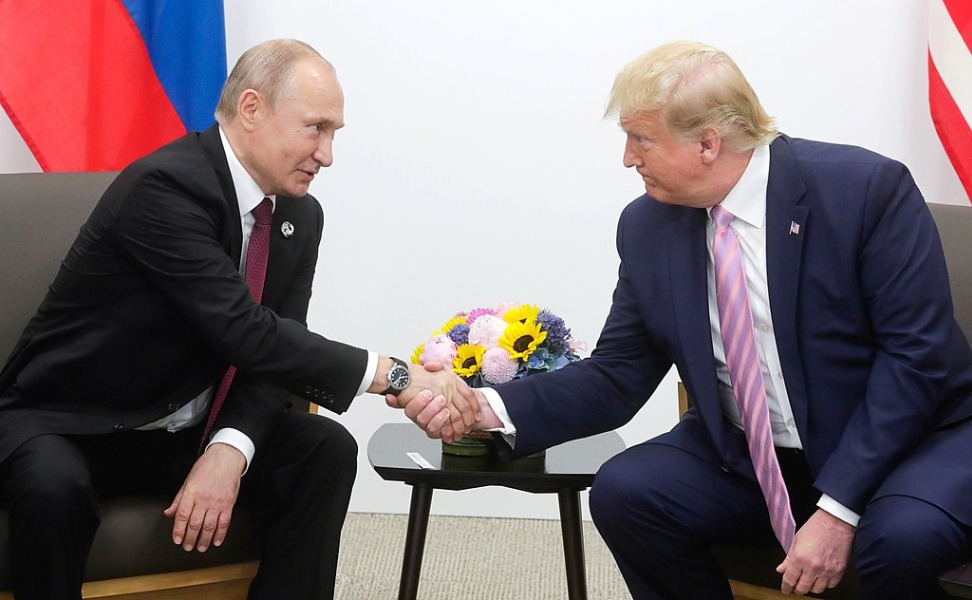
Two years after his Doral appeal, Trump stood beside Putin in Helsinki. A U.S. journalist asked whether he would, with the world watching, denounce Russia’s interference and warn Putin never to do it again. Trump replied that Putin had denied the operation and that, while U.S. intelligence officials believed Moscow was responsible, he didn’t “see any reason why it would be.” The next day, he added that it “could be other people.”
Fiona Hill, then the National Security Council’s senior director for Russia, was in the delegation and wrote that for Trump, endorsing his own government’s conclusions would have been tantamount to admitting his victory was illegitimate.
Special counsel Mueller documented the Russian operation in detail, and a bipartisan Senate Intelligence Committee report found “no reason to dispute” the assessment. Even House Intelligence Committee Republicans accepted that Russia interfered, disputing only the judgment that Putin preferred Trump.
Mueller found that the Trump campaign “expected it would benefit electorally” from Russia’s efforts but did not establish that it conspired or coordinated with Moscow, or that Trump’s request prompted the hack. The Senate committee, under its acting chairman, then-Sen. Marco Rubio, found that when WikiLeaks announced in June 2016 that it would publish material on Clinton, the Trump campaign “was elated by the news” and considered it “an unexpected ‘gift.’”
The special counsel also found that lies by several campaign associates “materially impaired the investigation of Russian election interference.” The president later pardoned five people convicted in the inquiry, among them Roger Stone, for lying to Congress about his efforts to reach WikiLeaks, and Paul Manafort, who provided campaign polling data to Konstantin Kilimnik—which Kilimnik passed to Russian intelligence.
John Durham, appointed by Trump’s attorney general to investigate the investigators, concluded that the FBI should not have launched a full investigation into the Trump campaign’s ties to Russia. But even Durham never disputed the fact of Russian intervention, and Trump’s actions could not erase the special counsel’s central finding, and the wound to the president’s legitimacy never closed.
Repairing the Defenses (2017-2024)
Despite the president’s denials, his own administration, his successor, and Congress expanded the system to detect the next foreign intervention, including through the FBI’s Foreign Influence Task Force, the Cybersecurity and Infrastructure Security Agency’s (CISA’s) election security office, and the ODNI’s Election Threats Executive. On the day of the 2018 midterm elections, U.S. Cyber Command knocked the Internet Research Agency offline.
The Biden administration activated the ODNI’s Foreign Malign Influence Center in September 2022. In 2024, the National Security Council organized working groups against Russian sabotage and disinformation, and in the 2024 campaign’s final weeks, the FBI, CISA, and ODNI publicly attributed fabricated election videos to Russia, while Cyber Command covertly disrupted Russian troll operations aimed at six swing states.
However, executive actions mostly built this system. Even the parts Congress created could be emptied of personnel or left dormant. In 2024, the voters reelected the official with the strongest incentive to dismantle it.
Disarmament (2025-Present)
With Trump’s return to the White House, the administration moved swiftly to gut the system and punish the officials who had investigated Moscow’s intervention. Whatever the president’s motives, each step served Moscow and the original operation’s ends.
On Feb. 5, 2025, her first day in office, Attorney General Pam Bondi disbanded the FBI’s Foreign Influence Task Force, dismantled the department’s unit pursuing Russian oligarchs’ assets, and narrowed enforcement of the Foreign Agents Registration Act. CISA paused its election security work, abandoned the information sharing center that connected it to state and local election officials, and by mid-2025 had lost more than a third of its workforce. Director of National Intelligence Tulsi Gabbard gutted the Foreign Malign Influence Center, the State Department closed its office for countering foreign disinformation, and National Security Council working groups on Russian sabotage and disinformation stopped meeting.
The next target was the people. In August 2025, Gabbard revoked the security clearances of 37 current and former officials, among them a senior Russia analyst who helped produce the 2017 assessment, citing the “politicization or weaponization of intelligence.” Comey was indicted on Sept. 25, 2025, over his 2020 Senate testimony, five days after Trump publicly demanded his prosecution. A judge dismissed the case, but the U.S. Court of Appeals for the Fourth Circuit is currently hearing the department’s appeal. CIA Director John Ratcliffe referred former Director Brennan for prosecution for alleged perjury in his congressional testimony, and Brennan has been subpoenaed to appear at a Florida grand jury examining whether officials who investigated Trump conspired against him.
The purge also reached below the senior level, and analysts who worked on the 2017 assessment also had their clearances stripped. The FBI forced out a veteran counterintelligence agent over his ties to an official in the original Russia investigation, and dozens of FBI agents and Justice Department prosecutors were fired or demoted for work investigating Trump or Russia’s interference.
The purge also silenced witnesses. Former intelligence officials approached by the journalist David Corn for his new book, “How Russia Won,” would speak only confidentially, if at all. “No one wants to speak to you,” one former CIA official told him. “They’re all scared. Especially when subpoenas are flying.”
The administration also attempted to rewrite history, and in July 2025, Gabbard accused Obama administration officials of a “treasonous conspiracy” to manufacture the 2016 assessment. The CIA director released an internal review that criticized “tradecraft issues” but still judged the 2016 assessment as “defensible,” and did not rescind the central finding of Russian interference. Whatever the alleged analytic shortcomings, the calendar rules out a conspiracy. As Lawfare’s Renée DiResta noted, the interference was documented before the election, so it cannot have been invented afterward to delegitimize the winner.
As an operations officer would summarize the findings: The supported party sought to expunge the record of the original act, punish the analysts and investigators, and gut the institutions that defend the United States against foreign interference.
Moscow spent almost nothing to obtain these outcomes, and the key payoff for its initial investment was the winner’s veto—the standing power of a leader who gained from foreign assistance to blind and disarm the country against further interference.
Scoring Russia’s Covert Action 10 Years Later
Former CIA and NSA Director Michael Hayden has called the 2016 operation “the most successful covert influence operation in history.” The lack of public information on covert action does not allow a comprehensive ranking, and on one criterion, secrecy, it plainly failed. However, we can assess the operation with the measures used by the profession:
- Programmatic: The operation achieved all three aims the intelligence assessment identified: undermining public faith in the U.S. democratic process, denigrating Clinton, and electing Trump—although it cannot be proved whether Russian support was decisive.
- Process: mixed success—the operation exploited U.S. political polarization, but the U.S. quickly detected and publicly named Russia while the operation was under way.
- Political: Russia paid a price in sanctions and expelled diplomats, but Trump absorbed most of the political cost and furthered Russia’s original aims while in office.
Judging the past 10 years by these criteria, the 2016 campaign stands out in two respects. First, it exhibits every trait Robarge associates with success. It was narrowly scoped, cheap, and part of a broader policy. It was flexible enough that GRU officers moved within hours of Trump’s invitation, and it exploited existing controversies, such as Clinton’s emails, rather than manufacturing new ones out of whole cloth.
Second, it did the opposite of the decay Robarge finds typical. Russia’s returns have grown rather than faded, at no further cost to Moscow. American voters chose to elect Trump, and he chose what came next.
Moscow has also enjoyed payoffs beyond the original aims identified by the intelligence community, because the man it helped elect shared many of its preferences and worldview. Trump has been solicitous of Putin, despite opposition within his own party, hostile to Ukrainian President Volodymyr Zelenskyy, and skeptical of U.S. assistance to Kyiv in its war with Russia. Trump’s election and the fight over the Russia investigation have also deepened polarization in the U.S. and likely sapped Washington’s ability to keep its commitments to NATO and other allies.
We have no public evidence that Putin planned any of this or foresaw all the second-order consequences. Overstating Moscow’s prowess, Cormac and his co-authors warn, may breed conspiracism, as it did after 2016, when “the Russian hand appeared everywhere.” Further, unlike most leaders installed or propped up by covert interventions, Trump was never a client that Moscow had to manage or sustain in office xx.
Few analogues to this exist in the public record. The U.S. funded Italy’s Christian Democrats from 1948 to 1968 and Eduardo Frei’s 1964 win in Chile. However, in each case, exposure came many years later, and the U.S. disclosed the operation itself through congressional investigations such as the Church Committee in 1975—long after the governments Washington had backed had left power.
In 1972, the East German Stasi bribed the West German opposition to defeat a no-confidence vote against Chancellor Willy Brandt, but the proof emerged only after the Berlin Wall fell and East Germany’s archives opened. In 2020, the United Kingdom’s Intelligence and Security Committee reported that the British government never looked into Russian meddling in the Brexit referendum. As a committee member put it, “no one wanted to know if there was interference”—different circumstances, same incentive.
In the 2016 case, the Kremlin has never acknowledged the operation, even after Yevgeny Prigozhin, whose company financed the Internet Research Agency, boasted on the eve of the 2022 midterms, “We have interfered, we are interfering, and we will continue to interfere.” It does not have to. The operation created the incentive, and Trump supplied the rest.
Next Time, If There Is a Next Time
In 2016, the warning came before the vote. It may not in 2026 or 2028. In March, the intelligence community’s annual threat assessment omitted foreign threats to U.S. elections for the first time in nearly a decade, in a midterm year. ODNI did not name officials to serve as its election threats executive until May, and the government is less equipped to detect it. Combined with the administration’s eagerness to accuse foreign countries of meddling in U.S. elections against the president, regardless of the underlying intelligence record, that gap may leave the public unable to know what foreign influence, if any, occurred.
A new president can sign executive orders on Inauguration Day to begin rebuilding what has been dismantled, particularly the FBI’s Foreign Influence Task Force, CISA’s election security mission, and the ODNI’s Foreign Malign Influence Center. These agencies could make public attribution of foreign influence operations during campaigns the default practice, to ensure the record exists in real time.
However, what a president builds by executive order, the next can undo using the same authority. Congress should pass legislation to make this system permanent and create an election threats office with protected funding and a statutory mission that no director can waive. They could also require pre- and post-election assessments to be provided to congressional oversight, and create a protected channel for officers whose findings are suppressed.
Ten years on, Russia’s 2016 operation offers two lessons. First, a foreign intervention pays off most durably when its beneficiary has every incentive to hide the sponsor’s hand. Second, defenses against the next intervention must be built so that no leader who profits from foreign interference can dismantle them. The answer to the winner’s veto is a system of checks and balances strong enough to withstand any president who tries to override them.