Everything Trump’s Election Speech Did Not Prove
After years of searching for any scrap of evidence that suggests the 2020 election was stolen, the White House still hasn’t found it.
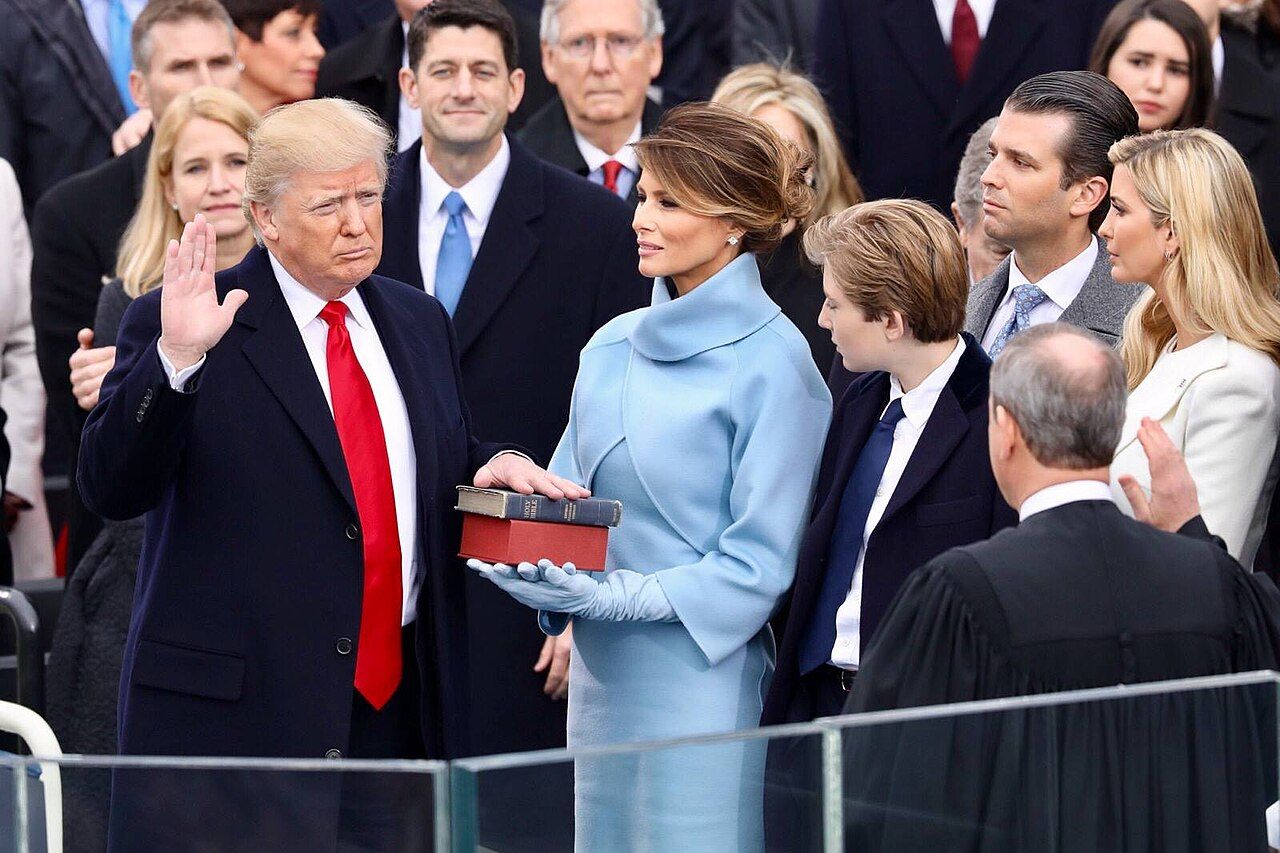






President Trump’s speech last Thursday on the 2020 election was most notable for what it did not contain: evidence that any malign activity affected the result. Much of what he described was already known. None of it showed that votes were changed, fraudulent ballots were counted, or the election was stolen. None of it showed that intelligence officials had concealed such evidence.

The White House released four separate datasets: on election infrastructure; on Chinese meddling; on a voter registration scheme in Michigan; and on noncitizens on voter rolls. In his speech, Trump linked them into a single narrative whose conclusion does not actually follow from any individual piece or collection of pieces:
China collected voter files → China ran influence operations → Some intelligence analysts disagreed → The intelligence community hid the truth → Voting systems were vulnerable → Michigan uncovered registration fraud → Noncitizens remained on voter rolls. Therefore, the election was stolen.
The bottom line is this: After years of investigations and multiple document releases—after years of searching for any scrap of evidence that suggests the 2020 election was stolen—the White House still hasn’t found it. The majority of Trump’s claims have been covered previously in the media. What follows is an inventory of each allegation Trump made in his speech and an analysis of what the supporting documents really show. We also explain how these allegations fit into this administration’s broader strategy of politicizing intelligence and the intelligence community.
What Allegations Did Trump Make in His Speech?
Trump’s speech and a section of the White House website on “election integrity” combined several substantially different allegations:
Election Infrastructure
- U.S. adversaries have the capability to compromise U.S. election infrastructure and could access election related data repositories to disrupt election processes.
- Intelligence agencies identified vulnerabilities in, or successful exploitation of, electronic voting technology used in foreign elections in Venezuela.
China and U.S. Voters
- China ran influence operations (“psychological operations”) targeting the American people.
- Chinese intelligence obtained information concerning as many as 220 million American voters across 16 states, including records from multiple state voter registration systems.
- Intelligence officials deliberately concealed the scope of China’s activity from the president and Congress for domestic political reasons, in a “deep state cover-up.”
Michigan Voter Registration
- A 2020 FBI investigation in Michigan uncovered an “industrial-scale” scheme to submit fraudulent voter registration applications carried out by Democrats in support of Biden that the bureau then slow-walked.
Voter Rolls
- A Department of Homeland Security investigation identified 190,000 noncitizens on voter rolls across 18 states.
The audience is invited to treat these separate allegations as mutually reinforcing evidence of a single stolen-election plot. But they do not corroborate one another. Evidence that China acquired voter data is not evidence that it altered registrations. Evidence that intelligence analysts disagreed about the goals of Chinese influence is not evidence that any intelligence was concealed, or that analysts believe the influence effort had meaningful impact. A vulnerability is not an intrusion; a fraudulent registration application is not a fraudulent vote.
The White House’s case depends on erasing those lines.
The Administration’s Politicization Playbook
Selective Declassification
This release is the latest example of a common practice in the second Trump administration of treating the intelligence community not as an instrument of the state but as an enemy within—its product useful only if it echoes and amplifies the president’s preferred narratives.
The playbook is now familiar. Reopen an old controversy. Selectively declassify emails, raw intelligence, and internal disagreements and post them under an inflammatory headline. Leave enough redacted that outsiders cannot fully evaluate the claim. Finally, accuse the analysts who reached a different conclusion of participating in a cover-up.
This administration has done this repeatedly. CIA Director John Ratcliffe reopened a decade-old assessment that Russia had interfered to help Trump in the 2016 election and denounced it in the press, even as the revised assessment did not change its conclusions. Director of National Intelligence (DNI) Tulsi Gabbard released documents on the origins of COVID-19, U.S.-funded biological research, and anomalous health incidents while attaching claims that often ran ahead of—or were contradicted by—the underlying material.
Cherry-picking intelligence is hardly new, but this administration's willingness to retaliate against the analysts themselves makes the practice even more insidious.
In May 2025, Gabbard fired two senior analysts whose assessment of Tren de Aragua undermined the administration’s litigation strategy. Three months later she revoked another 37 clearances, including one of the intelligence community’s leading Russia experts, citing “weaponization of intelligence.” Former CIA Director John Brennan was referred for criminal investigation over an assessment the administration sought to discredit.
The administration has also dismantled the primary institutional sources of expertise on foreign election interference, from the FBI’s Foreign Influence Task Force to the Office of the Director of National Intelligence’s (ODNI’s) Foreign Malign Influence Center to the Cybersecurity and Infrastructure Security Agency’s (CISA’s) election security mission. At least 21 senior ODNI analysts were sacked late last month—including the senior analysts for China and Russia.
Raw and Unverified Intelligence
This time around, with the intelligence community under sustained pressure, the administration has employed another tactic in its politicization campaign: one that focuses on the type of information it chooses to declassify.
Thursday’s release includes CIA products that appear purpose-built to substantiate the president’s allegations on China—most notably a summary of intelligence reporting from 2018 to 2020. The summary, declassified by the White House Counsel, offers no analytic judgments of its own. Its author and its publication date are redacted. This memo’s features are most consistent with a product tasked at the senior CIA or White House level and drafted outside the Directorate of Analysis, whose authorship the release’s comparable Venezuela report explicitly bears and which this summary conspicuously lacks. And the document contains exclusively reporting of Chinese interference and of Beijing’s intent to undermine Trump’s reelection.
That matters because Thursday’s speech—and the accompanying White House materials—repeatedly blur the distinction between raw reporting and finished intelligence. The administration treats the existence of an intelligence report as proof that the report’s underlying claim is true. But intelligence agencies collect enormous volumes of fragmentary information every day: intercepted communications, human-source reporting, imagery, technical data, rumors and second- or third-hand accounts. When that material first enters the system, it is “raw”; it has not necessarily been corroborated, contextualized, or assessed for reliability.
In other words, the mere existence of raw information cannot be taken as proof of its credibility. Yet a significant number of documents in Thursday’s release appear to consist of raw or lightly processed reporting. It’s difficult to say how many because the release also involves an enormous amount of redaction. That means the documents often provide too little information about sourcing, corroboration, or analytic context to evaluate the claims they contain. The White House nevertheless presents them as if their inclusion in government files settles the matter.
It does not. A raw report can justify further investigation. It cannot, without corroboration and analysis, establish that a foreign power interfered in the election, or that the election was stolen.
Assessing the Allegations
Is U.S. election infrastructure at risk?
Like other critical systems, U.S. election infrastructure contains vulnerabilities, and foreign adversaries have both the capability and the incentive to target it. But that general risk does not mean that an adversary exploited those vulnerabilities in 2020—much less that anyone altered votes or changed the outcome.
“Election infrastructure” covers several different systems. It includes voter registration databases, election management systems, electronic poll books, voting machines, tabulation equipment, election night reporting websites, and the ordinary government networks used by state and local officials. A compromise of one does not imply a compromise of the others. Hacking an election results website, for example, could create confusion without changing the certified count. Stealing voter registration data is not the same as modifying registrations.
There’s no evidence that China—or any other country—hacked U.S. election infrastructure or changed any votes. A National Intelligence Council memo written in January 2020 and declassified by then-DNI Gabbard in March of this year, did judge that U.S. adversaries had “the capability to compromise U.S. election infrastructure for the 2020 election,” and it judged centralized data repositories were vulnerable—but it didn’t judge that this capability had been exploited. Last week’s document drop includes a partially declassified CIA World Intelligence Review (WIRe) from July 2020, which details that China has attempted to target personal email accounts of senior U.S. leadership and target campaigns but assesses that “China does not currently intend to covertly interfere to try to sway the outcome of the election.”
A newly released CISA report, whose July 13, 2026, date indicates the document was created for this release, makes the same distinction. CISA, in partnership with Idaho National Laboratory, conducted direct technical assessments of election software between 2019 and 2024. CISA’s analysis confirmed that “election software, like any complex system, contains a spectrum of vulnerabilities” that could be exploited by a capable actor—but, crucially, the report indicates that “many vulnerabilities were remediated quickly by vendors before release.” For every vulnerability identified, CISA notified the product or network owner or operator and encouraged them to mitigate it.
Which of these vulnerabilities still exist today? With the Trump administration’s significant reduction in CISA’s election security activities and other federal government election protection efforts, the answer is unclear.
The White House therefore begins with a true proposition—American election systems face cyber risks—and invites an inferential leap: that those risks materialized into a successful attack. The documents show capability and vulnerability. They do not show exploitation, altered votes, or a changed result.
Did Venezuela hack U.S. voting machines?
No. The documents released on Thursday night include a CIA memo—dated June 29, 2026—summarizing intelligence community reporting, from 2004 to 2020, on “persistent concerns” about Venezuelan government manipulation of electronic voting systems. The intelligence community found that Venezuelan government officials “developed sustained interest and likely some capability in manipulating electronic voting systems, including Smartmatic technology, to influence electoral outcomes in Venezuela” (emphasis added).
This is not a finding that Venezuela hacked U.S. voting machines, or even tried. The intelligence explicitly concerns a potential plot by Venezuelan officials to influence electoral outcomes in their own country. And the CIA’s analysis hedges even on that narrower point: It states that the reporting “did not definitively confirm” that large-scale electronic fraud was ever successfully executed in Venezuela.
So why is Venezuela part of this conversation? One answer is that the country has long been at the center of conspiracy theories about the 2020 election—theories that reached a mass audience by way of Trump’s own legal team, who infamously alleged that Venezuela was part of a plot to steal the 2020 election during a Nov. 19, 2020, press conference. None of it held up, and nothing in the documents released on Thursday supports the wild theories propagated by Sidney Powell and Rudy Giuliani. But that may not matter to Trump and the most fervent 2020 election deniers; the implication is the point.
There is another reason why Trump may be inclined to implicate Venezuela in a plot to steal U.S. elections: The ousted former leader of Venezuela, Nicolas Maduro, now sits in U.S. custody at a detention facility in New York, where he awaits trial on criminal charges for drug trafficking and weapons offenses, among others. As one of us noted back in March, it’s not difficult to imagine a scenario in which Maduro tries to negotiate a deal with the Trump administration—perhaps one that could involve a “confession” regarding Venezuelan efforts to influence American elections in exchange for a lighter sentence.
Did China interfere in the 2020 election?
There is no evidence that China rigged or meaningfully interfered in the 2020 election. At most, the documents released after the speech add detail to a narrow and familiar story: China ran influence operations, produced propaganda to divide Americans, and gathered data on U.S. voters. But that is not the same as altering registrations, ballots, voting machines, or vote totals.
This is the unequivocal conclusion of a previously declassified 2020 Intelligence Community Assessment, drafted and approved by the first Trump administration’s own intelligence community led by then-DNI John Ratcliffe. That report’s key judgement read: “We have no indications that any foreign actor attempted to alter any technical aspect of the voting process in the 2020 US elections, including voter registration, casting ballots, vote tabulation, or reporting results.” Analysts did identify “compromises of state and local government networks prior to Election Day” but concluded they weren’t intended to alter election processes.
There is an important distinction between influence (attempts by foreign governments or their agents intended to directly or indirectly affect U.S. elections) and interference (a narrower set of activities that target technical aspects of those elections, such as casting, counting, and reporting votes). But the assessment found that neither occurred: “China did not deploy interference efforts and considered but did not deploy influence efforts intended to change the outcome of the U.S. presidential election.” To contend otherwise ignores not only the belief of the collective intelligence community but also all publicly available information on how China attempts to engage in foreign political disputes.
The China judgment was also issued in comparison with Russia’s much more explicit election operation. Russia used covert personas, hacked-and-leaked material, proxies, and influence infrastructure directed at changing the presidential outcome. China’s activity was more cautious, diffuse, and often attributable to state officials or state media, with much of it aimed at shaping U.S. policy toward Beijing rather than manipulating the mechanics of the election. That comparison helps explain why some analysts classified the same Chinese activity as general influence while others regarded it as low-level election influence.
There was also a “minority view” included in the 2020 Intelligence Community Assessment, supplemented in the latest document release by an “Alternative Threat Analysis” on China. These dissents gave greater “weight to indication that Beijing preferred former President Trump’s defeat” because of his unpredictability, and accordingly “took at least some steps” to undermine his chances “primarily through social media and official public statements and media.” China, in other words, did seek to influence the U.S. electorate through propaganda. But even the dissenters admitted “that we have no information suggesting that China tried to interfere with election processes.”
Did China access 220 million voter files?
The president touted declassified technical evidence that China had accessed voter registration data from multiple states. Voter files—which can contain personal information such as names, addresses, demographics, and phone, Social Security, and driver’s license numbers—may indeed prove useful to adversaries for identifying, profiling, targeting, intimidating, or impersonating American voters. There is no evidence that any of those activities occurred.
The files are also often commercially available, such that they can easily end up on the internet and accessible, without any hacking required. Multiple documents released Thursday confirm that China scraped or bought voter files from data brokers, as well as collected “likely leaked” data.
Here, too, the intelligence community had already declassified information about precisely this question: An April 2020 National Intelligence Council memo released in redacted form in October 2022 finds that “Chinese intelligence officials analyzed multiple U.S. states’ [REDACTED] election voter registration data [REDACTED] to conduct public opinion analysis on the 2020 U.S. general election.” China, the Intelligence Community Assessment concluded, likely leveraged this information “to predict electoral outcomes and to inform its efforts to influence US policy toward China under either election outcome, as it has during all election cycles since at least 2008.”
Importantly, the documents say that Chinese officials analyzed the data to conduct public opinion analysis. They don’t say that China used them to change any registration records, much less to transmit fake votes. This difference is fundamental: Unauthorized acquisition is a serious privacy violation that compromises the security and confidentiality of personal information. Election fraud would require the unauthorized alteration or use of that information to affect registrations, ballots, or votes.
Did China’s influence operations have an effect?
There is no evidence to suggest that they did. “Effort” doesn’t mean “effect.” China persistently runs full-spectrum influence efforts on both broadcast and social media, and has since the late 2010s. Public reporting by platforms and independent researchers has generally found that many Chinese covert social media campaigns attracted little authentic engagement and often resembled spam more than persuasive political movements. China has also used state media, diplomatic accounts, proxy sites, and other channels to shape opinion, but nothing in Thursday’s release measures their reach, changes in voter attitudes, or any effect on the result.
Was there a “cover-up” of 2020 Chinese election interference intelligence?
No. A previously released 2021 ombudsman’s review of the politicization of intelligence on foreign election threats requested by the Senate Intelligence Committee found inconsistent standards, resistance to alternative analysis, and attempts at politicization “from above and below.”
Specifically, the report noted a push-and-pull throughout the months leading up to the election between career analysts and some political appointees. The analysts believed the appointees were inflating the China threat in a “‘gross misrepresentation’ of established IC views”; the appointees believed the analysts were suppressing it. Those findings concern the integrity of the intelligence-production process. They do not establish that China compromised the election process or that there was a “deep state cover-up.”
The released documents detail some of these disagreements. Yet the result, for the most part, was that minority conclusions on China did make it into the Intelligence Community Assessment as well as separate analyses. The dispute may support a critique of how the intelligence community handled dissent. It does not support Trump’s claim that analysts concealed evidence of a stolen election, and the dissent itself contains no such evidence.
Was the Michigan election rigged?
No. The Michigan State Police did investigate claims of voter fraud beginning in October 2020, after a city clerk in Muskegon County alerted authorities to an estimated 6,000 voter registration applications from a single source—several hundred of which had “irregularities” such as addresses or birthdays that didn’t match the attached driver’s licenses. This was potential fraud in the production of voter registration applications, not evidence that fraudulent voters were registered or that fraudulent ballots were cast.
Almost three years later, conservative outlets and activists obtained police reports from the resulting investigation via Freedom of Information Act requests. The documents revealed that a canvasser for the Democratic Party-aligned get-out-the-vote organization GBI Strategies dropped off the forms. Gateway Pundit, billing this report as a blockbuster expose of a rigged election, declared in a headline, “NOW WE HAVE PROOF!”
Not so much. State authorities acknowledged the probe at the time. They also confirmed that the flawed registrations were voided before the election. Authorities did discover that some of the flagged applications were “clearly fraudulent” or “highly suspicious.” But the agencies determined that any fraud “occurred at the lowest levels,” by employees of GBI against the company “to fabricate work product … and not in explicit pursuit of defrauding the election infrastructure of the state.”
Michigan referred the matter to the FBI in 2021; the documents released last night relate to the resulting federal investigation. The new files add detail about how the applications may have been fabricated, but they do not connect that misconduct to successful registrations or votes. Importantly, nowhere does any of the new information suggest that any false applications resulted in successful registrations, much less in votes cast.
The declassified documents show that the federal government formally declined the case by November 2021. A line agent disputed the closure decision months later in early 2022. A full grand jury investigation was authorized in 2023, its scope limited to apparently fabricated applications. The most recent witness interview included in the release took place in the summer of 2025; no charges have been brought. Pam Bondi and Todd Blanche at the Department of Justice and Kash Patel at the FBI have had more than a year to discover something more nefarious in the matter—during which the Michigan GOP directly requested further investigation. They haven’t found it.
The events in Michigan actually aren’t an example of the system failing: They’re an example of the system working. There was real fraud in voter registration applications, and it was extensively investigated at the local, state, and federal levels—allowing Michigan to ensure the efforts didn’t affect the election, as well as providing the opportunity for law enforcement to have discovered any large-scale partisan plot if one did exist.
What did Trump’s document release say about noncitizens on voter rolls?
One of the four batches of documents released was used to support a claim of noncitizen registered voters. Of the two documents within this batch, only one, a Department of Homeland Security one-pager, includes information about noncitizen registration.
That document is a Department of Homeland Security release asserting that it identified through public voter files 250,000 noncitizens registered to vote in four states (California, Pennsylvania, New Jersey, and Nevada). The release also says that Department of Homeland Security coordination in 25 states has identified 28,000 noncitizens illegally registered to vote and 400,000 deceased registrants. The Department of Homeland Security explains the difference in scale between the two groups by noting that states “that have adopted alien-first policies … have a disproportionate number of non-citizens on their voter rolls.” Notably, neither of the documents provides evidence or even claims that any of these noncitizens actually voted in an election.
Judge Sparkle Sooknanan of the U.S. District Court for the District of Columbia ruled last month that the administration’s overhaul of the system to allow states to verify voters’ citizenship status violated three different statutes. One of her reasons was the database’s established inaccuracy. The Department of Homeland Security’s own tutorial on the SAVE database clarifies that “SAVE also cannot verify U.S. citizenship using only name and date of birth.” The 250,000 noncitizens number came from public voter files from four states that do not provide driver’s license numbers or Social Security numbers, though in some cases they may include addresses.
A database produced in 2017 by the Heritage Foundation that reviewed billions of votes cast over half a century turned up only 41 instances of noncitizens registering, voting, or attempting to vote.
What Happens Now?
President Trump stopped short of many democracy advocates’ worst fears on Thursday night. He did not issue an executive order declaring a national emergency. He didn’t seek to decertify voting machines, or enact the SAVE America Act unilaterally—opting to call on Congress to pass it instead. And he also didn’t release much that was new in the way of intelligence; most of the featured claims had already earned enough public attention to be thoroughly debunked.
The speech was, in short, political theater. But political theater can have real consequences.
The president’s demand that the intelligence community investigate the “why and how” of a cover-up that never actually occurred means that every analyst who touched the election influence assessments is now on notice. The White House may escalate its purges of nonpartisan staff from these agencies, and it has also sent the message that current employees dare not dissent. That’s troubling, considering more declassifications—potentially of documents yet to be drafted—may still come. The broader cost will be measured in warnings never delivered, options never presented, and decisions made in the dark.
The president also said he would be “working with those states and local jurisdictions to help them fix” the vulnerabilities he claimed to be identifying; the following day, Homeland Security Secretary Markwayne Mullin threatened top election officials who didn’t run their voter rolls through SAVE with criminal charges (odd, coming from the Department of Homeland Security) and also threatened to withhold grants from those who don’t “scrub” their voting machines.
These moves will certainly invite litigation, and so will any others the White House may take related to Thursday’s “revelations.” Yet regardless of whether the administration manages to strong-arm states into enacting any of its reforms before November—or ever—these declassifications and the accompanying demands may lay the groundwork for alleging foreign interference or fraud on or after Election Day as justification for federal intervention. Last week’s messaging may also simply be targeted at fomenting doubt and discord that could prove dangerous during a contested election.
Thursday’s speech was ostensibly about 2020. Its real significance may lie in what it prepares the public to accept in 2026.
.jpg?sfvrsn=407c2736_6)