Tulsi Gabbard’s Fauci Files Don’t Prove What She Says They Prove
.jpg?sfvrsn=2f856ee3_5)
In her final act as director of national intelligence, Tulsi Gabbard released a collection of declassified documents about COVID-19’s origins and Dr. Anthony Fauci. The headline claim was explosive: “Fauci Funded Wuhan Lab Research That Sparked COVID.” Her press release and accompanying five-minute-long video monologue went further, accusing Fauci of manipulating intelligence assessments and lying to Congress.
But the documents don’t show anything of the sort.
The origins of COVID-19 remain uncertain. A lab-associated incident is plausible; so is natural spillover. China’s obstruction has made the truth harder to establish, and scientific opinions vary. There are legitimate questions to ask, in general, about biosafety and U.S.-funded research abroad. But Gabbard isn’t asking those questions. Her press release implies that the debate is over—that the definitive answer is a lab leak—and then uses the assumed conclusion as the foundation for a far more sweeping allegation: that Fauci “sparked COVID” and covered it up.
Gabbard’s “Fauci Files" follow the same playbook as her past document drops: Put the desired conclusion in the headline. Use “declassification” as a credibility signal. Present a large, mixed dump of documents as if they were a prosecutor’s exhibit. Convert ordinary government processes—expert consultation, grant oversight, whistleblower routing, intelligence disagreement—into evidence of conspiracy. Then push the accusation on social media, where few people will read the underlying documents closely enough to notice the gulf between the documents and the claims.
Gabbard played this game of innuendo and accusation with her so-called Russiagate declassifications, accusing President Obama of a "treasonous conspiracy” and “coup” (he has yet to be charged). A few weeks ago she followed the playbook with a document dump on biolabs, reframing biological threat reduction work, much of which was already public, as nefarious. In each case, the underlying materials contain some facts, but they are often decontextualized, and the framing asks readers to take a much larger conspiratorial leap.
In her final drop, Gabbard makes four specific assertions: First, that Fauci funded dangerous gain-of-function research at the Wuhan Institute of Virology that “sparked COVID.” Second, that he manipulated intelligence assessments to conceal his role. Third, that he lied to Congress. Fourth, that he used a “deep state playbook” of “lies, disinformation, and censorship” to punish or marginalize dissent.
These are not small claims. They are accusations of grave misconduct by a named public official. So the question is simple: Do Gabbard’s documents prove them?
Let’s take the allegations claim by claim, with references to specific documents in the drop that the reader can go and examine for themselves.
Did Fauci Fund Gain-of-Function Research That “Sparked COVID”?
It is now well established that U.S. money flowed through EcoHealth Alliance, a nonprofit that studied emerging infectious diseases, to coronavirus research involving the Wuhan Institute of Virology (WIV). It is also true that there has been intense public debate over whether some of that work should be described as gain-of-function research (a broad term for experiments in which a virus or pathogen is altered to become more potent, virulent, or infectious for the purpose of studying risk or develop countermeasures).
But the existence of U.S.-funded coronavirus research at or involving WIV does not establish that U.S.-funded work created SARS-CoV-2, produced its progenitor, or caused the pandemic. The National Institutes of Health (NIH) has explicitly denied that viruses studied under the research it funded could have evolved into SARS-CoV-2.
Nothing in Gabbard’s documents supplies the missing causal link; even media outlets friendly to the release pointed out that much of the content had been in the public record for years. The documents contain grant materials, scientific papers, intelligence discussions, congressional correspondence, press clips, and whistleblower-related materials. They do not contain an intelligence assessment concluding that Fauci-funded research “sparked COVID.” They do not identify an NIH-funded virus that became SARS-CoV-2. They do not establish that EcoHealth-funded work at WIV caused the pandemic. Nothing in them establishes Gabbard’s banner claim.
Gabbard also claims that Fauci funded coronavirus research “linked to big pharma and the pursuit of ‘universal vaccines’ worth trillions of dollars.” But the released materials do not substantiate that motive assertion. They do not show Fauci acting on behalf of pharmaceutical companies, holding vaccine patents, or helping anyone make money. Mentions of vaccines in the documents primarily concern ordinary infectious-disease research and, in one case, EcoHealth’s interest in developing a vaccine for bats.
“Linked to” is doing heavy lifting. The phrase is often used to insinuate an association that a claimant can’t assert outright; anything tangentially related to anything else can be said to be “linked to” it. Here, the phrase lets Gabbard imply corruption without having to clarify who benefited, what decision Fauci made for that purpose, or how any of it connects to the origin of SARS-CoV-2.
The documents support a narrow and long-established predicate: U.S. funding touched coronavirus research involving WIV. They do not support the accusation built on top of it: that Fauci funded research that caused COVID.
Did Fauci Manipulate Intelligence Assessments?
Gabbard’s second major claim is that Fauci pushed the intelligence community (IC) “to endorse a natural, animal origin to hide his dangerous research.” In her telling, Fauci “hand-picked [National Institute of Allergy and Infectious Diseases]-funded scientists” to advise the IC. She alleges the existence of emails showing that it “almost always” incorporated Fauci’s recommendations and ignored “experts who might dissent from Fauci’s narratives”; Fauci’s purportedly manipulative behavior shaped the official assessments that were then publicly cited as scientific consensus to dismiss the lab-leak theory.
That is a serious accusation. Her documents once again don’t prove it.
What they show is narrow: Fauci participated in a February 2020 expert meeting about data needs for assessing the virus’s origins; he received a documented June 2021 intelligence briefing on COVID origins; and he recommended scientists the IC might consult. The documents do not show him steering an intelligence assessment. During a pandemic, intelligence agencies would naturally consult leading infectious-disease experts and virologists. Fauci was the head of the National Institute of Allergy and Infectious Diseases and a senior adviser in the Trump administration’s COVID response. His presence in the conversation was a predictable result of his job.
To support her claim, Gabbard declassified a readout from a June 4, 2021, virtual briefing (Doc 7/47) in which CIA and other officials presented COVID-origins analysis to Fauci. The notes show that Fauci expressed concern that Beijing’s rapid cleanup of the Huanan seafood market could have destroyed key evidence. He asked about WIV research involving pangolins, discussed reports of sick WIV researchers, pointed to a paper he thought supported natural origins, and recommended scientists whose views he believed the IC should consider.
But a subsequent July 14 internal email (Doc 6) shows analysts treating the recommendations with caution. One official questioned “whether to take a policymaker’s recommendations on who we should consult as part of an IC study—particularly given the various strong views on the subject and statements regarding their own conclusions.” Another email chain (Doc 25) about possible reviewers for the origins assessment paper is even more damaging for Gabbard’s story: It shows that officials considered Fauci as a possible outsider reviewer but rejected him because he would be seen as conflicted.
In other words, the record shows the IC keeping Fauci at arm’s length where the formal origins assessment is concerned.
Gabbard’s release also includes a transcript of Sen. Rand Paul (R-Ky.) talking to Fox News anchor Maria Bartiromo. Paul alleges that Fauci was visiting the CIA in early 2020 and implies that Fauci got CIA superiors to overrule CIA scientists in their COVID origins assessment (Doc 10/45). But the internal CIA email addressing the allegation says that the relevant office had “no record of Dr. Fauci coming to CIA headquarters to discuss the origins of COVID-19” (Doc 44). The same email describes Fauci’s involvement as consisting of the June 2021 virtual briefing where—in the CIA official’s words—he “offered thoughts” and “recommended contacting a group of US scientists … including some the office had already met with or planned to meet with.” (The documents also show Paul fundraising on a “FIRE FAUCI” message.)
So the document Gabbard uses to suggest secret influence says the opposite: no record of a CIA headquarters visit, no evidence of an early-2020 Fauci pressure campaign, and no indication that his recommendations controlled the analysis. The inclusion of several documents is frankly baffling; they make one wonder whether Gabbard actually read them, because they so thoroughly undermine her.
The documents show IC officials acknowledging uncertainty, debating the evidence, and consulting experts across the spectrum. After a contentious 2021 briefing with the House Permanent Select Committee on Intelligence (HPSCI), one official from the Office of the Director of National Intelligence (ODNI) wrote that Republican lawmakers accused the IC of ignoring lab-leak-friendly experts and rattled off names they believed had been excluded. The official’s declassified internal readout was blunt: “It’s actually kind of laughable, because every expert they named was consulted by the IC” (Doc 46).
This directly contradicts Gabbard: Her documents reveal that the IC actively consulted experts with views opposing Fauci’s, even though they refused to disclose their names publicly.
One of the most revealing documents in the packet is not from 2020 but from 2026. In a March 2026 forward of a 2020 email thread, the sender adds an editorial gloss: “The IC took direction straight from NIH” (Doc 26/56). But the thread shows diligent analysts weighing competing technical claims, asking for evidence, consulting experts, and warning against building an intelligence assessment on a single thin report. There is no indication that they were taking orders from the NIH at all.
Did Fauci Lie to Congress?
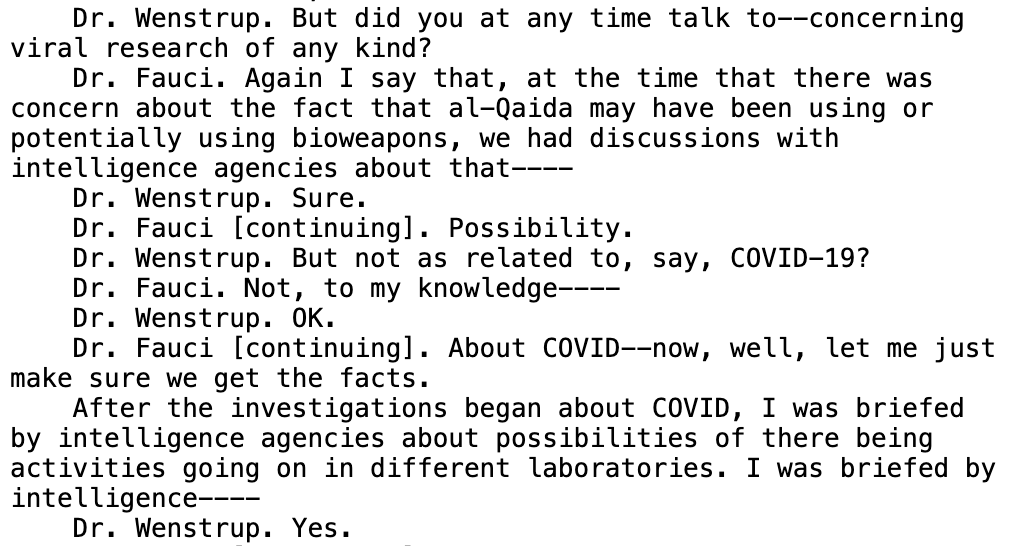
Gabbard claims that her documents directly contradict Fauci’s June 2024 testimony to the House Select Subcommittee on the Coronavirus Pandemic. In that hearing, Gabbard states that Fauci was asked whether he spoke to “FBI, CIA, DIA or any U.S. intelligence agency concerning viral research” before, during, or after the pandemic. Fauci “repeatedly dodged” the questions, she claims, “before falsely stating, ‘not to my knowledge about COVID.’”
But the transcript of that hearing shows that Gabbard is misrepresenting the statement.
In the exchange, the very next words Fauci says are a clarification to the comment Gabbard quotes: “let me just make sure we get the facts,” he says, before explaining that after COVID investigations began, he was briefed by intelligence agencies about possible laboratory activity. Later in the same hearing, Rep. James Comer (R-Ky.) said that Fauci testified that he “never had any communication with the intelligence community throughout all of COVID”—and Fauci promptly answered, “No, you heard wrong.”
Gabbard references a whistleblower complaint asserting perjury—but that complaint concerned a dispute over whether the NIH-funded Wuhan Institute of Virology work met the definition of gain-of-function research. It did not have anything to do with the exchange about Fauci’s contacts with IC officials.
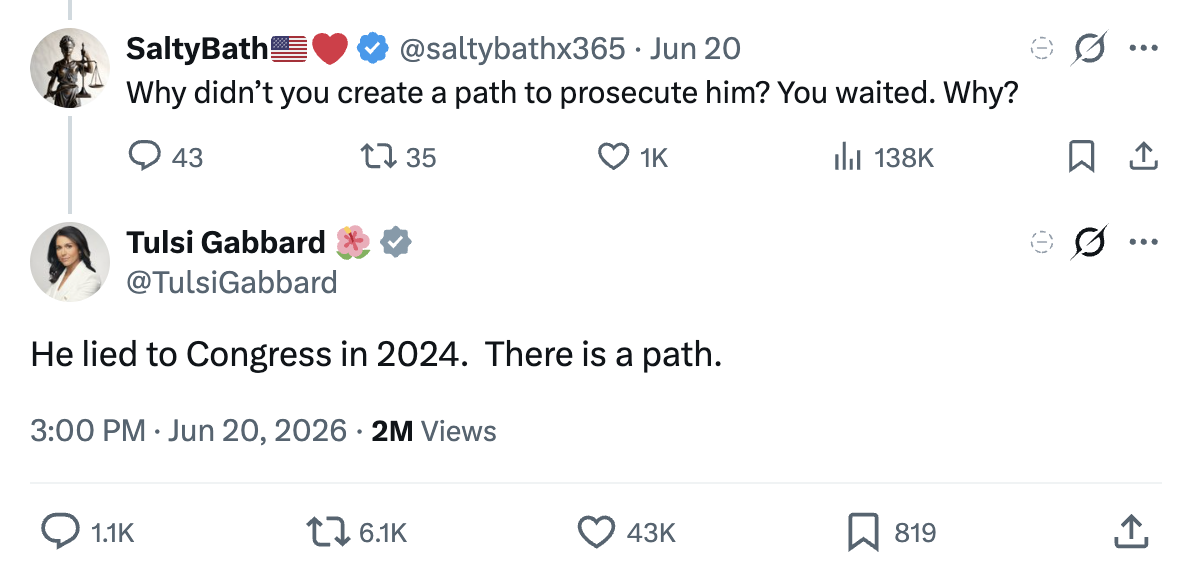
After releasing her Files, Gabbard alleged on X that there is “a path” to prosecution. That is an extraordinary thing for a former DNI to suggest on the basis of this record. Fauci acknowledged contact with intelligence officials in the exchange Gabbard cites. What he disputed was whether he had spoken with them about viral research in the way the question implied. That distinction is inconvenient for Gabbard’s narrative, but it is exactly the kind of distinction a perjury allegation turns on.
Did Fauci Use a “Deep State Playbook” of “Lies, Disinformation, and Censorship” to Suppress Dissent?
Gabbard’s final claim folds the Fauci allegations into a broader story about “lies, disinformation, and censorship.” She says Fauci leveraged “close IC relationships” to “shield him from scrutiny” and wield “outsized influence.” She states that those who challenged Fauci’s conclusions, or supported the lab-leak hypothesis, faced retaliation or marginalization: “The message was clear: disagreement with the manipulated finding would derail careers.” Gabbard also claims a contractor was terminated after coming forward to the ODNI as a whistleblower.
The documents do not show that.
Fauci was not shielded from scrutiny. He testified repeatedly before Congress. He was questioned aggressively by lawmakers. He was covered relentlessly by the press. Whatever one thinks of his pandemic-era statements or decisions, he was one of the most scrutinized public officials in the country.
The “outsized influence” assessment is not borne out either. As discussed above, the documents show Fauci receiving briefings, offering views, and recommending experts. They do not show him directing analysts, suppressing dissenting views, or dictating intelligence conclusions.
The whistleblower material is also thinner than Gabbard suggests. One complaint alleged Fauci provided false information to Congress about gain-of-function research. The IC discussed referring the complaint to the secretary of health and human services because Fauci was not an IC employee and the allegation was unrelated to intelligence activity (Doc 32). Another purported whistleblower allegation made to Congress, mentioned by a briefer in the Files, claimed that the CIA paid its analysts to not make the lab leak call (Doc 46). But the record Gabbard released includes an immediate alternative explanation: The assessment had been delayed because new information arrived the day before publication, not because analysts were paid off.
As to the allegation that lab-leak proponents faced retaliation: There was no document in the trove to support a whistleblower being subsequently terminated, so we must take Gabbard’s word for that. The clearest “firing” reference in the documents points in the opposite direction. After the contentious HPSCI Hill briefing, the ODNI briefer wrote, “I would expect the DNI to receive angry letters from the Hill calling my professionalism into question and demanding that the IC name names. And maybe that I be fired” (Doc 46). That concern was not about retaliation by Fauci or natural-origin advocates. It was about pressure from Republican lawmakers.
The documents do not reveal a deep-state playbook. When actually read, they show Gabbard’s playbook.
Declassification as Political Theater
Gabbard’s method is to take a real controversy, select documents that can be vaguely mapped to existing suspicions, and present the corpus as proof of a grand conspiracy. But the real work happens before readers ever reach the documents. Social media posts tell them what to believe; dramatic video monologues tell them who the villain is. The scale of the document dump—67 items across 391 pages—creates an impression of overwhelming evidence while making it less likely that anyone will actually read it. This trove is padded with filler—a PR Newswire release by Robert F. Kennedy Jr. and Children’s Health Defense, for example (Doc 4). It takes hours to read it all.
This playbook matters beyond Fauci. This is an official government release accusing a named person of specific crimes (perjury, intelligence manipulation, participation in a cover-up), on the basis of documents that are materially weaker than the accusation. Gabbard leaps from “some evidence supports a lab-associated origin” to “Fauci caused COVID and manipulated the intelligence community into covering it up,” and those are not remotely the same claim.
Selective declassification to shape a narrative is not new. What stands out, however, is the brazenness of Gabbard’s performance: the official custodian of the nation's intelligence secrets, using the authority of that office to stamp a political conclusion onto a controlled release of documents that don’t establish it.
The documents are interesting. People should read them. They provide a revealing look at the government’s internal debate over natural versus lab origins. But they are also a case study in how declassification can be turned into political theater when the conclusion is predetermined, and documents are made to serve it. And they will stand as a historical record of the dishonesty of America’s recently departed director of national intelligence.
The public deserves the truth about COVID’s origins. It also deserves better than a government official using declassification as a weapon.