Laundering Federal Election Interference in the Midterms
The administration has turned an unfixable fact—Chinese parts in nearly every U.S. voting machine—into a license to contest any election it loses.
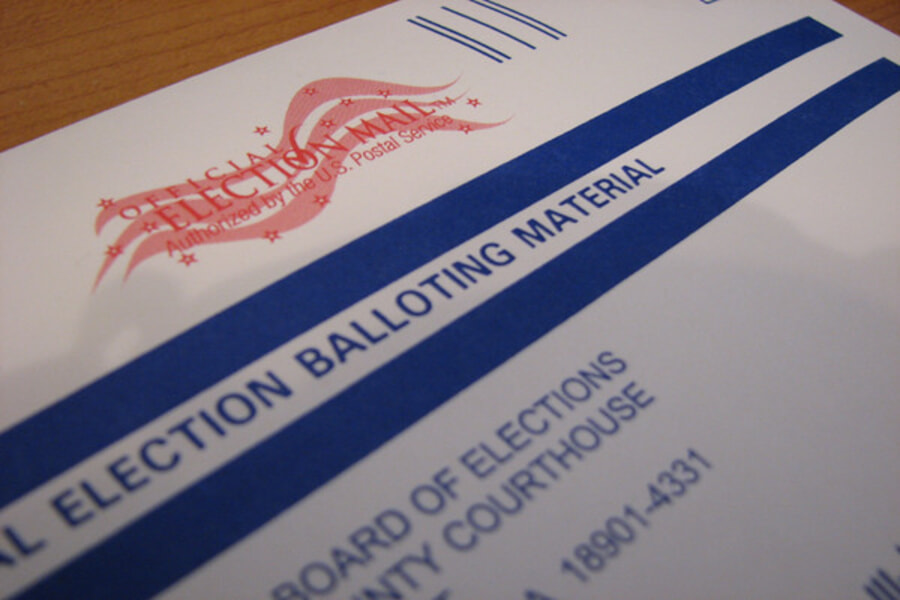

LANSING, MICHIGAN — NOV. 3, 11:40 pm
The Department of Homeland Security (DHS) posts a statement to its website at 9:15 pm—while polls in the Upper Peninsula are still open. DHS announces it has “identified Chinese-manufactured components” in tabulation equipment in four Michigan counties, and the department “cannot verify the accuracy of the results those machines produce.” The department cites no intrusion, exploit, or altered vote. Nearly all voting machines in the U.S. contain Chinese-made parts.
Press reports have dripped out all day. A federal citizenship database has flagged thousands of allegedly incorrect registrations. New envelope rules were issued for mail-in ballots after the ballots had been printed and were blocked by a court after they were mailed—but clerks are still rejecting envelopes under the invalidated rules. Republican House and Senate candidates lead narrowly in the in-person count, with 100,000 mail-in ballots still uncounted.
At 11:40 pm, President Trump demands that counting stop “until every machine is audited.” Michigan Governor Gretchen Whitmer receives a letter from the administration warning that certifying results from “compromised” equipment could draw a Justice Department investigation.
An election over who controls Congress is thrown into chaos, its legitimacy permanently marred.
* * *
None of this has happened (yet). But the scenario is based on actions the federal government has taken over the past six weeks, laying the groundwork for potential federal interference in the upcoming midterm elections.
In July, after the president’s speech alleging foreign interference in the 2020 election, several of my Lawfare colleagues and I warned that the administration’s selective declassifications could “lay the groundwork for alleging foreign interference or fraud” before or after Election Day 2026.
Then, on Aug. 24, Homeland Security Secretary Markwayne Mullin sent a letter to the White House Transparency Task Force warning that voting machines containing Chinese-manufactured components pose "significant security risks." The letter concedes that no evidence exists of any vote being compromised. But it places conditions on more than $1 billion in grants—requiring post-election audits, for example—that give DHS leverage over how states run their midterm elections.
DHS's Warning Has a Kernel of Truth
The claim at the center of the DHS memo is true: Voting machines in the U.S. contain Chinese-made components. A 2019 supply-chain study documented that fact, and all the major election equipment vendors acknowledged their use before Congress in January 2020. What’s new is the way that fact is being deployed:
Any unwelcome result can be attributed to Beijing.
Mullin’s Aug. 24 letter claims that three voting machine companies that account for more than 80 percent of the U.S. voting-machine market use Chinese-manufactured components. Some of those parts cannot be sourced domestically, and, in theory, a tampered component might allow hackers to change vote counts. Mullin’s letter bases the risk of foreign tampering on a 2024 intelligence community assessment, which names China as the most active and persistent cyber threat to the U.S.
The 2024 intelligence community memo continually points to the potential of compromised systems but provides no evidence of actual exploitation. As my coauthors and I wrote after Trump’s election speech in July: a vulnerability is not an intrusion, and an intrusion is not an altered vote. The 2020 Intelligence Community Assessment—produced under then-Director of National Intelligence John Ratcliffe—found no indications that any foreign actor had tried to alter any technical aspect of the voting process. Trump’s July release of documents included a report from the Cybersecurity and Infrastructure Security Agency (CISA), which confirmed that CISA and the Idaho National Laboratory conducted tests on the election software from 2019 to 2024 and flagged vulnerabilities to vendors, who subsequently fixed them. The government has already investigated these machines and shown the results.
Chinese suppliers provide about 20 percent of voting machine components, according to a supply chain study—as they do for most electronics Americans use, such as laptops, phones, cars, medical devices, and defense hardware. This is a consequence of global manufacturing, as the vendors testified. The presence of these components shows nothing beyond that the machines were manufactured in the last two decades. The vendors have acknowledged that this vulnerability is real and cannot be remedied, but it was equally true in the elections the president won.
Mullin’s accusation about Chinese components in election systems adds to DHS’s broader campaign to use federal election assistance to inhibit voting. DHS announced in August that funding from the Homeland Security Grant Program will be tied to states agreeing to hand-count at least 5 percent of paper ballots, abandon barcode tabulation, and verify voter citizenship through its Systematic Alien Verification for Entitlements (SAVE) database. In July, the Justice Department warned that officials who knowingly keep noncitizens on their voter rolls could face criminal liability, and Mullin declared he would prosecute state officials who decline to run their rolls through SAVE. DHS also has plans, according to internal guidance obtained by CNN, to surge voter fraud investigations in nine states from early September through mid-October.
The Playbook: From Declassification to Interference
The supply chain for voting machines has not meaningfully changed since 2020, but the institutions that protect U.S. elections have been gutted or dismantled, namely CISA’s election security mission, the Office of the Director of National Intelligence’s Foreign Malign Influence Center, and the FBI’s Foreign Influence Task Force. If the White House were genuinely worried about voting machine vulnerabilities, it would pay to replace the machines. It has done the opposite. With the election just weeks away, the administration is laying the groundwork to treat favorable results as correct and unfavorable ones as evidence of a stolen election.
The politicization playbook has four moves:
The Predicate
First, the administration will use official documents, including declassified intelligence assessments and the DHS letterhead, to claim the underlying vulnerability constitutes an ongoing threat. Why the alleged manipulation hurts the president’s party and only helps his opponents will go unexplained. It will not attempt to prove that any votes were changed. No such evidence exists, but the accusation itself is the point, and the alleged machine vulnerability cannot be remediated before Election Day.
No amount of auditing, and no use of the SAVE database, can prove the negative that no fraud occurred. In place of evidence, the administration will borrow the credibility of the CIA, DHS, and FBI to declare that specific counties’ voting machines have been “compromised.” The right-wing media ecosystem has already kicked into gear, claiming the DHS memo confirms that previous elections were stolen.
Increase Friction
Second, adding measures such as citizenship checks, envelope standards, audits, and hand counts—each defensible in isolation—raises the cost of voting and lowers turnout. Women who change their names and immigrants with nonanglophone names are more likely to trigger mismatches in federal databases, and DHS has admitted it cannot verify citizenship with a name and date of birth alone. Changes to envelope rules after printing deadlines have passed could result in rejected ballots among voters with limited transportation, unstable housing, and inflexible schedules, many of whom are concentrated in poor areas.
Cement the Narrative
Third, the administration will characterize friction during step two as fraud. A rejected ballot can be cast as a suspicious ballot, a database mismatch declared an illegal voter, and the ordinary rhythm of counting—election day ballots first, mail-in ballots later—a manufactured “shift.” Positive results will be declared correct; negative results, evidence of a stolen election. In Michigan, a local clerk caught the 2020 Muskegon registration fraud, which was voided before the election and investigated at every level. None of that stopped the incident from being repackaged by the White House as proof of the fraud the investigation had disproved.
Influence Outcomes
Fourth, the administration has built federal tools to delegitimize or block unwelcome results. In 2020, outsiders engaged in mass ballot challenges, certification delays, and pressure on county officials. Now they have a partner in the federal government. A state that certifies results from “compromised” machines risks its federal funding. A local official who declines a DHS database check risks federal investigation—from a department that does not have a history of investigating election crimes—along with legal bills and harassment from online mobs. Resistance itself becomes more evidence of the conspiracy. A long-standing Justice Department policy discourages overt investigative steps before an election, as doing so “runs the risk of chilling legitimate voting and campaign activities.” The first Trump administration rescinded this policy but largely observed it. But DHS is not bound by the policy, which means an election crimes investigation is being run out of a department with no legal mandate or restraints against politicization.
The executive also lacks the authority: Article I, Section 4 leaves congressional elections to Congress and the states. DHS has no statutory role as an election regulator. A judge has held the SAVE overhaul unlawful, and the Postal Service’s envelope rules have been stayed. But rules blocked after printing deadlines have passed will already have sown confusion that supports the narrative.
The federal government has been minimally involved in election administration in the past. The Help America Vote Act in 2002 built an entire agency for it. But for two decades, federal election security meant services offered to states: testing, threat briefings, grants without strings. Today, the Trump administration has inverted this apparatus’ purpose: limiting voting by the wrong people and punishing the authorities who help them.
Fighting Back
The defenses are unglamorous, and the states cannot mount them alone. The pro-democracy coalition—litigators, researchers, funders, and the groups that back election officials—should consider the following steps.
Fill the Federal Vacuum
The Brennan Center recommends that civil society, businesses, and state governments replace the threat briefings, cybersecurity assessments, and incident response that CIA previously provided.
Document the Pressure
Democracy organizations have begun to track federal requests to county offices for voter data. Taking proactive steps will be more effective than needing to subpoena such records after November.
Preposition Lawyers
Assigning legal counsel to the states and equipping them with election interference handbooks will help prepare local officials to resist federal demands for data. Providing legal support for election workers and local officials will also give them more confidence that they can resist threats of prosecution.
Litigate Fast
Last-minute changes in procedures by the federal government should be litigated rapidly, following best practices from advocacy organizations like Democracy Forward’s Democracy 2025 hub. Blocking new restrictions before ballot printing begins is essential to avoid confusion in local offices and to allow time to educate the public.
Prebunk the Count
Messaging similar to States United’s playbook can help explain count timelines and the blue shift. Delivering these warnings before Election Day helps negate accusations of a manufactured “shift.”
In July, we closed by noting that the most important part of the president’s election speech was not what he alleged, but what it was preparing the public to accept in 2026. As Peter Pomerantsev wrote in "Nothing Is True and Everything Is Possible”, the manipulation of facts prepares the public to accept that it can never disprove the regime’s latest conspiracy. If the public can never know what is true, even about its own electoral system, it might as well accept what it is told about who gets to vote and who ultimately gets to rule.
.jpg?sfvrsn=407c2736_6)