
The Visual Performance of Precision Lethality on Social Media
How precision strikes became visual performances—and why that matters for law, legitimacy, and civilian harm.
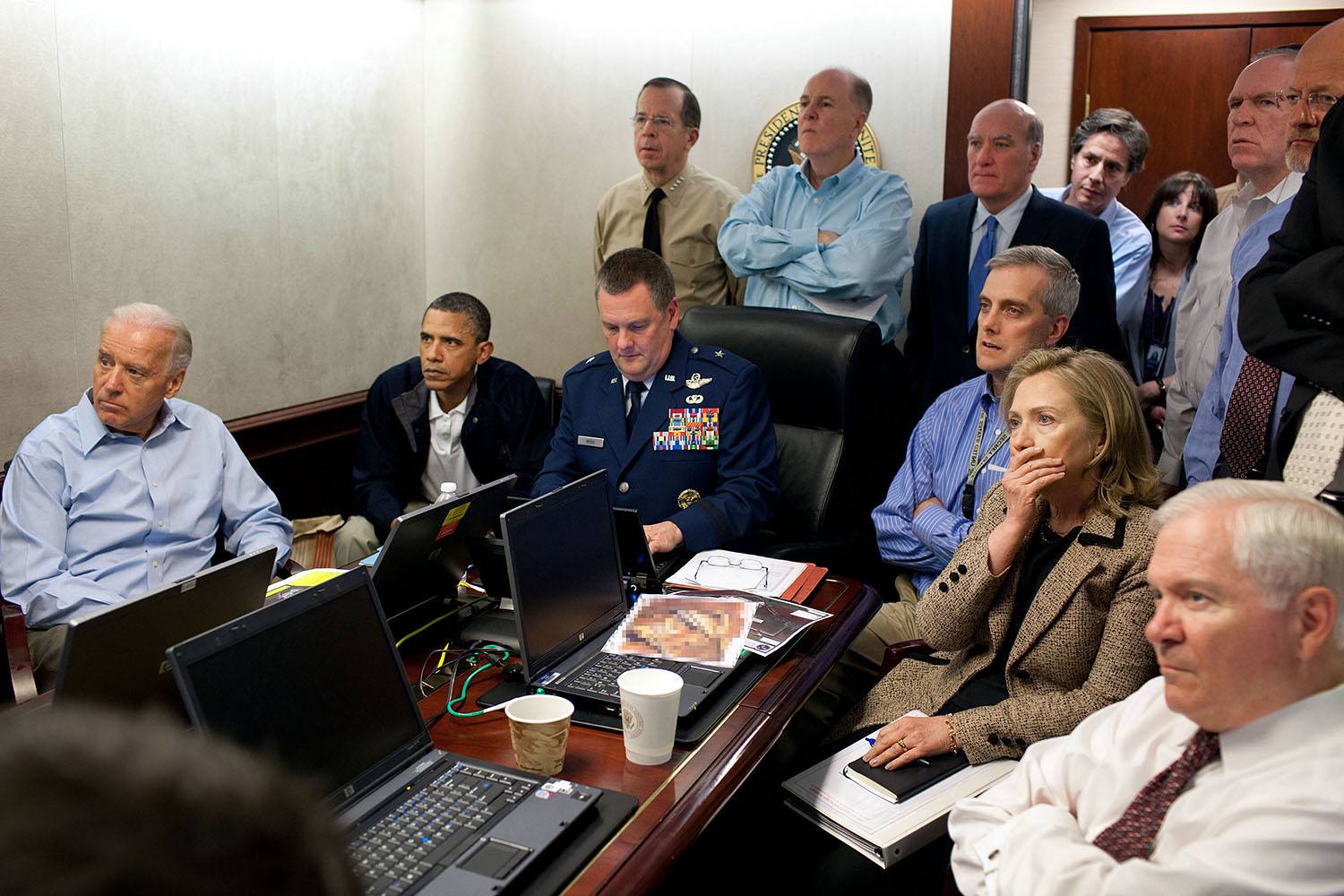

Precision warfare today is defined not only by what happens during a strike, but by how that act is seen, framed, and circulated. Over the past two decades, the United States has developed a visual language—gun-camera footage, Situation Room photographs, and eyewitness social media posts—to present targeted killing as restrained, lawful, and morally controlled, turning attacks into political performances as well as military actions. These representations are not ancillary but constitutive: They shape public expectations about how war should be fought, constrain political and military decision-making, and legitimize further uses of force. While this “precision cycle” has at times advanced civilian harm mitigation, it also risks hollowing precision into performance—allowing visual credibility to stand in for legal, strategic, and ethical judgment.
Bush: Frontier Justice and “Dead or Alive”
Shortly after 9/11, when asked how his administration intended to deal with Osama bin Laden, George W. Bush replied: “I want justice … there’s an old poster out West, as I recall, that said ‘Wanted: dead or alive.’” In one line he fused the necropolitical language of sovereign authority—the right to kill in the name of justice—with the frontier myth of American violence as righteous and necessary. While Bush never got his man, five years into the “war on terror” he revived the idiom in announcing the killing of Abu Musab al-Zarqawi, the leader of al-Qaeda in Iraq. At a specially convened Rose Garden event in June 2006, Bush declared that special operations forces had “delivered justice to the most wanted terrorist in Iraq.” The justice in question came from two 500-pound, laser-guided bombs dropped by F-16s, their moment of impact viewed through the crosshair displayed on gun-camera footage released to accompany the announcement.
The footage was not simply proof of success. It drew on a visual grammar of precision that stretched back to propaganda films shot through the Norden bombsight during World War II, and later to the 1991 Gulf War’s carefully edited “smart bomb” tapes—montages curated to give their audience the impression that the entire campaign had been conducted with surgical accuracy and restraint, even though precision-guided munitions made up only a small fraction of weapons used, and Iraqi civilians suffered greatly from the destruction of dual-use infrastructure. Alongside the crosshair’s communication of accuracy, the elevated viewpoint, flattened thermal imagery, and absence of bodies in such footage created what John Armitage termed “the aesthetics of disappearance”: violence without blood, death without the dead.
In the Zarqawi case, however, the administration did not fully embrace disappearance. Lacking official social media accounts at the time, the Pentagon staged a traditional press conference featuring an enormous still image of Zarqawi from an al-Qaeda propaganda video, opposite an equally large photograph of his corpse lying atop a pool of congealed blood—a literal before-and-after echo of Bush’s “Wanted: dead or alive” line. Time magazine extended the imagery into the civilian sphere, putting Zarqawi’s face on its cover with a red X through it, marking only the third time it had used such a device (after Hitler and Saddam Hussein). The public response to Zarqawi’s killing gave Bush one of his few upticks in approval, revealing that targeted killing not only was an instrument of national security but also served as a political performance, staged for public consumption.
The success of this performance contributed to a dramatic escalation in targeted killings against al-Qaeda and its successor, the Islamic State of Iraq. Under Donald Rumsfeld, Joint Special Operations Command (JSOC) grew rapidly, with raids orchestrated by Gen. Stanley McChrystal removing much of the group’s top leadership. The deaths of these individuals were routinely accompanied by before-and-after images, revealing the transition of the visual tradition of bomb damage assessment photography, to ground raids. Where post-strike imagery once served purely operational ends, it had evolved through the 1990s during the NATO intervention in Bosnia and Kosovo to function as a public relations asset, providing proof of precision and signaling that the United States and its allies could hit targets with surgical force while sparing nearby civilians. JSOC’s images mimicked the Air Force’s style: mapped horizontally rather than vertically, and showing the up-close nature of ground raids as opposed to a removal perspective from 30,000 feet.
Obama: “Near Certainty” and the Bureaucratic Gaze
Where targeted killings under Bush were communicated through the “dead or alive” bravado of frontier justice, Barack Obama wrapped the same tools of violence in the linguistic and visual rhetoric of legality, restraint, and process. Under his administration, the maturation of drone technologies and an expanded JSOC mandate drove a sharp increase in targeted killings in Pakistan, Yemen, Somalia, and elsewhere. The remotely piloted nature of these strikes, and their execution under clandestine authorities, fitted neatly within the aesthetics of disappearance.
Despite its concealment, the growth of this campaign eventually triggered debate about its effectiveness, legality, and humanitarian impact. Casualty estimates were contested, but it became clear that intelligence and rules of engagement were not always as discriminating as the official rhetoric of “surgical strikes” suggested. At the same time, U.S. commanders in Afghanistan grew increasingly concerned that civilian casualties were undermining counterinsurgency efforts. Empirical work on the “revenge effect” suggested a measurable link between International Security Assistance Force-caused civilian deaths and future insurgent attacks, leading McChrystal—transferred to the Afghan theater after his success in Iraq—to warn bluntly: “We are going to lose this fucking war if we don’t stop killing civilians.”
In response, Obama’s chosen commander introduced new directives under the banner of “courageous restraint,” later softened to “tactical patience” by Gen. David Petraeus, designed to transfer risk from civilians to U.S. forces. The Obama administration’s 2013 guidance on targeted killing went further, requiring “near certainty that non-combatants will not be injured or killed” before authorizing a strike. The standard was flexible in practice, but it codified civilian harm mitigation as a core tenet of U.S. policy. The results were mixed: Civilian casualties from U.S./NATO actions fell, but greater restraint gave the Taliban time and space to operate, increasing casualties from their actions. Still, the principle of minimizing civilian harm remained central to how the administration understood—and sold—its use of force.
The symbolic apex of this approach came with the killing of Osama bin Laden in May 2011. Obama’s televised address echoed Bush’s “justice” formulation but embedded the raid within a decade-long narrative of 9/11, grief, and resilience. The operation’s signature image, however, was not of bin Laden’s body. It was then-White House photographer Pete Souza’s now-iconic photograph of the president and his national security team in the Situation Room, eyes fixed on an unseen screen as the raid unfolded.
Uploaded to Flickr, the image became one of the most widely viewed government photographs in history. Everything about it emphasized process: drab walls, generic laptops, tangled cables, cardboard coffee cups, and a diverse array of officials crowded around a table. Befitting Armitage’s “aesthetics of disappearance,” the violence was entirely outside the frame. As art historian Hanna Rose Shell has argued, such images function as “ruses of war”: They appear to “capture everything” while ultimately “revealing nothing” of the human cost. The viewer witnesses war only as governance—as watching, authorizing, managing. The political payoff was substantial. Time ran another red X cover, and Obama’s approval ratings spiked more sharply than after the passing of the Affordable Care Act.
Trump: Populist Spectacle
Donald Trump inherited this visual repertoire and pushed it toward an explicitly populist spectacle. His first major targeted killing announcement—the operation against Islamic State leader Abu Bakr al-Baghdadi—began not with a podium but with a late-night tweet: “Something very big has just happened!” Only later did he appear in the Diplomatic Reception Room to deliver the familiar verdict that the United States had “brought the world’s number one terrorist leader to justice.”
Where Obama’s rhetoric emphasized care and deliberation, Trump reveled in lurid description. Baghdadi, he said, died “whimpering, crying and screaming” in a dead-end tunnel, “terrified” by American forces, before detonating his suicide vest and killing his own children. The language dwelled on humiliation, fear, and retribution. Yet the official photograph released alongside the announcement adopted a familiar bureaucratic pose: Trump seated at the head of a table, flanked by his staff, cables snaking from a central hub, screens just out of view. The image mimicked Obama’s Situation Room shot but placed the president more centrally. It drew nowhere near the same public attention, but it signaled continuity at the level of form: Again, the act of watching and ordering displaced the act of killing itself. No Time cover accompanied the killing, despite Baghdadi once having adorned the publication’s front page, and while there was a modest uptick in approval, it was minor compared to that gained by his predecessor, signaling the nation’s fatigue.
The January 2020 strike on Iranian Gen. Qassem Soleimani pushed targeted killings into more dangerous legal territory. Once again, the news was trailed on Twitter—an image of the U.S. flag on Trump’s feed. The target this time, however, was not a non-state actor but a senior commander of a recognized state’s armed forces, killed on the soil of a third country with which the United States was not at war. The image of Soleimani’s burned-out car—a testimony to America’s ability to hit specific targets while sparing collateral damage—was released by the Iraqi press office and published by media outlets across the world, the U.S. notably avoiding releasing footage of the controversial strike, while Trump’s follow-up posts on Twitter framed the operation as self-defense against a figure who had “killed or badly wounded thousands of Americans” and was “plotting to kill many more,” declaring that “he should have been taken out many years ago!”
Despite the self-defense angle, the legal basis for the strike was hotly contested. Iran called it an act of war, and the UN Special Rapporteur on extrajudicial killings condemned it as a violation of Iraqi sovereignty and international law, warning that to claim the right to “eliminate high-ranking military officials in absence of war” created a precedent by which “all soldiers, anywhere in the world, could constitute a legitimate target.” Here the imagery and rhetoric of targeted killings—the language of imminence, the visual form of the clean strike—were repurposed to justify an act closer to interstate coercion than traditional decapitation. The precision aesthetic, honed in the war on terror, now underwrites a significant expansion of lethal authority, something the second Trump administration would build with its strikes in the Caribbean, discussed below.
Biden: The Return of Bureaucratic Sobriety
Joe Biden’s presidency largely reverted to the Obama-era language of process and legality. His August 2022 announcement of the killing of Ayman al-Zawahiri—delivered from the White House’s Blue Room balcony—followed the standard script: “[J]ustice has been delivered, and this terrorist leader is no more.” In a departure from Biden’s predecessors however, the accompanying official image did not show the strike or Situation Room, but instead a briefing, with CIA Director William Burns presenting a scale model of the Kabul building where Zawahiri was believed to be staying. The focus was on find and fix, not finish, emphasizing the intelligence work that goes into a precision strike.
The operational story behind this image was the use of the R9X variant of the Hellfire missile—a munition that kills through kinetic blades rather than an explosive warhead. First documented in a 2017 strike against al-Qaeda deputy Abu Khayr al-Masri in Syria, the R9X reduces blast radius to a few feet, limiting collateral damage even in dense urban environments.
The communication strategy around these strikes reflected a shift. Unlike the curated gun-camera clips and before-and-after photos, U.S. officials now often withhold official visuals when the R9X is used, and allow local witnesses to provide imagery instead. In the Zawahiri case, photographs of a house in Kabul with two shattered windows but no scorch marks circulated on social media, matching the outline of the model in the White House post. And in January 2024, after three U.S. service members were killed by a militia-launched suicide drone in Jordan, Biden vowed to hold those responsible “to account, at a time and in a manner of our choosing.” A subsequent retaliatory R9X strike in central Baghdad, which reportedly killed a Kataib Hezbollah commander, was announced in dry Pentagon prose: no official footage, only the assurance that there were “no indications of collateral damage or civilian casualties.” The visual record of the audacity of the strike came instead from a nearby shop’s CCTV camera, uploaded to social media: a busy street, an off-screen blast, then a car rolling into view, intact except for a hole punched through its roof, trailing flame from a ruptured fuel tank.
Find, Fix, Finish … Flaunt
What the evolution of the communication of targeted killings has revealed is the emergence of a fourth stage beyond the special operations mantra of “find, fix, finish:” “flaunt.” The U.S. has learned to routinely manage the timing, framing, and circulation of precision imagery—sometimes directly, sometimes by allowing witnesses to act as unwitting amplifiers—to project competence, legality, and restraint.
Other actors have learned to exploit this final “flaunt” stage. Ukraine’s campaign of long-range drone strikes against Russian military airfields—culminating in Operation Spiderweb, which damaged aircraft linked to Russia’s nuclear triad—was accompanied by deft visual messaging: first-person-view footage of drones hitting bombers, satellite images annotated with red Xs over vulnerable components showing the intense intelligence efforts, and high-profile briefings by security officials. The effect has been to present Ukraine not only as a victim but also as a sophisticated practitioner of precision lethality, helping to sustain Western public support by aligning its conduct with the expectations forged by two decades of American rhetoric.
By contrast, Israel’s messaging during its campaign in Gaza since October 2023 illustrates the risks when the performance of precision diverges too sharply from observed reality. The Israel Defense Forces released hundreds of strike clips framed through gun-camera crosshairs, emphasizing the elimination of Hamas operatives and the care allegedly taken to avoid civilians. However, independent investigators such as Airwars, using open-source methods previously validated by the Pentagon itself, linked many of these promoted strikes to significant civilian casualties. At the same time, inconsistencies appeared in official claims—including instances where individuals reported killed in earlier operations were shown again as new eliminations. The result has been a severe credibility crisis. For a generation raised on the promise of “surgical” war, images of neighborhoods in northern Gaza flattened into rubble—visually akin to World War II strategic bombing—sit uneasily with crosshair clips presented as precise and restrained. The protests that have roiled Western campuses and streets are better read not as simple anti-Israel animus, but as reactions to this dissonance: an anger at being told one thing and seeing another.
The United States has also begun to test the outer edges of the precision cycle’s legitimacy. On Sept. 2, 2025, the president’s social media accounts released thermal gun-camera footage of a drone strike on a speedboat allegedly carrying “narcoterrorists” from the Tren de Aragua cartel and “illegal narcotics” bound for the United States. The administration had reportedly designated the cartel a foreign terrorist organisation under a now-declassified legal opinion, repurposing post-9/11 legal frameworks to authorize lethal force outside traditional war zones. Yet there was no indication of an imminent threat. Precision imagery—the neat crosshair, the contained blast, the absence of bodies—served to present the operation as a just and clean act rather than the extrajudicial killing of suspected criminals in the Western Hemisphere. The visual grammar of counterterrorism was used to shift what had historically been a matter for law enforcement into the domain of war.
The scholar Paul Virilio warned that the modern “ruse of war” lies not in camouflage but in the “obliteration of the appearance of facts” through digital images that disconnect viewers from reality. The precision aesthetic—the circulating crosshair, the clinical thermal feed, the sober Situation Room—now risks becoming precisely such a ruse: a way to expand and normalize state violence under the guise of control.
Precision as Principle, Not Performance
Despite all of this, the broader story of the past eight decades is not simply one of manipulation. For all the indifference to civilian casualties revealed in some surveys, the long arc from strategic bombardment to precision lethality has involved a genuine, if uneven, move toward restraint and civilian harm mitigation—driven by strategic necessity, moral pressure, technological possibility, and the political need to sustain public consent.
That trajectory is now contested. Frustrated by the failures of the post-9/11 wars and keen to justify Israel’s devastation of Gaza, some American commentators have begun to argue that precision lethality itself is the problem: that “fighting to win” requires a return to large-scale, population-punishing bombing. Trump gave this sentiment expression at the U.S. Navy’s 250th anniversary celebration when he complained that in Vietnam and Afghanistan, “we stopped fighting to win … we got politically correct,” before adding concerningly, “We’re not politically correct anymore, just so you understand.”
Such claims misread the history of how past wars have ended. Strategic bombing has never been decisive on its own. The defeat of Nazi Germany owed as much to the mass and sacrifice of the Red Army as to Allied airpower. The Korean War ended in stalemate despite catastrophic civilian losses in the North. In Vietnam, enormous bombing campaigns failed to break enemy resolve while corroding domestic support and America’s international standing. In Afghanistan and Iraq, it was overreach—regime change, nation-building, and counterinsurgency with unreliable partners—not excessive restraint, that doomed success.
Haywood Hansell, one of the early architects of American precision bombing theory, told his students at the Air Corp Tactical School in the 1930s that “as professional soldiers … we are concerned not only with the strategy of war; we are concerned with the strategy of peace as well.” For Hansell, precision was not just a way to win faster, but a way to facilitate reconstruction and reconciliation by limiting destruction. Unfortunately, the technology of his era was not equal to his vision. The current technology comes closer—but only if the aesthetic of precision remains tethered to a genuine operational and legal commitment to spare civilians.
The precision aesthetic must not become a fig leaf: a ruse that disguises brutality behind the spectacle of control. It should remain what it was originally meant to be: a visual and operational expression of the ambition to make war as discriminating and humane as possible, in a domain that can never be wholly clean. When performance eclipses practice, and the spectacle supplants the discipline of restraint, precision ceases to mark progress and becomes instead a new language for old forms of destruction. The challenge for those who wage, regulate, and analyze war is to ensure that the image of precision remains a constraint, not a licence—a principle, not a performance.




.jpg)