Tokyo’s Nuclear Dilemma
Would a nuclear-armed Japan be a deterrence shortcut or a source of instability?
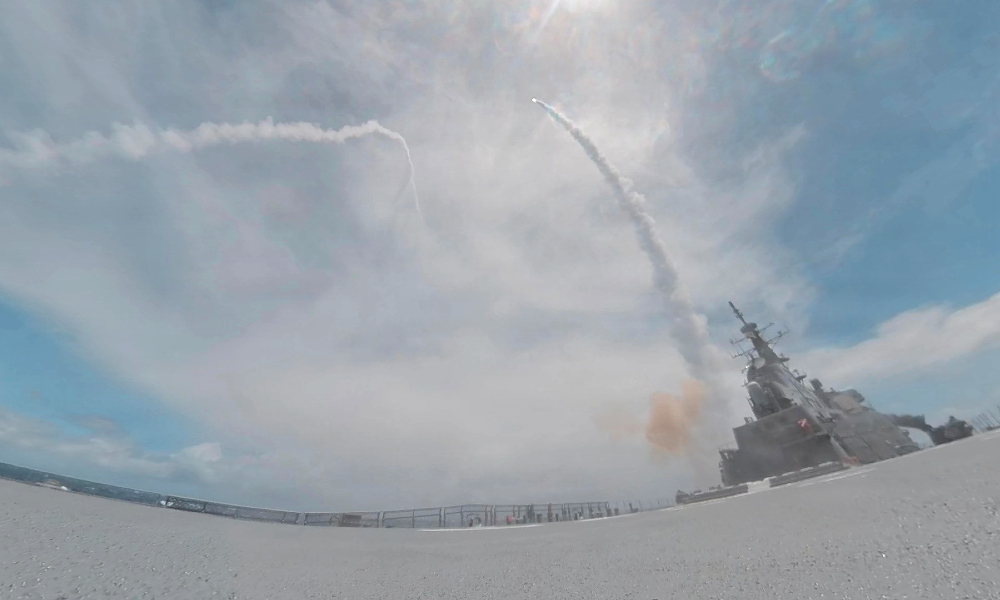


Editor’s Note: The United States seeks to have allies take on more responsibility for their own security, and many key allies now doubt the solidity of a U.S. security guarantee. As a result, some allies may consider building nuclear weapons. Evan Montgomery and Toshi Yoshihara of the Center for Strategic and Budgetary Assessments, drawing on their recent article in Washington Quarterly, consider what might drive Japan toward nuclear weapons and then discuss how such a development might prove costly for Japan as well as dangerous for the United States.
Daniel Byman
***
Japan may be rethinking its long-standing aversion to building, maintaining, or hosting atomic weaponry. Some American strategists see such friendly proliferation as an acceptable cost for reducing the U.S. role in the region or even as beneficial in preserving stability. This is a mistake. Although there are strong reasons for Tokyo to consider abandoning its aversion to hosting or even sharing nuclear weapons in service of extended deterrence, assessments of the benefits of fully joining the nuclear club often rest on caricatures about the risks of pursuing a nuclear capability, the viability of minimal nuclear deterrence, and the extent to which a nuclear arsenal can solve a state’s security problems. Japan would face increased risk from China, and the United States would probably have to play a greater role in ensuring its ally’s security.
Japan is surrounded by three nuclear-armed revisionist powers—China, Russia, and North Korea—that are each enhancing their arsenals. This threat, along with a new prime minister who appears less bound to foreign policy tradition than some of her predecessors and widespread questions regarding the U.S. role in the region and the world, may change Tokyo’s approach to nuclear weapons. This is especially likely if South Korea opts to adjust its own nuclear status, leaving Japan as the only major power without a nuclear arsenal in an increasingly dangerous neighborhood.
Notably, over the past year, various reports have raised the possibility that Japan could rethink its nuclear status. In a November 2025 Diet session, Prime Minister Sanae Takaichi hinted at revisiting the language of the three non-nuclear principles (“not possessing, not producing, and not permitting the introduction of nuclear weapons” onto Japanese territory) as her government revised Japan’s key national security documents. The following month, an unnamed adviser to the prime minister’s office allegedly declared that Japan “should possess nuclear weapons” in response to a reporter’s question. Takaichi later reiterated her commitment to the three non-nuclear principles, but just recently her defense minister advocated an open debate over the nuclear issue.
Should Japan pursue an independent nuclear weapons capability, this path-breaking choice would introduce three significant risks. First, it would open a window of opportunity for adversaries to attack before it crosses the nuclear threshold or fields a survivable arsenal. Second, if it crossed that threshold, and even after it established a “minimum deterrent,” it would enter a valley of vulnerability given how unfavorably the nuclear options it builds would stack up against the arsenals of its neighbors. Third, if the financial costs of a nuclear buildup came at the expense of investing in conventional forces, which seems likely, Japan might find itself in a prolonged period of instability during which it would improve its protection from some threats while increasing its exposure to others.
Consider, for instance, how the rivalry between Japan and China could evolve in response to a nuclear push by Tokyo. Beijing has long been highly sensitive to any developments that could undermine its deterrent posture. A Japanese nuclear breakout, however, would represent an entirely different—and far more acute—level of danger. Beijing’s supercharged threat perceptions about Tokyo would magnify its fears of a hostile proliferator next door. Many on the mainland hold deep suspicions about Japan’s commitment to nonproliferation and believe that it maintains a latent nuclear weapons capability. Such profound distrust of Tokyo likely reinforces Beijing’s unwillingness to accept mutual vulnerability vis-a-vis Japan.
If Tokyo were to attempt a nuclear breakout, China could count on a range of coercive tools that would expose Japan to the three kinds of risks described above. Beijing could sanction Japanese companies, use subversion to divide Japan’s body politic, or mass naval, air, and paramilitary forces near disputed territories, like the Senkaku Islands. Chinese leaders and commanders can mix and match these well-honed coercive options to disrupt the various stages of Tokyo’s quest for the ultimate weapon before the window of opportunity slams shut. This pressure could erode Japan’s will while the possibility of military preemption looms in the background.
These coercive actions, moreover, would be taking place in China’s nuclear shadow, the ultimate backstop to its strong-arming tactics. Indeed, Beijing could maneuver its nuclear triad in a demonstration of its resolve to intimidate Japanese leaders. China enjoys escalation dominance over Japan, meaning that its superior military prowess allows it to climb the escalation ladder higher than its rival. Beijing’s ability to escalate further than Tokyo enables the Chinese side to threaten to impose unacceptable costs on the Japanese side, bargain from a position of strength, and walk back its threats in exchange for Japan’s concessions.
Even if Japan were to reach escape velocity in its nuclear breakout, Beijing’s overwhelming nuclear superiority in numbers and quality would likely raise the bar, perhaps substantially, for what might constitute a satisfactory deterrent for Japanese planners. To achieve a level of sufficiency that meaningfully ensures mutual vulnerability, Tokyo might have to invest in a far larger, more diverse, and more survivable nuclear force structure and posture than presumed, which would prolong the period in which Japan would be vulnerable to China. And even if Tokyo were to field a credible second-strike capability, it would still not deter Chinese coercion that fell short of war, including demonstrations of force, economic reprisals, and political warfare. If Japan were to divert substantial resources to nuclear breakout at the expense of conventional military modernization and other tools for countering coercion, then it might remain vulnerable to those threats, which the nuclear shield is inadequate to deter. In other words, after crossing the nuclear threshold, Japanese leaders would face stark decisions and trade-offs as they balanced competing resource demands under persistent duress.
Ultimately, China’s imperative to preserve its nuclear superiority, its hypersensitivity to Japan as a potential nuclear rival, and its many tools that were unavailable to it just a generation ago suggest that Beijing will likely go to great lengths to maintain its preferred status quo. Meanwhile, Russia and North Korea might have fewer coercive options at their disposal, but that does not rule out either state taking steps to derail or counter Japan’s nuclear ambitions—or the prospect that Tokyo’s rivals could work together to keep the status quo intact.
Of course, the United States could help to offset each of these dangers. That is, it could provide the resources, technology, and expertise necessary to support a nuclear buildup, not only to accelerate the process but also to avoid a situation in which Japan cannibalizes much-needed conventional defenses in pursuit of a viable nuclear capability. At the same time, the United States could double-down on its security commitment to get Japan safely across the nuclear threshold, backstop its new arsenal with U.S. nuclear forces to make it a better match for rivals, and make up for any gaps that might emerge in Tokyo’s ability to address non-nuclear threats. Yet doing so would undercut the rationale that proliferation allows Washington to reduce its commitments, avoid being drawn deeper into regional competitions, and conserve its limited resources.
The potential blowback from Japanese proliferation uncovers a major paradox that advocates of friendly proliferation miss: Any potential benefits of nuclear proliferation for the United States would be highly dependent on Washington assuming the very costs and risks that friendly proliferation would be meant to offset. Debates over alternatives to extended deterrence must be clear-eyed about the hidden and not-so-hidden dangers of friendly proliferation.

-(1).jpg?sfvrsn=af0bd5fc_5)