What’s up with Trump’s Mail-In Voting Executive Order?

Judge Carl Nichols of the U.S. District Court for the District of Columbia, refusing to grant a preliminary injunction to halt President Trump’s executive order targeting mail-in voting, didn’t rule that the directive was likely lawful. Instead, he ruled that it was too early to tell—because the administration simply hadn’t done anything yet.
Within days, almost as if the ruling had served as a convenient reminder, it did.
Originally, experts interpreted the March 2026 executive order on mail-in voting (not to be confused with the March 2025 executive order on voting) as an effort to create federal lists of eligible voters that would dictate who received a ballot in future elections. But the text of the order didn’t exactly resemble this master plan so much as it did, to borrow the chief executive’s own phrasing in an entirely unrelated matter, “concepts of a plan.”
The order consisted chiefly of two directives: one to the Department of Homeland Security (DHS) to construct “State Citizenship Lists” derived from federal databases, and the other to the United States Postal Service (USPS) to initiate a rulemaking to create “State Absentee and Mail-in Participation Lists” indicating whose mail-in and absentee ballots USPS would carry. That rulemaking was also supposed to include a provision specifying that states should submit to the USPS their own lists of voters to whom they intended to provide mail-in or absentee ballots.
The logical assumption was that these three separate lists would effectively merge into one. The USPS, if it complied with the order, would cross-reference the state lists with the DHS list in order to produce the crucial list in this conversation; that is, the one that would determine whose ballots were eligible for transmission by mail and whose were not. Yet this remained only an assumption. The order itself mentioned only three separate lists with no requirement for how they would interact—or even that they would interact at all. The proof of the pudding was always going to be in the rulemaking.
Now, not only has the USPS published its proposed rule, but the DHS has also disclosed multiple memos detailing implementation thus far. Finally, on Thursday, June 25, Judge Indira Talwani of the U.S. District Court for the District of Massachusetts ruled in a separate challenge to the order that many of its central provisions were unconstitutional. Taken together, these developments make it easier to assess how insidious and illegal the executive order will prove to be. They also offer insight into what exactly the administration is trying to accomplish—both less and more, it turns out, than what the order technically demands.
Mailing Lists
The USPS issued its proposed rule on “Ballot Mail for Federal Elections” on June 2, characterizing the initiative as “regarding the preparation of ballot mail for federal elections to facilitate the enforcement of federal law.” The notice opened a 30-day public comment period, to conclude on July 2, after which the USPS may, or may not, revise its rule at any point prior to publication.
The rule actually stops short of many opponents’ worst fears: While it would require states to submit to the USPS lists of individuals to whom they’re mailing ballots, and while it would also require the USPS to return final lists of enrolled individuals to the states, the proposal is very clear that “the Postal Service would not change the information provided by [states] when compiling the lists.” The rule also asks for initial lists from states 30 days ahead of an election rather than the 60 days mentioned in Trump’s original order, and it would allow states to modify the enrollees list “until the last day that ballots may be mailed out to individuals under state law.”
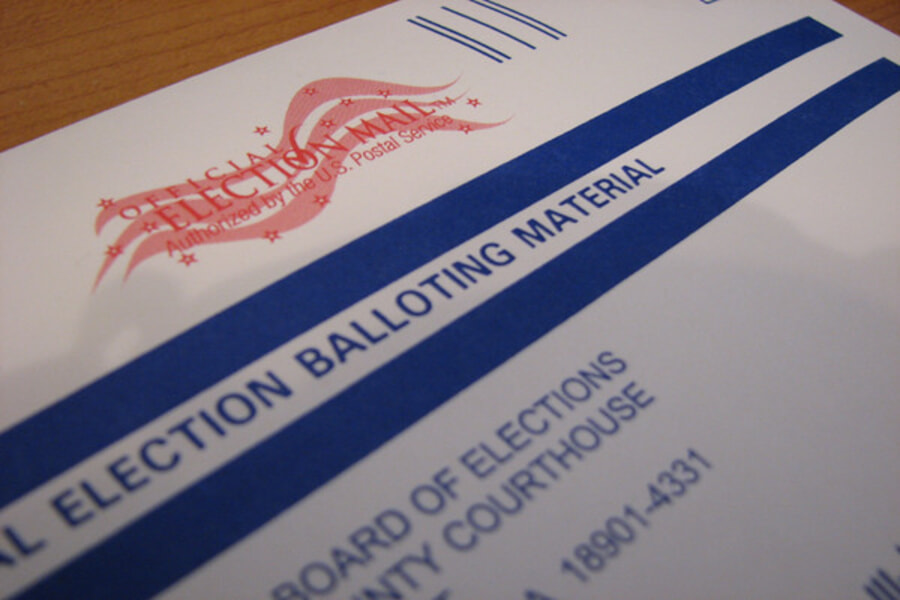
Under the rule, the USPS would also “identify new standards” for the design of “outbound and return ballot envelopes,” to ensure that each sports an official “Election Mail” logo as well as a “uniquely serialized Intelligent Mail barcode” to facilitate tracking. Many jurisdictions have already instituted these or similar standards, which are regarded as modern-day best practices.
All of this may assuage some concerns about the degree to which the federal government is intent on meddling with state elections. But it doesn’t—or shouldn’t—resolve every one.
The USPS purports to find authority for the rule in 39 U.S.C. §§ 401 and 404, which authorize the agency to adopt regulations “as may be necessary in its execution” of its assigned functions and grant it general and specific powers to further those functions. The proposal pairs federal statutes regarding false information in voting registration or voting with a statute authorizing the USPS to investigate crimes involving “the use of the mails” to assert that the new rules fit the regime §§ 401 and 404 sketch out. Of course, whether providing voting lists, forcing states to submit lists of their own in a specified format, and mandating changes to voting mail design all really qualify as postal functions is a matter of debate. The order’s opponents say the statutes the USPS cites have nothing to do with elections; its supporters counter that voting by mail has more than enough to do with the mail—and illegal voting by mail has to do with investigating mail crimes.
Other fundamental issues remain: While states would ostensibly have autonomy over who appears on ballot transmission lists, under the rule, the USPS would still refuse to transmit ballots to anyone not on those lists, contrary to its statutory universal service obligation. What’s more, by forcing states to conform to a stringent set of technical specifications handed down by the executive to have mail-in and absentee ballots transmitted to anyone at all, the USPS would encroach on the authority to control elections that the Constitution assigns to the states and Congress—in what opponents of the order say is not only a violation of the separation of powers but also a violation of the Help America Vote Act of 2002 and the National Voter Registration Act of 1993.
The USPS’s insistence that states will retain control over who appears on the list of voters to whom it will transmit ballots seems calculated to head off this argument; there’s also the fact that the USPS isn’t purporting to require the states to do anything. Still, Postmaster General David Steiner left no room for confusion in his testimony before the Senate Homeland Security Committee on June 23: The USPS won’t transmit mail-in ballots for a state if the state doesn’t give the federal government its voter list. “We would tell the state that we need the manifest,” he said.
There are logistical problems, too. Those technical specifications may be best practices and may already have been implemented by many jurisdictions. But they haven’t been put into place by all jurisdictions, because for many smaller—typically more rural—localities, the lift is preclusively high. The executive order doesn’t indicate any source of funding to assist them. To the extent that states do comply, the USPS will have in hand a trove of information about not only who is eligible to vote but also who voted, barcode by barcode. On June 18, the government filed a notice in court disclosing the records system it intends to build to support its proposed rule.
What will the USPS do with this system? The rule offers a hint: The mail-in and absentee participation lists generated by the USPS based on states’ submissions “will help determine adherence to federal law and facilitate law enforcement efforts. For example, the provided lists will evidence how many ballots have been mailed, and allow law enforcement officials to compare the total number of mailed ballots to the total number of received ballots to detect potential issues meriting further investigation.”
Anyone familiar with the original executive order likely won’t find this surprising. Not only did it threaten to withhold federal funding from states “noncompliant” with a host of statutes related or tangentially related to illegal voting, but it also directed the attorney general to prioritize the investigation and prosecution of “individuals and public or private entities engaged in, or aiding and abetting, the printing, production, shipment, or distribution of ballots” to ineligible recipients. An election records retention requirement in the order would surely help along those investigations, too.
Apparently, the administration believes the USPS lists will prove instrumental in sussing out irregularities. But the Postal Service won’t be able to do that alone.
A Listless Department of Homeland Security
The USPS rule focuses almost entirely on the USPS, but it’s impossible to comprehend its effects without also considering the second entity at the center of the March 2026 executive order: the Department of Homeland Security.
In recent weeks, the DHS has taken significant steps toward implementation—and backsteps, too. Initially, in a June 5 filing, the DHS said it had approved a recommendation from the United States Citizenship and Immigration Services (USCIS) to create the State Citizenship Lists that the order describes. This recommendation came in two parts. First, the USCIS would allow states to submit their entire voter rolls to its SAVE system—originally designed to help states ascertain the immigration status of people applying for benefits—to verify the citizenship of those on the rolls. Second, the USCIS would create a registry of citizenship-related data incorporating its own records with information from the Social Security Administration and the Department of State that states could access.
The proposal, much like the USPS’s, didn’t claim to tell states they had to submit their voter rolls to SAVE or had to consult the new database and update their registration lists accordingly, perhaps because such a mandate would be too obviously unconstitutional. Somewhat perplexingly considering the executive order involved not one, not two, but three lists, the memo didn’t explain how the DHS would create a list at all. It did, however, articulate a connection that the USPS’s own pending rule left unspoken—stating that the DHS was considering working with the USPS “to integrate USPS datasets from Mail-In and Absentee Ballot Participation Lists” to “identify anomalies that may suggest voter fraud or misuse.”
Throwing an already complicated matter into further confusion, the DHS retracted portions of this update within days. The government indicated in a June 8 filing that Homeland Security Secretary Markwayne Mullin had signed a superseding memo saying never mind about the SAVE database, or, more exactly, “Executive Order 14,399 does not direct that approach, and the new memorandum no longer includes that discussion.” This may have been calculated to forestall the inevitable complaint that the Trump administration’s overhaul of SAVE for the revised purpose of verifying citizenship is illegal on multiple fronts—which is exactly what a federal judge in D.C. ruled on June 22 in a case unrelated to the executive order.
The new filing focused instead on what the Department of Justice called a “technological method” of establishing a “mechanism” by June 30 “for States to receive secure, state-focused citizenship-related information from” USCIS, the Social Security Administration, and the Department of State. The filing also mentioned building a public-facing portal for citizens to access further down the line. And that USPS coordination? Those talks, the filing emphasized in a presumable attempt to play to judicial skepticism about ripeness, are merely “preliminary conversations” about data-sharing arrangements that “are not directed by” the executive order and “would be contingent upon whether USPS issues a final rule.”
This filing somehow managed to provide less rather than more information than the previous iteration about what precisely the DHS was planning. Later that week, however, the described memo itself appeared on the docket—too late, inconveniently, for the plaintiffs in the case to incorporate it into their opening brief in their appeal to the U.S. Court of Appeals for the District of Columbia. The memo tells a fuller story.
The executive order requires the DHS to build its “State Citizenship List” capability by June 30, but doing so completely by the deadline without running afoul of privacy and other laws isn’t feasible. (It’s worth asking whether it would ever be feasible, on any time frame.) The memo reveals this has led to an interim measure: the aforementioned portal for states to access and download “citizenship related data elements, such as name, date of birth, and relevant agency identifiers.” Looking forward, the DHS “will continue to work to generate from the information contained in this portal a consolidated list … to provide to state election officials no fewer than 60 days before each regularly scheduled election.”
The DHS locates authority for its project in 8 U.S.C. § 1373, the Immigration Reform and Control Act of 1986, and the Illegal Immigration Reform and Immigrant Responsibility Act of 1996. These laws involve (among other things) sending and receiving immigration status to and from states, though largely for federal benefits purposes; the last of them requires the DHS to respond to federal, state, and local inquiries to verify citizenship status “for any purpose authorized by law.” Whether any of these statutes is sufficiently related to voting or voter registration to overcome the Privacy Act’s prohibition on disclosures that aren’t authorized by federal law is dubious—and made more so by the reality that the lists, as even the government concedes, are sure to be inaccurate.
But practically, the memo makes it clear: The lists are coming; they’re just not here yet.
When (or Where) Will the Courts Come In?
The lists, of course, are coming only if the government gets its way in court. The odds are, or ought to be, long. Article I, Section 4, of the Constitution, after all, reserves regulation of the time, place, and manner of elections for the states, with a secondary role for Congress—which hasn’t authorized anything similar to what the government is aiming to accomplish. These and other barriers to the order’s survival are described in a previous Lawfare piece on the executive order published soon after its signing.
Judge Nichols declined earlier this month to grant a preliminary injunction against the executive order on the grounds that—when his order was issued—the directive hadn’t yet been carried out, and therefore the plaintiffs hadn’t yet been harmed. “The Court recognizes that the Postal Service may ultimately issue a final rule that directly affects Plaintiffs or their members, or that the Government may develop State Citizenship Lists that omit specific individuals due to particularized flaws,” he wrote. “Plaintiffs may, of course, renew their motions if and when those future actions occur.”
The steps both agencies have now taken may move the lawsuit closer to ripeness in his eyes, but it’s unclear they move it close enough. In any event, the Democratic Senatorial Campaign Committee and the voting rights groups who joined in its lawsuit have filed an appeal with the D.C. Circuit, where briefing is scheduled to be complete by July 6. A date for oral argument has not yet been set, but the case is proceeding on an expedited basis.
Up the coast, things are different in Massachusetts. Judge Talwani ruled on June 18 that challenges to the executive order from voting rights groups and 23 states and D.C. couldn’t proceed as they related to future elections after this fall, but could proceed as they related to the midterms. She took a different view than Judge Nichols, writing that the organizations and states had shown that preparation for the election is already underway by necessity; they can’t simply wait for implementation without the order having an effect on them in the interim.
Then, on June 25, she granted a summary judgment in favor of the plaintiffs in the challenge from the states and D.C., finding the executive order’s central provisions ultra vires and unconstitutional—and enjoining the government from giving them effect with respect to the midterms in the suing jurisdictions.
Judge Talwani said the order’s directive to the USPS “to compile its own Lists of individuals eligible to vote by mail” and prohibit transmission of a ballot completed by anyone not on those lists was an impermissible infringement by the executive branch on the states’ power to determine voter eligibility. She noted that Congress may well have empowered the USPS to adopt rules necessary to execute its functions—but that it hasn’t enacted any laws that delegate “authority to control mail-in voting to USPS.” And she declared the directive that the USPS mandate all states use a specific mail-in ballot inconsistent with the rulemaking procedure Congress created for the agency, because it would be impossible to follow it properly in time for the election.
Talwani also wrote that the State Citizenship Lists detailed in the order will “necessarily be incomplete” due to the legal restrictions of the Privacy Act and the practical limitations of federal records that don’t always track name or residence changes. Crucially, she ruled that the DHS has no statutory or constitutional authority to compile not merely a citizenship database, but tailored lists that include individuals who meet the states’ particular residence requirements for voting eligibility.
The portion of the order devoted to enforcement, Talwani ruled, similarly exceeded the executive’s authority. While the government argues “no legal significance, criminal or otherwise” attaches to states’ decision of whether to heed any lists transmitted to them, she explained that where “the President seeks to have the Attorney General and DOJ rely on” the lists “to reduce voter fraud,” the lists function at minimum as “a threatened enforcement mechanism that will chill local election officials from complying with legal obligations to ensure that all eligible citizens might vote.” Effectively, they’re an attempt by the administration to create a new criminal offense. Talwani said the order’s election records retention requirement was “merely precatory”; it can serve as a suggestion for states, but it can’t bind them.
What precisely will happen next to the executive order is still a matter of speculation—but what has happened already at least makes it informed speculation. The universe of possibilities begins with the administration prevailing in court at least on some provisions of the order. The Justice Department will almost certainly appeal Talwani’s decision (as well as any forthcoming ruling from her in the parallel challenge from voting rights groups, if it goes the same way)—just as voting rights groups are appealing Nichols’s decision in favor of the government. The matter may well end up in the Supreme Court eventually. The Justice Department’s chances could depend in part on whether future judges who hear the case consider the order itself, as Talwani has done, or only its implementation, as Nichols appears to believe is appropriate.
After all, the implementing agencies didn’t do what everyone expected them to: that is, attempt to force states to rely on the federal government’s citizenship lists in determining who can vote, or reject states’ determinations of whom to send ballots to by refusing to transmit them via the USPS. So far, the DHS hasn’t even created State Citizenship Lists, including information about residence requirements, at all. There’s a chance, slim as it may be, that a court will find the DHS can draw up at least some form of list so long as it does it in compliance with privacy and other laws (a gargantuan caveat), or that the USPS can, too—though for the aforementioned constitutional and statutory reasons, the agency almost certainly cannot force states to provide lists to it or refuse to carry certain pieces of mail to and from people who aren’t on them.
If all the administration does is create a series of lists, that could still cause harm: by leading election officials to provide information for those indices or even wrongly withhold ballots from eligible voters who aren’t on them because they’re confused or intimidated, or simply because they want to. Twelve red states, for instance, motioned to intervene in the states’ challenge before Judge Talwani, stating “a concrete interest in receiving the resources” the order directed be provided to them. (The potential for the order indirectly to cause disenfranchisement in this fashion could itself be a basis for the courts to strike down the order; Talwani rejected its enforcement provisions on a similar theory.)
There’s also the other course of action the notices and memos regarding the order clearly contemplate: That, even if the lists don’t end up changing who is or isn’t able to vote, they will serve a purpose after those votes have been shipped off for tabulation—because by cross-referencing who received or sent a mail-in ballot with who the federal government thinks should have received a mail-in ballot, the administration can point to supposed irregularities that would support claims of election fraud.
The second possibility is that the administration loses eventually, but it doesn’t lose in time for the midterms. The Justice Department could successfully forestall a decision until the plans the USPS and the DHS are currently considering have been fully implemented, or at least long enough for states to have taken significant steps to comply with the tentative regime. That could simply mean providing lists along with substantial voter information to the USPS, or it could mean setting themselves up to send ballots only to those the DHS’s database indicates ought to be eligible. That eventuality could lead to the same alarming outcomes for the midterms as above.
The third possibility is that the administration loses, and loses fast enough that no information reaches a federal actor who doesn’t have it already, and no state adjusts its administration of the election, from envelope-formatting to voter eligibility, from what it otherwise would have been. Even then, this administration has a tried and true tactic for making the most of failures before the judiciary: If they lose, they can always say they tried to save the election—but those cowardly judges on corrupt courts wouldn’t let him.