American Troops at the Polls: A History



In early September 1875, Gov. Adelbert Ames (R) of Mississippi sent an urgent request to President Grant. White paramilitary organizations, operating openly as the armed wing of the state Democratic Party, had launched a coordinated campaign of assassination and voter suppression across the state, intended to prevent newly enfranchised Black men from voting in the upcoming November elections. State authorities were unable to stop the violence on their own, Ames said. Federal troops were needed.
Grant had the legal authority to act. Indeed, he had acted twice before in similar circumstances: once in 1871, invoking the Third Enforcement Act to break the Ku Klux Klan in the South Carolina upcountry, and once in 1874, invoking the older state-application statute of 1795 to put down a paramilitary coup in New Orleans. But political considerations this time intervened and persuaded the president not to supply the governor with troops. Grant was sympathetic; he initially approved Ames’s request and ordered the provision of troops “without delay.” But political considerations intervened. In the recollection of Rep. John R. Lynch (R-Miss.), a committee of Ohio Republicans warned Grant that sending troops to Mississippi would cost the party Ohio’s October elections. Grant’s attorney general conveyed the following infamous line to the governor of Mississippi: “The whole public are tired out with these annual, autumnal outbreaks in the South.” No troops would be sent.
The episode is now roundly regarded as having been a disaster for the project of Black political participation in the postbellum South. Without federal intervention, the so-called Mississippi Plan worked exactly as designed: Republican vote counts reached as low as the single digits in some majority-Black counties.
Now, 150 years later, allies of President Trump are openly entertaining the possibility of new deployments to polling places. “You’ve got to call up the 82nd and 101st Airborne on the Insurrection Act,” Steve Bannon said in a February 2026 podcast. “You’ve got to get around every poll.” The president, when asked whether he’d be open to sending Immigration and Customs Enforcement (ICE) officers or National Guard service members to polling locations in November, responded, “I would do anything necessary to make sure we have honest elections.”
Such a deployment would be, if nothing else, extraordinary. The United States has had one period in its history of sustained and vigorous federal military deployments to election sites: Reconstruction. After the Civil War, troops fanned out across the former Confederacy—especially in areas still under military occupation under the Reconstruction Acts—supervising voter registration, guarding canvassing boards, and arresting paramilitary insurgents. The backlash, however, was such as to produce a taboo against election-related military deployments that lasted for over a century. Not even at the height of Freedom Summer 1964, when voter registration drives in the South were met with violence at scale, did the taboo break. The federal government’s response came only the following year, with the Voting Rights Act’s provision of federal examiners and observers to secure the franchise.
The legal regime that evolved over the course of U.S. history is complex, but the modern framework reflects an unequivocal principle: With extremely limited exceptions, the military should have no role in elections. In this piece, we explore the historical context that shaped that evolution. Where has the United States been in the area of election-related military deployments?
Pre-Reconstruction Deployments
An 1864 report from the Senate Committee on Military Affairs and the Militia identified multiple instances of military interference in elections in Delaware, Maryland, Missouri, and Kentucky from 1861 to 1863. In reviewing Gen. John Schofield’s order declaring that any judge in Missouri who permitted admitted Confederate soldiers to vote would be charged with a military offense, the Senate noted approvingly that “his justification can only be found in the duty he owed to his country as a military commander to prevent her enemies from obtaining an advantage, and for that reason the order was plainly legal and necessary.” Gen. Ambrose Burnside issued a similar order in Kentucky, commanding “all military officers … to aid the constituted authorities of the State in support of the laws and of the purity of suffrage.” A previous order in effect in Maryland directed the military to “where the elections are to be held to protect the Union voters, and to see that no disunionists are allowed to intimidate them, or in any way to interfere with their rights.” At the conclusion of the report, the Senate Committee on Military Affairs and the Militia recommended against proposed legislation that would have limited military interference in elections, finding that military interference was justifiable to prevent Confederate soldiers from participating in elections during wartime. These deployments continued to be a prominent issue through the 1864 elections.
In 1865, however, Congress disregarded the conclusions of the Senate Committee on Military Affairs and the Militia and passed the bill that had previously been proposed to the committee—this legislation constituted the predecessor of 18 U.S.C. §§ 592-593 and included prohibitions specific to previous incidents of military interference in elections as reported in the 1864 Senate committee report. The law had three components: (a) a prohibition on keeping troops at polling places unless necessary “to repel the armed enemies of the United States, or to keep the peace at the polls”; (b) a prohibition on any military involvement in determining voter qualifications or permitting the exercise of the right to vote; and (c) a prohibition on any use or force or intimidation to prevent qualified voters from voting or to compel election officers to accept ballots from people not qualified to vote.
Reconstruction: High-Water Mark of Election-Related Military Deployments (1867-1894)
American experience with election-related military deployments reached a peak during the Reconstruction era.
With the Reconstruction Acts of 1867, Congress divided all former Confederate states except Tennessee into five military districts, each commanded by a Union general. Some 20,000 federal troops were stationed across the occupied South, with specific statutory duties related to elections. Under Section 4 of the Second Reconstruction Act, each district commander was to appoint boards of registration, “consisting of three loyal officers or persons,” to “make and complete the registration, superintend the election, and make return to him of the votes.” These were military-appointed boards, answerable to the commanding general and not bound by the legal interpretations of any “civil officer,” even the attorney general. (Congress wanted to make sure presidents would not eliminate by construction what they had been unable to defeat by veto.) It was these boards that registered formerly enslaved men to vote for the first time in their lives, and that superintended the elections for the state constitutional conventions required for readmission to the Union.
Congress appeared to base the constitutionality of this new statutory regime on Article IV, Section 4’s republican guarantee. The preamble to the First Reconstruction Act read, “no legal State governments or adequate protection for life or property now exists in the rebel States”; “it is necessary that peace and good order should be enforced in said States until loyal and Republican State governments can be legally established”—practically a finding within a statute that the Guarantee Clause had gone unsatisfied. Others were more dubious of the acts’ constitutional basis. President Andrew Johnson vetoed each one on constitutional grounds, likening in one veto message each commanding general to “an absolute monarch” whose “mere will is to take the place of all law.” These military districts lasted no longer than the readmission process itself. The last one dissolved in 1870, with the readmission of Georgia.
Congress passed three laws, known as the Enforcement Acts, to secure compliance with the new terms of the former Confederate states’ Union membership—the terms set forth in the 14th and 15th Amendments. The First Enforcement Act, passed on May 31, 1870, authorized federal marshals to summon military personnel to enforce the 15th Amendment’s voting rights provisions as part of a posse comitatus: Section 10 empowered marshals and their deputies to summon to their aid “such portion of the land or naval forces of the United States, or of the militia, as may be necessary.” The Second Enforcement Act of February 1871 brought federal elections under federal supervision: Section 8 directed marshals and their deputies to attend “the polls of the election” in congressional races, and Section 10 authorized them to summon to their aid “such portion of the land or naval forces of the United States ... as shall be necessary.” The Third Enforcement Act, known as the Ku Klux Klan Act and passed two months later, addressed not elections but the threat of insurrection. Section 3, which survives today as 10 U.S.C. § 253, authorized the president to employ the militia or the land and naval forces wherever “insurrection, domestic violence, unlawful combinations, or conspiracies” obstructed the laws so as to deprive people of their constitutional rights and state authorities were unable or unwilling to protect them. Section 4, finally, permitted suspension of the writ of habeas corpus wherever such combinations were “organized and armed, and so numerous and powerful as to be able, by violence, to either overthrow or set at defiance the constituted authorities of such State, and of the United States within such State.”
The first major presidential deployment came in 1871. Following a massive Ku Klux Klan terror campaign in South Carolina, President Grant deployed companies of the 7th U.S. Cavalry to Yorkville and the surrounding upcountry counties to support U.S. marshals in the arrest of suspected Klansmen, invoking Section 3 of the Third Enforcement Act. His attorney general, Amos Akerman, reporting from Yorkville, described combinations embracing “at least two thirds of the active white men” of the affected counties, existing “for the purposes of preventing the free political action of citizens who are friendly to the Constitution.” Instances of criminal violence in the preceding 12 months, he wrote, “could be reckoned by thousands.”
The troops were not sent directly to polling sites. But their mission was to quell violence that was meant to suppress Black Republican voting. Grant proceeded in the sequence the statute prescribed: a proclamation of Oct. 12 that commanded the combinations to disperse, the warning Section 4 required, and, when those combinations refused, a second proclamation on Oct. 17 suspending habeas corpus in nine counties. (The composition of the counties changed slightly in November: Marion was dropped, and Union was added.) This remains the only suspension of the writ ever ordered under the Ku Klux Klan Act. The deployment produced over 600 arrests, hundreds of prosecutions, and peaceful elections the following year.
Grant again deployed regular U.S. forces to the South in September 1874, when members of the Crescent City White League, disgruntled over the outcome of the 1872 gubernatorial election, overthrew the Republican state government in New Orleans, seizing the statehouse and armory and deposing Gov. William Pitt Kellogg. Kellogg, as Grant later told the Senate, “made a formal requisition upon me, pursuant to the act of 1795, and section 4, article 4 of the Constitution, to aid in suppressing domestic violence”—the state-application provision that survives today as 10 U.S.C. § 251. The president issued a proclamation commanding the insurgents to disperse and dispatched 5,000 federal troops as well as three gunboats to New Orleans to restore the deposed governor to power. The White League withdrew before the troops arrived; no insurgents were prosecuted.
Six weeks later, the federal troops were put to a different use under a different statute. On Oct. 19, U.S. Marshal S. B. Packard reported “authentic information that systematic violence and intimidation will be practiced toward republican voters on the day of election at three or four points in this States.” He asked that Gen. William H. Emory send troops to Franklin in Saint Mary’s Parish, Napoleonville in Assumption, and Moreauville in Avoyelles; Kellogg would furnish transportation at no cost to the government. Grant agreed to the request. “Upon a requisition of the marshal of Louisiana,” he recounted in a message to the Senate early the next year, “and in view of said armed organizations and other portentous circumstances, I caused detachments of troops to be stationed in various localities in the State, to aid him in the performance of his official duties.” He cited Section 8 of the Second Enforcement Act, which made it the duty of marshals to keep the peace at the polls in congressional elections. He did not cite a deployment provision, but the facts of the deployment fell squarely under Section 10 of the First Enforcement Act, authorizing marshals and deputy marshals to summon the land and naval forces as a posse comitatus.
Intimidation of Republican voters occurred anyway, as Grant later acknowledged. In a January 13 message to the Senate, he reproduced a pledge signed by 80 local merchants vowing that they would discharge any employee who voted Republican. He then reproduced a second pledge, published the same day, that bound its signatories not to advance payment to planters who employed or rented land to laborers who voted Republican.
The deployment backfired. On Jan. 4, 1875, at the invitation of state officials, federal troops entered the Louisiana House of Representatives and removed 13 members whose seats were contested. The reaction in the North was severe, and Grant, who claimed not to have been consulted, sharply disavowed the act. “I am well aware that any military interference by the officers or troops of the United States with the organization of the State legislature or any of its proceedings, or with any civil department of the Government, is repugnant to our ideas of government. I can conceive of no case, not involving rebellion or insurrection, where such interference by authority of the General Government ought to be permitted or can be justified,” he said.
Deployments could backfire; they could also be declined altogether. Later that year produced what may be the most consequential non-deployment in American history. In Mississippi, white supremacist paramilitaries waged a coordinated campaign of violence to seize control of the state, assassinating Republican officials and terrorizing Black voters in advance of the 1875 elections. On Sept. 8, Gov. Ames applied for federal aid under Article IV, Section 4, telling the president in a telegram that “domestic violence prevails in various parts of this State beyond the power of the State authorities to suppress” and that the legislature could not be convened in time. Grant responded the same day, instructing the adjutant general that the commanding officer in Mississippi “may assist the Governor in maintaining order and preserving life in case of insurrection too formidable for him to suppress,” specially directing that the order first be submitted to the attorney general “to see if it is entirely legal.” No expedition was required; Gen. Christopher C. Augur, the commanding general, reported later that day that there were “troops enough” in the state already to suppress the rebellion, needing only to be “distributed where necessary.”
Problems arose when Attorney General Edwards Pierrepont pressed Ames repeatedly to clarify whether there truly existed “such an insurrection against the State Government as cannot be put down by the State military forces.” James Z. George, chairman of the Mississippi Democratic executive committee and himself an architect of the campaign of violence, telegraphed Pierrepont directly to argue that the governor’s call “does not even pretend that there is any insurrection against the State Government, as required by the revision of United States Statutes of 1873.”
Pierrepont, it appears, came to adopt George’s framing of the situation, reporting to the president that the facts in Mississippi fell short of the language of the statute. Grant responded on Sept. 13: “The whole public are tired out with these annual, autumnal outbreaks in the South,” he wrote, in the sentence that has come to be seen as his epitaph on Reconstruction. But he continued: “I do not see how we are to evade the call of the governor, if made strictly within the Constitution and acts of Congress there under. If the Executive is to be the judge when such insurrection or invasion exists as to warrant federal interference the Constitutional provision refered to in your report may become a dead letter even under a well meaning but timid executive.”
It is unclear precisely when the delegation of Ohio Republicans visited Grant. The 1913 memoir from which the account emerges, Rep. John R. Lynch’s “The Facts of Reconstruction,” records only that they called on the president “before the orders were put into execution.” The tone of the letter, however, suggests the political costs of troop deployments were rather fresh in the president’s mind. Pierrepont wired the governor the next day, quoting the sections of Grant’s letter that expressed exhaustion with troop deployments. The president sent no troops. Democrats took the legislature that autumn through violence and fraud. In Yazoo County, where 2,400 Republican votes had been cast two years earlier, the official returns for 1875 recorded seven Republican votes. Mississippi became the model for Redemption politics. Grant’s annual message that December did not mention the episode.
His regrets became clear the next year. Writing to Gov. Daniel Chamberlain (R) of South Carolina in July 1876—shortly after the Hamburg massacre, in which a white mob killed six Black militiamen—Grant described Mississippi as a state “governed to day by officials chosen through fraud and violence, such as would scarcely be accredited to savages,” and stated the principle that had constrained him in 1875: “Government that cannot give protection to the life, property and all guaranteed civil rights (in this country the greatest is an untrammeled ballot,) to the citizen, is in so far a failure.” He promised Chamberlain “every aid for which I can find law, or constitutional power.”
Chamberlain applied for aid on Oct. 11, three weeks before the election of 1876, reporting insurrections in Aiken, Barnwell, and Edgefield counties he felt he could not control with his own forces. On Oct. 17, Grant proclaimed that armed combinations known as “rifle clubs” were riding “up and down by day and night in arms, murdering some peaceable citizens and intimidating others,” beyond suppression “by the ordinary course of justice.” He invoked Article IV, Section 4, along with the same state-application statute he had invoked on Kellogg’s requisition two years earlier, commanded the clubs to disperse within three days, and directed the secretary of war to concentrate the available force of the Military Division of the Atlantic on South Carolina, stationed where it could be “most speedily and effectually used in case of resistance.” Four days later the state’s attorney general reported that the rifle clubs had begun formally disbanding and that Republican meetings were proceeding without disruption. No troops were stationed at the polls; Grant wrote in a January 1877 message to Congress that while the 1865 statute discussed above permitted troops to be stationed at polling places to “keep the peace,” that had “not in any case been done” to his knowledge.
Federal troops remained in South Carolina, Louisiana, and Florida when the presidential returns from those three states came into dispute that November. In South Carolina, the governor’s race came to be contested as well. The Republican-led canvassing board rejected returns from the heavily Democratic Edgefield and Laurens counties, which had the effect of preserving Republican control of the House of Representatives, the body responsible for resolving disputed gubernatorial elections. When the legislature convened on Nov. 28, 1876, federal troops blocked the entry of Democratic members-elect from those counties who claimed to have been wrongfully denied their seats. The local commander, Gen. Thomas H. Ruger, later denied having instructed the troops to exclude the members as they had. On Nov. 30, however, the Democrats returned, and Ruger instructed his troops to stand aside. For four months, two rival legislatures sat in Columbia, one Republican and one Democratic, each claiming to be the lawful General Assembly. After President Hayes withdrew federal troops from the State House in spring 1877, Chamberlain, the Republican incumbent, had little choice but to relinquish his claim to the governorship to Democrat Wade Hampton.
It was the troops in South Carolina, Louisiana, and Florida whose withdrawal by Hayes in the Compromise of 1877 marked the effective end of Reconstruction.
Long Period of Non-intervention (1894-2020)
When Congress formally repealed the Enforcement Acts’ federal election-supervision provisions in 1894, it dismantled the Reconstruction-era framework for an affirmative federal role in overseeing elections. The repeal did not, however, affect the 1865 restrictions on military involvement in elections. As discussed above, those restrictions prohibited federal personnel from bringing or keeping troops or armed men where an election was held except when necessary to repel armed enemies or “to keep the peace at the polls.” They also prohibited military interference with voter qualifications, the exercise of suffrage, and election officials.
In 1909, Congress removed the exception permitting troops “to keep the peace at the polls,” leaving only the exception for forces necessary to repel armed enemies. These restrictions remain in place today: 18 U.S.C. § 592 prohibits covered federal personnel from bringing or keeping troops or arms where an election is held, subject to the narrow “armed enemies” exception; 18 U.S.C. § 593 prohibits members of the armed forces from interfering with voting or election officials; and 52 U.S.C. § 10102 prohibits specified military officers from determining voter qualifications or interfering with the freedom of elections or the exercise of suffrage.
Other episodes, including the Ocoee massacre of 1920, showed how election-day racial terror could destroy Black political participation. In Ocoee, white mob violence following a Black resident’s attempt to vote caused multiple deaths, destroyed more than 20 Black homes and two churches, and displaced at least 253 Black residents. By 1930, only two Black residents remained in the community.
In 1948, Congress consolidated the criminal prohibitions derived from earlier statutes into the provisions now codified at 18 U.S.C. § 592, prohibiting covered federal personnel from bringing or keeping troops or arms where an election is held, subject to the narrow “armed enemies” exception, and 18 U.S.C. § 593, which prohibits members of the armed forces from interfering with voting or election officials. Another descendant of the 1865 statute, 52 U.S.C. § 10102, prohibits specified military officers from determining voter qualifications or interfering with the freedom of elections or the exercise of suffrage.
Domestic military deployments did not disappear, however. Presidents have deployed troops during civil rights crises. President Eisenhower, for example, sent soldiers to Little Rock in 1957 to ensure public safety during school desegregation, invoking Sections 332, 333, and 334 of the Insurrection Act (today §§ 252, 253, and 254 after recodification in 2016) and authorizing federal forces to enforce the district court’s orders. In 1962, President Kennedy requested federal assistance in Mississippi under the same provisions to remove illegal obstructions during the Ole Miss integration.
Federal protection of voting rights was urgently needed. Freedom Summer in 1964 was a major voter registration campaign in Mississippi, and contemporary historical accounts describe the campaign as taking place amid pervasive violence. The murders of civil rights activists James Chaney, Andrew Goodman, and Michael Schwerner by the Ku Klux Klan occurred at the start of Freedom Summer.
In 1965, President Lyndon Johnson similarly authorized military aid in Alabama, again invoking Sections 332, 333, and 334 to enforce a federal court order and to suppress domestic violence related to the Selma-to-Montgomery march. Like the Little Rock and Ole Miss deployments, the Selma deployment enforced federal law and judicial orders during an extraordinary civil rights crisis. It did not place the military in charge of polling places or election administration.
Against the legal background and history, federal voting-rights protections developed through civilian legal mechanisms. The Voting Rights Act of 1965 prohibited discriminatory voting practices, authorized federal examiners, and empowered the attorney general to enforce 15th Amendment guarantees through legal proceedings. The Justice Department’s Voting Section enforces the civil provisions of federal voting-rights laws, including the Voting Rights Act and the Civil Rights Act. Federal election monitoring relies on civilian observers, attorneys, and staff, not military forces. The violence surrounding Freedom Summer thus led to a strengthened federal role in protecting the franchise, but that role developed within a civilian legal framework rather than through an expansion of the military’s role in elections.
The Current Moment
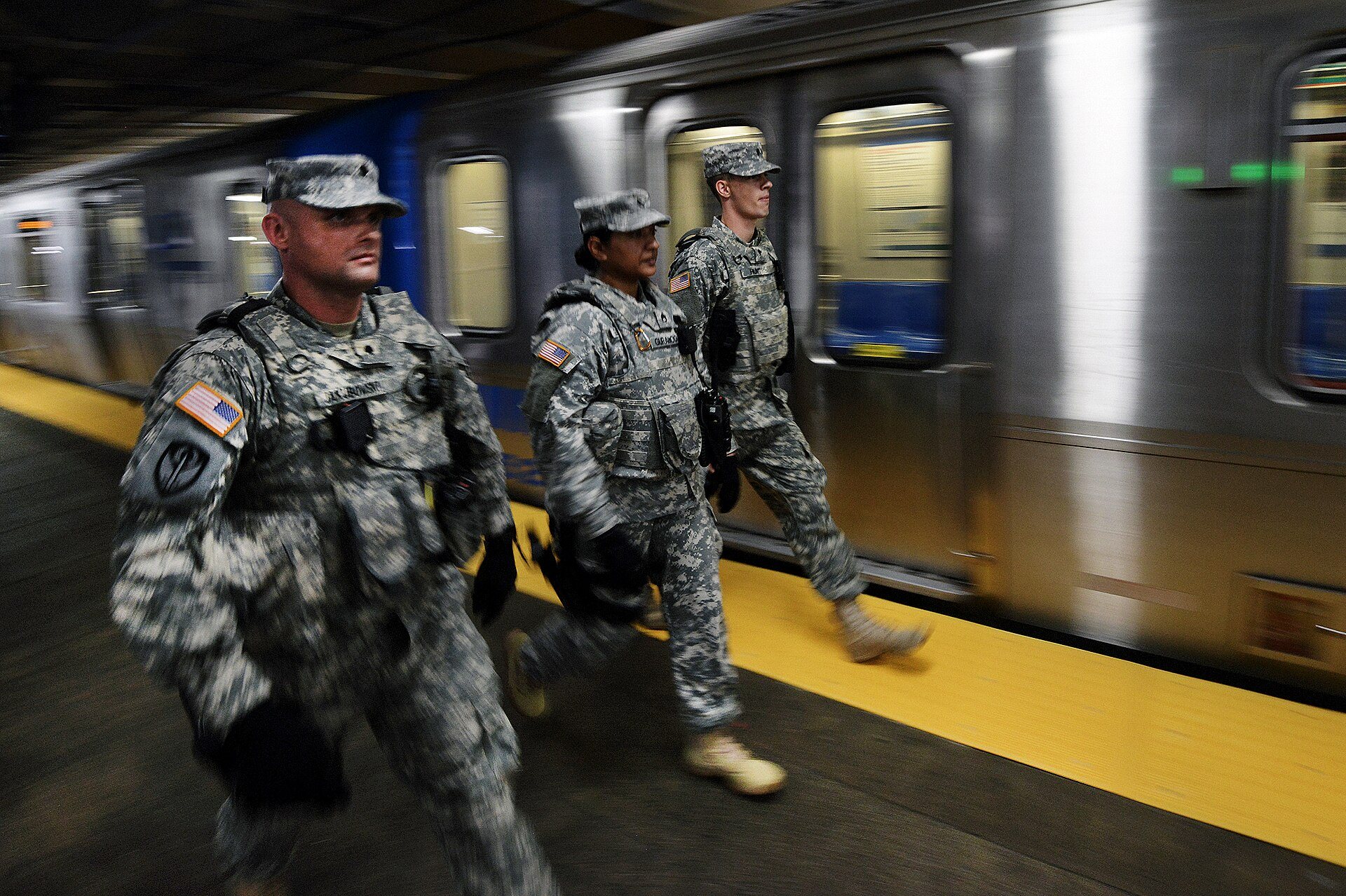
Besides deployments to safeguard civil rights, soldiers and airmen of the National Guard have deployed in response to state governors’ requests for assistance during emergencies such as natural disasters, public health crises, and threats of election‑related violence. In the 21st century, National Guard involvement in elections has been under the command of governors and largely focused on cybersecurity and logistical support. Guard personnel involved in election‑related support generally participate unarmed and in civilian clothes.
National Guard units activated under federal authority are considered part of the U.S. military. They may not deploy to polls under applicable criminal and civil statutes and are subject to the Posse Comitatus Act. The National Guard may, however, support elections under state authority and has done so in various types of emergencies. Following the extensive damage caused by Hurricane Andrew in 1992, which destroyed or disabled approximately 200 polling places, about 30,000 National Guard and active-duty military personnel assisted with cleanup operations, including establishing temporary polling facilities. The Hawaii National Guard performed a similar role weeks later when Hurricane Iniki impacted the island of Kauai. Guard personnel erected temporary polling facilities and transported ballots to Oahu to be counted. In 2012, the New York Army National Guard helped New Yorkers cast ballots in the wake of Hurricane Sandy by refueling generators at polling places.
In 2020, states activated more than 3,600 Guard troops across the country and held them on standby for a range of missions on Election Day. The National Guard primarily provided cybersecurity and COVID-19-related support. In several states, Guard units had begun partnering with state election authorities as early as 2016 to provide cybersecurity support. Due to the poll-worker shortage caused by the COVID-19 pandemic, Guard personnel served as emergency election workers in multiple states. In anticipation of unrest, multiple states also placed their National Guard personnel on alert, prepared to assist with any required response to election-related violence.
In 2024, states again deployed the National Guard as a precaution against potential election-related unrest. More than 250 Guard personnel were activated or placed on standby for activation across 18 states and Washington, D.C., while another 600 troops were placed on standby orders if needed. The activated troops consisted primarily of cyber specialists and general-support troops.
In congressional testimony, Secretary of Defense Pete Hegseth stated, “I will note that in 2024, troops were depl…—that was Joe Biden by the way, Joe Biden—were deployed to polling locations in 15 states.” The National Guard’s role in connection with the 2024 elections, however, focused on cybersecurity and general support while on state active duty. State governors—not the president—activated the National Guard and provided command and control. States also utilized Guard troops for tasks such as assisting technology staff in responding to cyberattacks, which did not result in Guard presence at polling places.
Upon taking office, President Trump deployed active-duty troops and National Guard forces to major U.S. cities throughout 2025 to support various public-safety and federal-protection missions. The president’s domestic use of the military, combined with his remarks about regretting not having ordered the National Guard to seize voting machines after his election loss in 2020, has drawn criticism from civil-society organizations. Trump has continued to assert that there is widespread voter fraud, suggesting in February 2026 that Republicans should nationalize elections, despite the Constitution’s allocation of primary responsibility for election administration to the states. Trump’s former White House strategist Bannon has expressed support for the president’s election-security efforts and asserted that the Army’s 82nd and 101st Airborne Divisions should augment ICE to surround polling places during the midterm elections. As recently as May, the president declined to rule out sending troops to polling sites during the midterms.
In response, Democrats introduced legislation to add safeguards limiting the president’s authority to send troops to polling places ahead of the November 2026 midterm elections. These efforts to strengthen restrictions on federal troop presence at polling locations have stalled in Congress, leaving existing statutory constraints in place without additional measures specific to the 2026 election cycle. In response to Sen. Elissa Slotkin’s request for a commitment to keep the military out of the midterm elections in November, Gen. Dan Caine, chairman of the Joint Chiefs of Staff, confirmed in writing that there are “no plans to send Federal military personnel or Federalized members of the National Guard to polling places during the 2026 elections” or “to use such personnel to seize ballots, voting machines, or other election-related material.”