The Situation: “It Used To Be a Beautiful Building”
A chic window on disaster.

The Situation a week ago discussed the weirdness of watching America while traveling abroad and focusing intensively on the security problems of a different country.
Wednesday evening found me in Kharkiv, having coffee at a chic cafe called 1654 with a woman named Kate Bohuslavska. Bohuslavska is a local blogger who writes about life in Ukraine’s second city, which has been under continuous Russian attack for the past four years. I have learned a great deal from following her account over the years, and we had corresponded occasionally but never met before. The cafe itself could have been in any modern European city. It is elegant. There is good coffee, cocktails, and food. The people are fashionable. You feel sitting in 1654 very far from war.
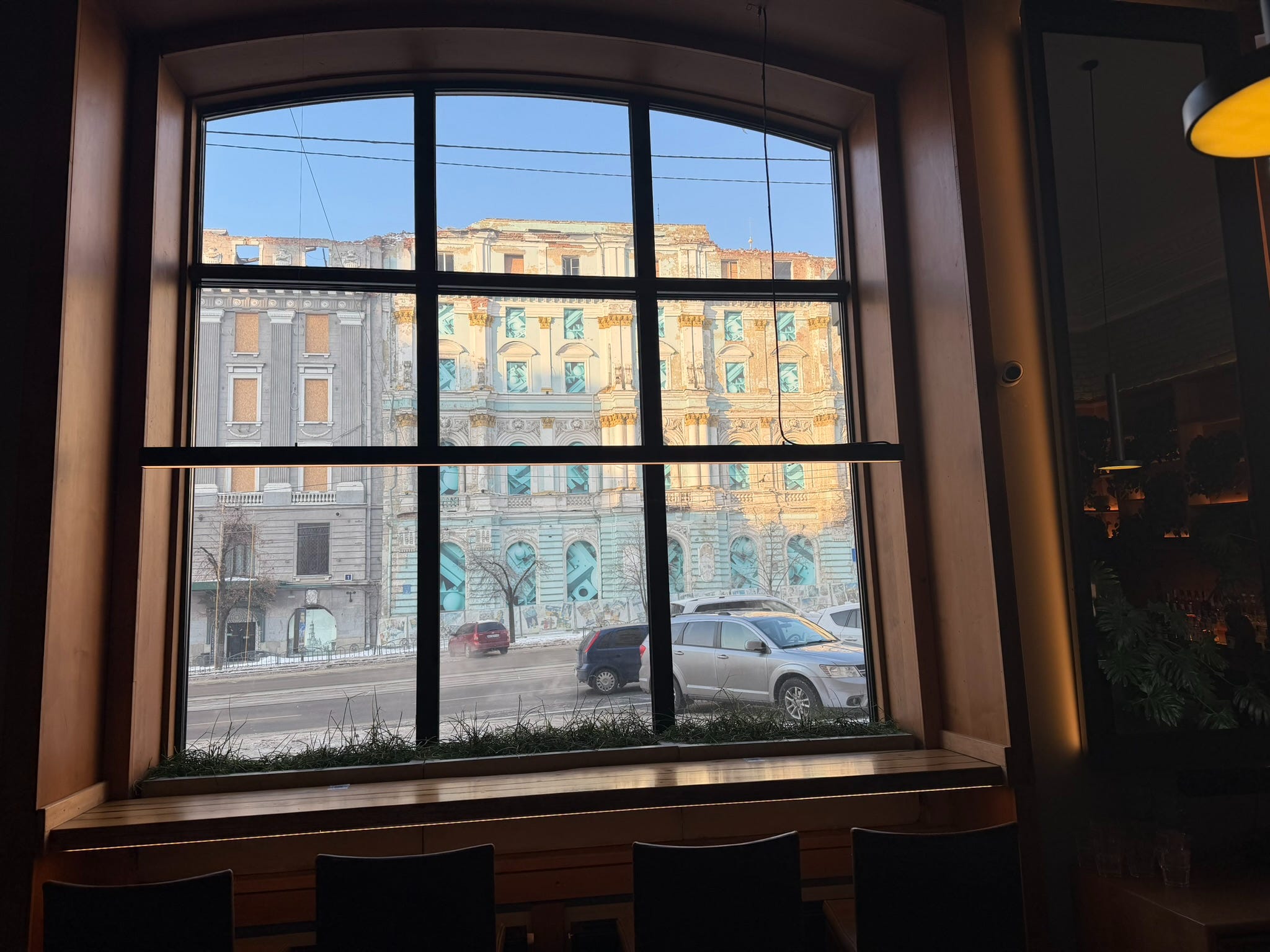
Unless, that is, you look out the window.
Across the street from the cafe is an old pre-Soviet building that has been destroyed. Ukraine offers the dead—including dead buildings—a certain dignity, so the building is dressed up nicely in death. The bombed-out windows have been replaced with painted plywood so as not to look too war-zoney.
Bohuslavska told me she had chosen 1654 for our meeting because this view out the window of a working cafe had a lot to say about her hometown.
“It used to be a beautiful building,” she said ruefully.
My guide in Kharkiv, a British freelance writer named Jimmy Rushton who has lived in Ukraine since 2022, hastened to reassure: “And it will be again,” he said earnestly. But Bohuslavska did not seem confident.
This exchange has particularly haunted me over the past few days, and not just because it is such a poignant account of Kharkiv’s modern reality.
The Situation has made us all, metaphorically speaking, into Kate in Kharkiv. Here we are, sitting in a beautiful cafe. It is comfortable and modern in here. The Dow bounced back nicely from Trump’s threats to invade Greenland. The food here is good. The atmosphere is chic. I hear the Golden Globe awards happened the other day. You really can kid yourself that America chugs along, Situation or no Situation, that we are not destroying ourselves—as long as you don’t look out the window onto the wreckage just outside.
It used to be a beautiful country, one thinks ruefully.
And as Jimmy did with Kate, people rush to reassure me. I was sitting with a distinguished economist the other day in Kyiv—a man who trained at American universities and who has lived in America and admires America and wants to bring a more American free market style of governance to Ukraine. And I mentioned Minnesota, and the fact that federal law enforcement was shooting people in the streets of an American city—the horrific view from out of my cafe window that particular day and week. And he hastened to agree that it was all shocking but, sounding remarkably like Rushton, also promised me that, “That’s not America.”
And like Kate about the maiming of her city being temporary, I am not so easily reassured anymore. Looking out of the window of my cafe, I cannot be confident that this is not America. After all, nobody is doing this to us. It is the Russians who are destroying Kharkiv, but our maiming is entirely self-inflicted.
In this sense, the comparison between Kharkiv and The Situation is quite inapt—offensive even. The destruction outside of 1654 is an ongoing series of war crimes, perpetrated by an external enemy who invaded Kate’s country and has assaulted her city with unspeakable violence for four long years. The destruction outside of my metaphorical cafe is a function of a kind of decadence, wherein Americans have chosen war against their own institutions—and each other—based on grievance politics and made-up nonsense. Rather, we have chosen to pick at scabs instead of addressing issues. We have chosen to destroy the sources of our own greatness, rather than perfect them. We have chosen conflict because conflict is fun. There is no Russian villain in our story. The wrecked building outside our cafe window is ourselves.
The comparison is unfair to Kharkiv in another sense, too. Kharkiv’s damage is rawly physical and unremittingly violent. There is nothing metaphorical about it. It is blown up daycare centers and bombed-out municipal buildings and schools. It is gas stations with sandbags stacked against their windows to prevent a blast from shattering windows and hurting people inside. It is apartment buildings that just aren’t there anymore. It is villages with live mines. It is playground equipment surrounded by buildings with no windows. It is a part of a much larger attempt at genocide against the Ukrainian people by the Putin government. I did a photo essay on the subject the other day for those who want to see what lies outside of 1654’s windows. The morally serious person knows better than to compare in earnest what is happening in Kharkiv to what is happening in The Situation.
And yet there are these little senses in which the comparison works. One of them is that sense of helplessness as one’s country is destroyed before one’s eyes—that sense of madly doing everything one can to protect it but also knowing the forces tearing things apart are just too relentless and are so much stronger than what one person and all that person’s friends and everyone he or she has met in the course of trying to hold things together can possibly do. And so you lose confidence that the building will be beautiful again, or that American democracy will overcome, or that ICE murder of protestors really isn’t America.
And there is rage in that realization. And there is depression. And there is determination to do one’s part anyway. And there is fatalistic humor. And there is defiance. And those emotional responses are actually not so different from what many Americans have felt these last few years. It is all sharper, of course. This is a frontline city in a real war, a war that—as I cannot emphasize enough—is in no sense a metaphor. But it’s a sharper, more all-consuming expression of a similar collection of feelings, the feelings of a free people facing and resisting domination by a violent authoritarian cabal.
It is impossible, as an American marinating in The Situation, not to see in Kharkiv, among many other things, an allegory of our own struggle. There is moral danger in that instinct, of course. To look at the struggles of others and see only oneself is rank narcissism. Not everything is about us, after all. But the inverse fact is true too: To look at Kharkiv and not recognize something connected about its struggle to our own would be a failure of empathy and human connectedness.
As Kierkegaard might have put it, if you compare The Situation and the destruction of Kharkiv, you will regret it. If you don’t compare The Situation and the destruction of Kharkiv you will also regret it. This, gentlemen, is the essence of all philosophy.
And then there’s the cafe with the window—that place where it’s easy to pretend your city isn’t being destroyed, that everything is normal and fashionable and elegant, and yet which has a view directly onto the destruction. We all have such places. Some people choose to spend all their time in them—and not look out or at the window. We call this denial. Some people use them for shelter yet stare relentlessly at the window. Sometimes, as with 1654, these places are physical. Sometimes they are places we retreat to in our heads—meditation or prayer or deep thought. They are the places we go to mourn what’s outside the window, even as they shield us from what’s outside the window.
One person who—it turns out—does not object to the comparison is Bohuslavska, who texted me this evening moments after I arrived back in Washington:
If power belongs to the people, then the people must defend it, or someone will hijack it like a precious, unguarded chest of gold.
I’ve seen people disregard democracy as it was slowly eroded, bit by bit—thinking things would just settle down, thinking it wasn’t their business, thinking politics was something distant, something for someone else to care about. Those are the very people bombing us now.
I’ve also seen people defend their democracy by force. Over a hundred of us died that winter. And yet here we are—free, still standing, even if the road is hard.
In other words, the building may become beautiful again if people care enough about it.
It’s not up to us in the short term what happens on the other side of that window. We don’t get to decide when the next atrocity will be committed—either against us or by a masked thug acting in our name or maybe both at the same time—and everyone needs a space between engagement and denial.
The Situation continues tomorrow.