Understanding Trump’s Coercive Foreign Policy
Trump’s attempts to dominate allies come with many costs and few benefits.
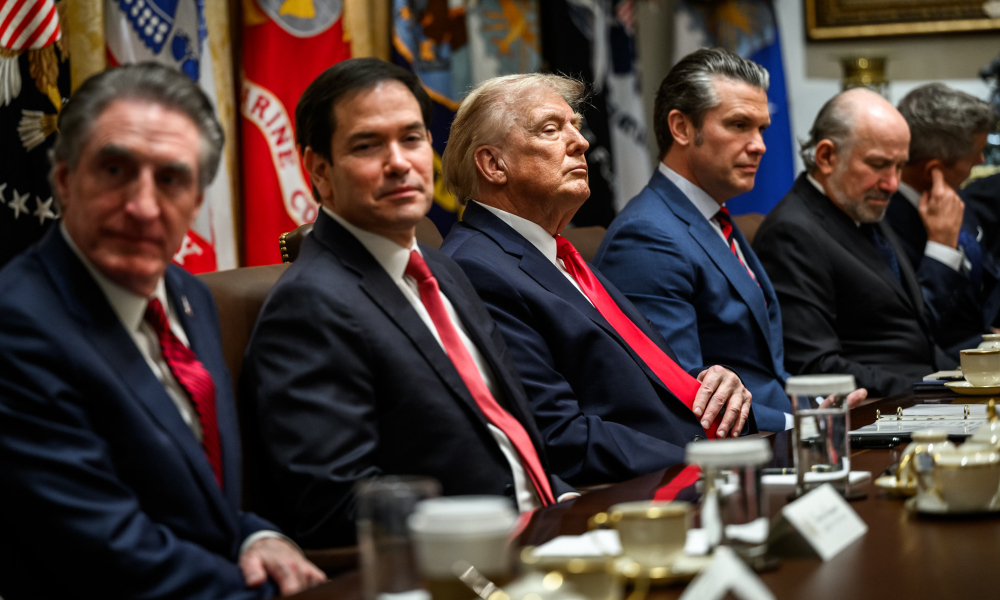


Although the worst period of the intra-NATO crisis over Greenland seems to have passed, the Trump administration’s consistent and continuing reliance on coercion as a tool of alliance management undermines the trust that makes allied commitments credible in practice. As Denmark’s annual intelligence outlook report explicitly recognized, “the United States is leveraging economic power, including threats of high tariffs, to assert its will, and the possibility of employing military force—even against allies—is no longer ruled out.”
In his first term, President Trump focused on trying to withdraw from international agreements and institutions while eroding the norms that have underpinned U.S. security since World War II. A year into his second term, the president is no longer satisfied by the United States merely retreating from this order; he seeks to dismantle it, potentially shattering U.S. alliances, the foundation of America’s security, in the process. The United States will emerge from this period weaker—and possibly alone.
Despite the administration’s view that coercion extracts concessions, doing so comes at a cost that exceeds their strategic value. Most consequently, the administration’s willingness to threaten military action against Denmark, a close ally, sends a signal that at best U.S. security commitments cannot be taken for granted and at worst the United States is now a threat to allies’ security, prompting allies to take greater steps to hedge against U.S. coercion.
A Foreign Policy of (Un)limited Coercion?
In Trump’s foreign policy approach, the distinction between allies and adversaries is blurred, if not completely erased. Alliances in this worldview better resemble a protection racket than a group of states united against a common threat.
Even those allies that meet the administration’s expectations are not exempt from coercion. For example, on Jan. 26, Under Secretary of Defense for Policy Elbridge Colby lauded South Korea as a “model ally.” The South Korean government, in Colby’s telling, “understands geography, threat, and the centrality of concrete military power” and has increased its defense spending to meet the United States’s “new global standard,” in the process putting the “storied and historic [U.S.-South Korea] alliance on sound footing for the long haul.” Despite Seoul’s purported model ally status, Trump announced the next day that he would raise tariffs against the country from 15 percent to 25 percent because the national legislature had not yet approved a bilateral trade deal signed in 2025. Seoul was “not living up to its Deal” and would be coerced into compliance.
Threats, even if they are not carried out, can reshape alliance behavior, and the administration has saved some of its most consequential coercive threats for allies. These threats have focused on territorial expansion at the expense of allies’ sovereignty, including Trump’s attempts to annex Greenland, which sparked a major crisis within NATO in mid-January as the administration threatened, among other things, to use force to take control of the Danish semiautonomous territory. He has also regularly spoken about his desire to make Canada the United States’s “51st state.”
Trump’s attempts to execute those threats face potential constraints both domestically and internationally, although those limitations have yet to neutralize the damage the administration is causing. Bipartisan groups in both the House of Representatives and the Senate are seeking to legislate limits on Trump’s ability to threaten NATO allies. And a growing number of Republicans and Democrats are vocally opposing Trump’s erratic and coercive approach to alliance management. At the same time, however, they have thus far failed to take meaningful action to stop the administration as it pertains to both alliances and other major foreign policy decisions. For instance, the Senate failed to pass a resolution to reassert congressional oversight over the administration’s future use of force in Venezuela, demonstrating the political limits on executing congressional power. These limits stem from deep partisanship and a general deference by congressional Republicans to the executive.
During the acute phase of the Greenland crisis, NATO allies remained united against the United States. They publicly considered retaliation, including via the European Union’s so-called trade bazooka, or Anti-Coercion Instrument, that would have enacted $108 billion in retaliatory tariffs after Trump’s own economic threats. Some European officials have argued that the administration backed down on its threats against Greenland because of the unity, resolve, and tough stance taken collectively. This stands in contrast to previous attempts at persuasion and acquiescence, which did not lead to a return to normal relations with Washington. Thus far, U.S. allies have had to learn how to adjust to this new reality of a coercive United States via trial and error.
Whether NATO can survive in its current form is an open question. NATO’s primary focus since its establishment in 1949 has been to face external threats: first Soviet and subsequently Russian aggression. But can the alliance continue to function when the major threat to cohesion emanates from within?
Hedging Against an Unreliable Ally
Trump’s approach is pushing allies to hedge domestically, economically, and militarily against the new normal in relations with the United States.
Trump’s threats are backfiring politically, rewarding candidates who oppose the president vocally and fostering anti-U.S. sentiment. Trump’s threats against Canada helped the struggling Liberal Party overcome a 25-point deficit in the 2025 election, ultimately putting Mark Carney in the prime minister’s office. Canadians are also boycotting U.S. goods and choosing not to engage in tourism in the United States, hurting U.S. industries, such as alcohol. A similar rallying effect seems to be underway for Denmark’s ruling coalition. And U.S. foreign policy in the Trump era is moving public opinion in Europe against the United States, with a majority of Europeans in some polls characterizing Trump as an “enemy” and 73 percent seeing self-reliance in defense as the path forward, according to surveys. In other words, Trump’s attempts at coercion helped crystallize a negative view of the United States, reinforcing his targets’ search for greater autonomy. There are already some areas, including tech and trade policy, where backlash goes beyond politics and rhetoric.
While U.S. allies may not be willing or able to downgrade most aspects of their defense relationship with the United States in the short term, they can and are choosing to do so in trade—albeit with some limitations. As Canadian Prime Minister Mark Carney put it, this is due to the view that “integration becomes the source of your subordination” as the Trump administration continues to pressure, undermine, and insult close U.S. allies. To diversify away from Washington and build a more independent economy, Ottawa has increased trade with other allies and sought to double its non-U.S. exports, including by looking to increase exports to China by 50 percent by 2030.
For its part, Europe is seeking to diversify its trade options with increased urgency to respond to growing uncertainty about U.S. reliability. The EU struck a historic trade deal with India and revived stalled negotiations on a free trade deal with South America’s Mercosur bloc in reaction to Trump’s tariffs (although implementation of the latter is now delayed pending a European Parliament-requested legal review). Ursula von der Leyen, president of the European Commission, characterized the EU’s deal with India as “the mother of all deals” and “a signal to the world that rules-based cooperation still delivers great outcomes.” Individual European countries have also been exploring deeper trade ties with China, though often in lower risk areas.
This is not to suggest that European allies have abandoned the United States for China economically, but rather that they are exploring options to hedge against their security concerns arising from the United States. Some European countries, most notably the United Kingdom, have tried to balance their interests vis-a-vis both the United States and China, and other challenges, such as the trade deficit between Europe and China, have created obstacles to increased cooperation. Moreover, China’s support for Russia’s war effort in Ukraine has put an additional brake on deepening economic cooperation. Further attempts by the United States to coerce its allies will likely provide those allies with incentives to seek more opportunities to hedge, particularly in areas outside defense cooperation.
Another important implication of Trump’s threats resides in the potential resumption of nuclear proliferation, the prevention of which has preoccupied U.S. foreign policy for 70 years and can be considered largely a policy success. In the 1960s, there were concerns that at least two dozen countries would possess nuclear weapons within a couple of decades. These fears did not materialize in large part due to U.S. offers of security guarantees and assurances to friends. Now, the combined fear of Trump’s shredding international commitments and the potential loss of U.S. protection should his efforts lead to the worst-case scenario is driving countries to look for other means to defend themselves—including by seeking nuclear options or new deterrence arrangements. A public debate has begun in Sweden over nuclear options, German Chancellor Friederich Merz has discussed creating an independent European nuclear deterrent led by France and the United Kingdom, and the Polish government has said it must “reach for opportunities related to nuclear weapons.” Other U.S. allies and partners around the world are likely to follow suit.
The results of Trump’s approach will be a more challenging security environment for the United States—defined by alliances that remain formally intact but are substantially weakened, competitors less restrained by those alliances than before, and renewed danger from long-standing problems like nuclear proliferation. This will leave everyone worse off.